
Exploring the Cutting Edge: Top 5 3D Printing Innovations This Week
Another dynamic week has concluded, bringing forth a fresh array of groundbreaking advancements and exciting developments within the ever-expanding universe of 3D printing and additive manufacturing. As innovators continue to push the boundaries of what’s possible, we’re constantly seeing new applications, improved technologies, and solutions to real-world challenges emerge. This week, we’ve curated a selection of the five most captivating videos that highlight the versatility and profound impact of this revolutionary technology. From fundamental explanations of core processes to life-changing humanitarian efforts and crucial sustainability discussions, our latest roundup promises to be both informative and inspiring. So, without further ado, let’s delve into this week’s must-watch collection and discover the amazing innovations shaping our future!
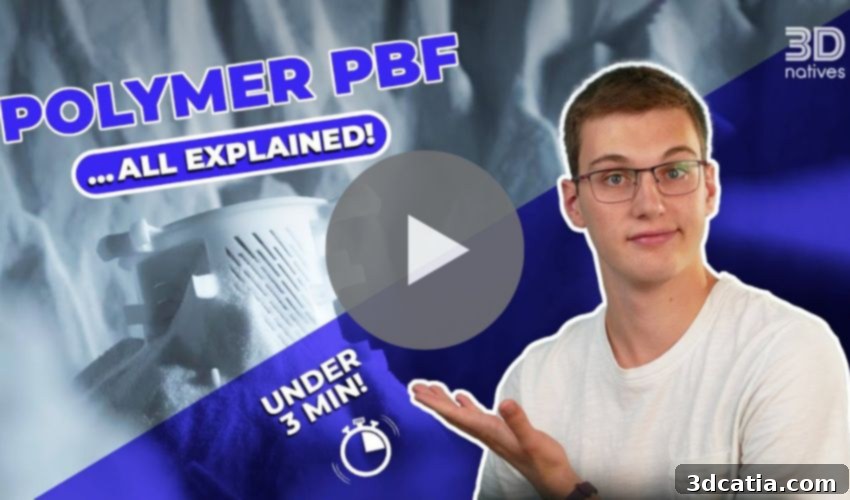
Top 1: 3D Explained: Polymer Powder Bed Fusion Technology
For those new to the world of additive manufacturing or seasoned enthusiasts looking to refresh their knowledge, understanding the underlying processes is key. In the latest insightful episode of our “3D Explained” series, we demystify one of the most widely used and critical 3D printing technologies: Powder Bed Fusion (PBF). This particular video offers a concise yet comprehensive explanation of how polymer powder bed fusion works, focusing on its intricate mechanics and crucial applications. PBF technologies, which include selective laser sintering (SLS) and multi jet fusion (MJF), are renowned for their ability to produce highly complex, durable, and functional parts without the need for support structures, allowing for unprecedented design freedom. The video dives into the core principles, illustrating how a heat source (like a laser or an infrared lamp) selectively fuses powdered material layer by layer to build a three-dimensional object. You’ll learn about the advantages of using polymers in this process, such as creating lightweight components with excellent mechanical properties, as well as the considerations and potential challenges involved, including material limitations and post-processing requirements. Grasping the fundamentals of polymer PBF is essential for anyone interested in high-performance prototyping, custom manufacturing, or exploring advanced industrial applications of 3D printing. This segment provides an invaluable foundation for appreciating the precision and engineering brilliance behind many modern additive manufacturing successes.
Top 2: The Future of Medicine: 3D Printed Breast Implants
The medical sector continues to be one of the most exciting frontiers for 3D printing innovation, where its unique capabilities are leading to personalized healthcare solutions and improved patient outcomes. This week’s second video highlights a truly groundbreaking project that could revolutionize reconstructive surgery: the development of 3D printed breast implants. Researchers at the Royal Brisbane and Women’s Hospital in Australia are spearheading world-first human trials of these innovative new implants. Unlike traditional silicone implants, which can sometimes lead to complications or have a less natural feel, these 3D printed alternatives offer the potential for unparalleled customization and biological integration. The project aims to create implants that are not only patient-specific in terms of size and shape but also potentially biodegradable and regenerative, encouraging the body’s own tissues to grow into and eventually replace the scaffold. This approach promises to mitigate many of the issues associated with conventional implants, offering a safer, more comfortable, and aesthetically superior solution for women undergoing mastectomy or seeking breast augmentation. The implications for women’s health, confidence, and quality of life are immense, representing a significant leap forward in surgical technology and demonstrating how additive manufacturing can profoundly impact even the most sensitive areas of medical treatment. This pioneering work underscores the transformative power of 3D printing in advancing personalized medicine.
Top 3: Humanitarian Impact: Dr. Kyle Reeser’s Mission in Africa
Beyond industrial applications and medical breakthroughs, 3D printing technology also serves as a powerful tool for humanitarian aid, making a tangible difference in the lives of vulnerable populations. Our third featured video shares the inspiring story of Dr. Kyle Reeser, a biomedical engineer and a brand ambassador for the renowned 3D printing company Creality. Dr. Reeser embarks on a vital humanitarian mission to Tanzania, a country in East Africa where a significant portion of the population grapples with challenges like hunger, poverty, and limited access to essential medical services. His mission is to leverage portable 3D printing technology to create custom prosthetics and orthotic devices for both children and adults. In regions where traditional medical infrastructure is scarce and custom-fitted devices are prohibitively expensive or simply unavailable, 3D printing offers an agile and cost-effective solution. By designing and fabricating these crucial mobility aids on-site, Dr. Reeser directly addresses the immediate needs of individuals with physical disabilities, enabling them to walk, play, work, and gain greater independence. This initiative not only improves their physical capabilities but also significantly enhances their quality of life, offering hope and opportunities that might otherwise be out of reach. It’s a poignant reminder of how accessible 3D printing can be deployed for incredible social good, transforming lives one printed device at a time and highlighting the ethical and altruistic potential of additive manufacturing.
Top 4: Enhancing Automotive Design with 3D Scanning
In the competitive world of automotive design, precision, speed, and iterative development are paramount. Our fourth video showcases how cutting-edge 3D scanning technology is streamlining the design process at Hyundai North America, a subsidiary of the prominent Korean car manufacturer. Traditionally, car designers have relied heavily on physical clay models to visualize and refine new vehicle concepts. While invaluable for tactile evaluation, obtaining precise digital measurements from these physical models used to be a time-consuming and often outsourced task, requiring external, third-party experts. However, this workflow has been dramatically improved with the integration of portable 3D scanners. The video demonstrates how Hyundai’s design team now utilizes Creaform’s user-friendly HandySCAN 3D portable scanner to perform these critical measurements in-house. This allows designers to quickly and accurately digitize their clay models, capturing intricate surface details and dimensions with unprecedented ease and speed. The immediate benefits are manifold: the design team can iterate much faster, directly translating physical modifications into digital CAD models for further refinement. This reduces development cycles, lowers costs by eliminating external services, and empowers designers with greater control and flexibility throughout the entire creative process. 3D scanning is not just a tool; it’s a catalyst for innovation, enabling automotive giants like Hyundai to bring more sophisticated and visually stunning vehicles to market with greater efficiency and precision.
Top 5: Navigating 3D Printing and Power Consumption for a Sustainable Future
While the benefits of 3D printing are vast and continually expanding, it’s crucial to also consider the often-overlooked aspects that impact its overall efficiency and environmental footprint. Our final video of the week addresses a critical, yet frequently underestimated, factor in additive manufacturing: power consumption. Many 3D printing devices, especially industrial-grade machines, consume substantial amounts of energy, primarily due to the intense heating required for materials, the power needed for lasers or light sources, and the continuous operation of motors and cooling systems. This high energy demand can lead to significant operating costs and contribute to a larger carbon footprint, making sustainability a key concern for users and manufacturers alike. In this insightful discussion, Ignasi Guardia, support manager at BCN3D, a leading 3D printer manufacturer, delves into the intricacies of 3D printing’s power usage. He not only explains why these machines require so much energy but, more importantly, provides valuable advice and practical tips on how users can optimize their printing processes to reduce electricity consumption. This includes strategies like selecting appropriate materials and print settings, optimizing print schedules, ensuring proper machine maintenance, and exploring newer, more energy-efficient printer models. Understanding and actively managing power consumption is vital for making 3D printing a more sustainable and economically viable technology in the long run. This video serves as an essential guide for anyone looking to make their additive manufacturing operations more eco-friendly and cost-effective.
This week’s collection truly showcases the incredible breadth and depth of the 3D printing industry – from foundational technology explanations to life-changing medical innovations, inspiring humanitarian efforts, industrial design efficiencies, and vital sustainability considerations. We hope you’ve found these insights into the latest additive manufacturing trends as fascinating and enlightening as we have. What do you think of this week’s top 5 videos? Did any particular innovation capture your imagination or spark new ideas? We encourage you to share your thoughts, feedback, and perspectives in a comment below! Don’t forget to connect with us on our LinkedIn, Facebook, and Twitter pages to stay engaged with our community and the latest news. For direct updates straight to your inbox, be sure to sign up for our free weekly Newsletter here. And if you’re eager to explore more compelling content, you can find all our videos and an extensive library of additive manufacturing resources on our YouTube channel. Thank you for joining us on this journey through the world of 3D printing, and we wish you a wonderful and productive week ahead!