
Exploring the Cutting Edge: Top 5 3D Printing Innovations and Insights This Week
Welcome to our weekly roundup of the most captivating developments in the world of 3D printing and additive manufacturing. This week, we dive into a selection of five groundbreaking videos that highlight the incredible versatility and ongoing evolution of this transformative technology. From a revolutionary palm-sized 3D scanner designed for precision and portability to the exciting integration of additive manufacturing in high-performance automotive safety cars, and from critical advancements in metal 3D printing process control to innovative educational tools and sustainable architectural applications, there’s something to inspire every enthusiast and professional. We’re proud to bring you insights into how 3D printing continues to push boundaries, making processes more efficient, designs more complex, and manufacturing more accessible. Get ready to explore the future, one video at a time, and discover the diverse ways 3D technologies are reshaping industries worldwide.
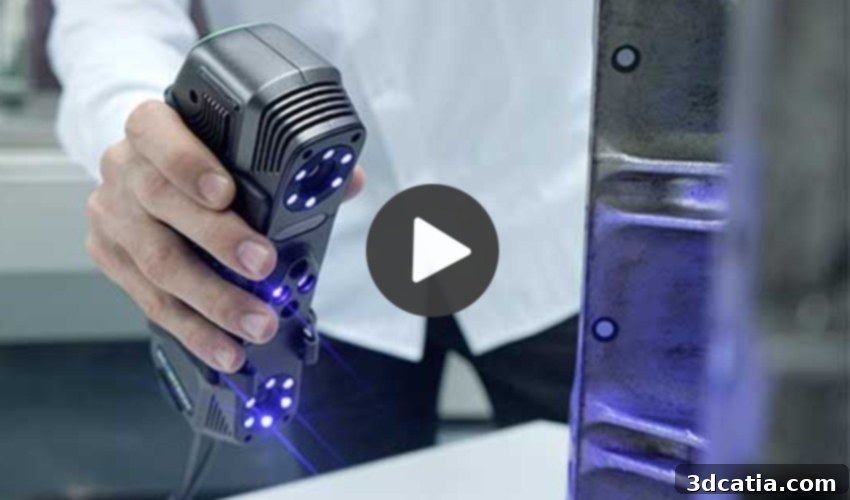
1. ScanTech Unveils SimScan: The World’s First Palm-Sized Professional 3D Scanner
In a significant leap forward for metrology and portable 3D scanning solutions, ScanTech has officially launched its groundbreaking SimScan. This innovative device distinguishes itself as the only palm-sized 3D scanner currently available on the market, setting a new benchmark for portability without compromising on performance. After years of dedicated research and development in metrological precision, ScanTech has engineered a tool that combines compact design with industrial-grade accuracy. Measuring a mere 203 mm × 80 mm × 44 mm and weighing just 1.3 lbs (570g), the SimScan is incredibly lightweight, making it an ideal companion for on-the-go professionals. Despite its diminutive size, it’s equipped with a sophisticated metrology-grade measurement system, enabling it to capture highly detailed and precise 3D data in minimal time. This impressive combination of portability and accuracy has already earned the SimScan a coveted spot on our top ten best professional 3D scanners listing. The SimScan’s capabilities extend across numerous applications, from rapid reverse engineering and meticulous quality control in manufacturing to intricate design and artifact preservation in cultural heritage. Its ease of use and ability to perform complex scans with speed will undoubtedly revolutionize workflows in various sectors, democratizing access to high-precision 3D measurement. Discover the future of portable 3D scanning and witness the SimScan in action in the compelling video below, showcasing its unparalleled efficiency and remarkable output.
2. MINI Electric Pacesetter: Formula E’s Partially 3D Printed Safety Car
Innovation in the automotive industry continues to accelerate, and this week, MINI showcases its commitment to electric performance and advanced manufacturing with the introduction of the new MINI Electric Pacesetter. This striking vehicle has been officially designated as the safety car for the prestigious ABB FIA Formula E World Championship races, leading the charge for electric motorsport. What makes the Pacesetter particularly noteworthy is its strategic integration of 3D printed components, highlighting the transformative potential of additive manufacturing in high-performance automotive applications. Among these custom parts are specially designed 3D printed seat paddings. This innovative approach allows for unparalleled personalization, as seats can be tailored precisely to the driver’s unique build, weight, and ergonomic preferences. Such customization not only enhances driver comfort but also significantly improves safety and performance, offering optimal support during the demanding conditions of competitive racing. Bruno, the official championship safety car driver, lauded the vehicle, remarking, “Agility, performance, and a cool looking car. The MINI Electric Pacesetter […] has it all.” This partnership between MINI and Formula E, amplified by the use of 3D printing, underscores a broader industry trend towards lighter, stronger, and more customizable vehicle parts. It demonstrates how additive manufacturing contributes to both the cutting-edge aesthetics and the functional superiority required in top-tier motorsport, setting a precedent for future electric vehicle design and production. For an in-depth look at this remarkable vehicle and its additive manufacturing journey, you can read our comprehensive article here, or simply watch the exhilarating video below:
3. Mastering Metal 3D Printing: Advanced Process Control in LPBF
The precision and reliability of metal additive manufacturing are paramount, particularly in critical applications where component integrity is non-negotiable. This week, we highlight a crucial discussion on the advancements and ongoing challenges in online process control for Laser Powder Bed Fusion (LPBF). On March 30th, 3Dnatives hosted an insightful webinar featuring Dr. Yves Hagedorn, CEO of Aconity3D, and Ryan Sommerhuber, an Application Engineer from XARION Laser Acoustics. These leading experts delved into the intricacies of ensuring consistent quality and performance in LPBF, a technology vital for producing high-strength, complex metal parts. The discussion focused on the imperative for robust and reliable process control, which spans a wide spectrum from comprehensive command over applied parameter sets to sophisticated automated inline process adaptations. They also explored the innovative application of modifiable beam shapes, enabling full temperature control throughout the intricate layering process. Achieving such a high degree of control is essential for preventing defects, ensuring material property consistency, and ultimately, reducing waste and cost in industrial 3D printing. The experts detailed how advanced sensor technologies and real-time data analysis are being leveraged to monitor and adjust print parameters on the fly, transforming LPBF from a complex art into a highly controllable science. This webinar offered invaluable insights into the strategies and solutions that are paving the way for wider industrial adoption of metal 3D printing, addressing some of the most pressing concerns regarding repeatability and part certification. For anyone involved in or interested in the industrialization of metal additive manufacturing, understanding these advanced control mechanisms is key to unlocking the full potential of the technology. You can gain a deeper understanding of these critical topics by watching the full webinar replay below:
4. SPEE3DCraft: Gamifying Metal 3D Printing Education and Skills Training
The recent global pandemic significantly impacted traditional educational and training opportunities across various industries, including additive manufacturing. Recognizing this challenge, SPEE3D, a pioneer in cold spray metal 3D printing technology, ingeniously developed an alternative solution to keep learning accessible and engaging. This innovative response led to the creation of SPEE3DCraft, an immersive game and simulator designed to teach users about SPEE3D’s own high-speed metal additive manufacturing technologies. The core concept of SPEE3DCraft is both intuitive and highly educational: players assume the role of a craftsman tasked with the entire production cycle. This includes critical decision-making such as selecting the appropriate metal material, skillfully crafting the part using the simulator’s virtual 3D printing interface, and ensuring timely delivery of the finished product. The game features a scoring system that evaluates performance based on the number of high-quality parts successfully printed within a given time limit. This gamified approach allows aspiring engineers, students, and professionals to gain practical experience and a deeper understanding of metal 3D printing principles without requiring access to expensive physical machinery. It’s a testament to the power of digital tools in overcoming real-world constraints, providing a risk-free environment to experiment with different parameters, understand material behaviors, and optimize manufacturing workflows. SPEE3DCraft is not just a game; it’s a powerful training platform that makes complex industrial processes approachable and enjoyable, fostering a new generation of additive manufacturing talent. Would you accept the challenge and try SPEE3DCraft to hone your metal 3D printing skills? See how it works in the video below:
5. Advancing Sustainable Architecture: IAAC’s 3D Printing Postgraduate Course
The intersection of additive manufacturing and sustainable architecture is a frontier of immense potential, offering innovative solutions to environmental challenges in construction. This week, we’re excited to highlight an exceptional educational opportunity: Project Colette and the Institute for Advanced Architecture of Catalonia (IAAC) have jointly announced scholarship opportunities for their renowned postgraduate 3D printing course in Barcelona, known as 3DPA. These scholarships are specifically aimed at prospective students from Africa, South America, and Asia, promoting global diversity and accessibility in advanced architectural education. The 3DPA program is an intensive six-month course designed to immerse students in the multifaceted role of additive manufacturing within modern architecture and, crucially, its contribution to sustainable construction practices. Participants will explore how 3D printing can revolutionize building design, material efficiency, and waste reduction, addressing some of the most pressing issues facing the construction industry today. The curriculum delves into advanced techniques for structural optimization, innovative material development, and robotic fabrication methods, preparing students to become leaders in ecological design and construction. The video below offers a compelling glimpse into the practical aspects of the curriculum, vividly demonstrating how complex architectural elements, such as vaults and domes, can be additively manufactured using extrusion-based construction 3D printers. This showcases the immediate applicability and transformative power of these technologies in creating not just aesthetically impressive structures, but also highly efficient and environmentally friendly buildings. By fostering expertise in these areas, the IAAC and Project Colette are cultivating a new generation of architects and designers equipped to build a more sustainable future. Don’t miss this opportunity to see the future of construction unfold:
We hope you enjoyed this week’s exploration into the dynamic world of 3D printing innovations. From groundbreaking scanners enhancing metrology to customized automotive parts, advanced process controls in metal additive manufacturing, novel educational approaches, and pioneering sustainable architecture, these videos truly showcase the breadth and depth of impact that 3D technologies are having across diverse sectors. Which of these fascinating videos captured your imagination the most? We’d love to hear your thoughts! Share your favorite highlights or insights in a comment below, or engage with us on our social media platforms: Facebook, Twitter and LinkedIn. To ensure you never miss out on the latest advancements, news, and exclusive content from the ever-evolving 3D industry, remember to sign up for our free weekly Newsletter. Stay informed, stay ahead, and keep exploring the incredible possibilities of 3D printing delivered straight to your inbox!