

Porsche’s 3D Printed Pistons: Revolutionizing High-Performance Engines for the 911 GT2 RS
Porsche, a brand globally recognized for its unparalleled engineering, groundbreaking innovation, and relentless pursuit of performance, has consistently positioned itself at the vanguard of automotive advancement. This strategic vision extends significantly into the realm of manufacturing, particularly through its proactive and deep adoption of additive manufacturing technologies. The German luxury car manufacturer began integrating 3D printing into its operations several years ago, fundamentally reshaping its approach to design, production, and the intricate process of performance optimization. As early as 2018, Porsche was already demonstrating the practical utility of 3D printing by fabricating spare parts for its iconic vehicles, showcasing an early recognition of the technology’s potential for creating custom solutions and enhancing supply chain efficiency. Building upon this foundational success, the company further expanded its application of additive manufacturing earlier this year by introducing 3D printed customizable seats, an innovation that offers unparalleled ergonomic benefits and personalized comfort specifically tailored for discerning sports car enthusiasts.
However, Porsche’s journey into leveraging additive manufacturing is far from complete; in fact, it is rapidly accelerating. The German automotive giant is increasingly integrating 3D printing deeper into its core production processes, aiming for transformative impacts that enhance both vehicle performance and overall engineering excellence. The most recent and arguably most significant development in this ongoing endeavor is the brand’s pioneering announcement regarding the use of 3D printing to fabricate pistons for one of its most powerful and prestigious sports cars: the 911 GT2 RS. This groundbreaking move signifies a pivotal moment, showcasing additive manufacturing not merely for specialized parts or bespoke customization, but for critical, high-stress engine components that directly influence a vehicle’s raw power output, dynamic response, and overall efficiency, setting a new benchmark in performance engineering.
Pistons are unequivocally vital components within any internal combustion engine, functioning as the primary mechanism that translates the immense energy released from combustion into kinetic energy, ultimately driving the vehicle. Their design, material composition, and manufacturing precision are critical determinants of an engine’s overall performance, long-term durability, and fuel efficiency. These components operate under extraordinarily demanding conditions, subjected to immense pressure, searing temperatures, and continuous mechanical friction at incredibly high speeds. Consequently, engine parts like pistons must exhibit exceptional resistance to wear, fatigue, and thermal stress while simultaneously being as lightweight as possible to minimize inertia and maximize operational efficiency. Traditionally, pistons have been meticulously crafted from durable aluminum alloys, chosen for their excellent strength-to-weight ratio and thermal conductivity. The crucial piston rings, responsible for sealing the combustion chamber and transferring heat away from the piston crown, are typically manufactured from robust cast iron or specialized high-strength steel. While conventional manufacturing techniques have undergone decades of refinement, they inherently impose significant limitations on geometric complexity and the extent of material optimization. Until the advent of advanced additive manufacturing, achieving substantial improvements upon the conventional structure and performance characteristics of pistons remained an elusive engineering challenge.
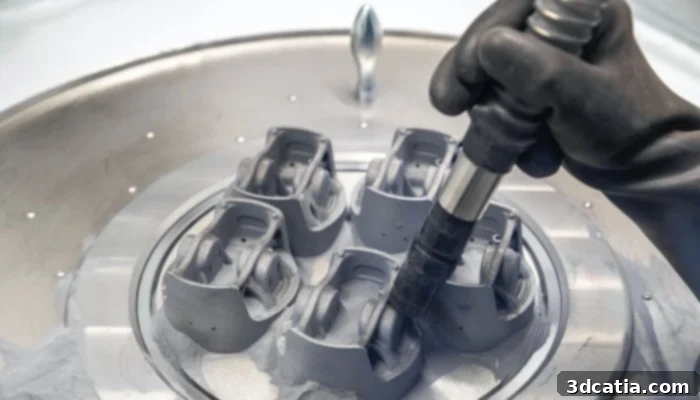
All image credits: Porsche
Porsche’s strategic decision to implement 3D printed pistons for the exceptionally high-performance 911 GT2 RS is a direct result of its unwavering commitment to achieving superior engineering outcomes. The additively manufactured pistons introduce a suite of advantages that were previously unattainable with conventional production methods, fundamentally redefining existing performance benchmarks. One of the most immediate and impactful benefits is the significant reduction in piston weight. Through the unparalleled design freedom afforded by 3D printing, engineers can now create highly optimized internal lattice structures and complex geometries that are simply impossible to achieve using traditional casting or forging techniques. This revolutionary approach results in new pistons that are an impressive 10% lighter than their conventionally manufactured counterparts, a substantial reduction that translates directly into enhanced engine dynamics, improved responsiveness, and overall superior vehicle agility.
The implications of this significant weight reduction are profound and far-reaching for a high-performance sports car. Frank Ickinger, a distinguished member of Porsche’s advanced drive development department, eloquently articulated these critical benefits: “Thanks to the new, lighter pistons, we can increase the engine speed, lower the temperature load on the pistons, and optimize combustion. This makes it possible to get up to 30 horsepower more from the 690-horsepower, twin-turbocharged engine while at the same time improving efficiency.” This statement powerfully highlights the synergistic advantages derived from the precision of 3D printing. The reduced mass allows for higher engine speeds with significantly less inertial resistance, leading to quicker acceleration, more agile throttle response, and a more immediate power delivery. Furthermore, the optimized internal architecture, which can incorporate bespoke cooling channels, facilitates superior thermal management, effectively lowering the localized temperature load on the pistons. This not only dramatically enhances the component’s durability and lifespan but also enables more precise and controlled combustion, leading to a more efficient and powerful burn cycle. The cumulative effect of these improvements is a remarkable increase in power output, with experts estimating a gain of up to 30 horsepower for the 911 GT2 RS – a truly substantial boost for an already formidable 690-horsepower, twin-turbocharged engine. This innovation underscores how additive manufacturing is not just about making parts, but about unlocking entirely new levels of performance.
To successfully bring this groundbreaking project to fruition, Porsche strategically forged partnerships with two preeminent industry leaders, carefully leveraging their specialized expertise in advanced manufacturing technologies. These crucial collaborators include MAHLE, a globally renowned German automotive parts supplier with an extensive and rich history in developing and manufacturing high-performance engine components, and Trumpf, recognized as one of the foremost manufacturers of industrial 3D printers and laser technology worldwide. This collaborative approach highlights the inherent complexity and the deeply multi-disciplinary nature of pushing the absolute boundaries of automotive engineering through the cutting-edge capabilities of additive manufacturing. It’s a testament to how complex innovation often requires a synergy of different expertises.
Volker Schall, Head of Product Design at MAHLE, eloquently emphasized the profoundly transformative role of additive manufacturing within the company’s extensive operations. He highlighted that 3D printing is not merely an alternative production method but rather a crucial enabler for delivering highly complex components to clients with unprecedented speed, agility, and flexibility. This revolutionary approach significantly reduces traditionally lengthy development cycles, allowing for rapid iteration, rigorous testing, and swift deployment of innovative solutions directly into high-performance applications. For Porsche’s demanding GT2 RS pistons, MAHLE and Trumpf collaboratively utilized Laser Powder Bed Fusion (LPBF) technology to precisely 3D print a complete set of six pistons. LPBF is a highly precise and robust method for metal additive manufacturing, particularly well-suited for producing high-strength, complex components due to its ability to create fully dense parts with superior mechanical properties and intricate internal structures that were previously impossible.
The Laser Powder Bed Fusion (LPBF) process itself is a sophisticated additive manufacturing technique that involves a high-power laser selectively melting successive layers of fine metal powder. The intricate process commences with a thin layer of specialized metal powder being meticulously spread across a heated build platform within a controlled inert atmosphere. A highly focused laser beam then precisely traces the cross-section of the piston geometry onto this powder bed, instantaneously melting and fusing the minute powder particles together. Once an entire layer is successfully completed, the build platform is lowered by a minuscule, predefined increment, a fresh layer of metal powder is applied and leveled, and the entire process meticulously repeats. This layer-by-layer fabrication continues with exceptional precision until the entire three-dimensional piston is fully formed. The intense and localized heat generated by the laser ensures complete melting and subsequent solidification, resulting in a homogenous, high-density metal part with superior mechanical properties, including enhanced strength and ductility. This unparalleled precision inherent in LPBF allows for the creation of intricate internal cooling channels, optimized structural elements, and lightweighting designs that significantly enhance thermal efficiency and reduce overall component weight, factors that are absolutely paramount for high-performance engine components operating under extreme conditions.
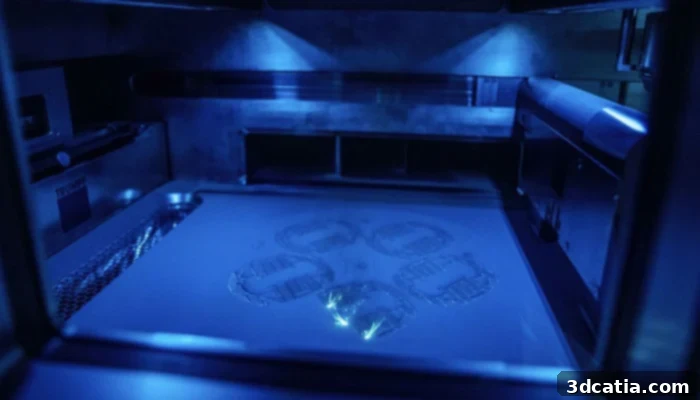
LPBF 3D printing in process for high-performance components
This pioneering application of 3D printed pistons by Porsche marks a truly significant milestone, not only for the company itself but also for the entire automotive industry. It unequivocally demonstrates the tangible, real-world benefits of additive manufacturing extending far beyond mere prototyping and low-volume, specialized parts. By successfully integrating these highly advanced components into a flagship model like the 911 GT2 RS, Porsche is effectively setting a bold new standard for performance engineering and challenging conventional manufacturing paradigms. This remarkable achievement undoubtedly paves the way for broader and deeper adoption of 3D printing in the production of other critical engine components, potentially leading to the development of even lighter, significantly more powerful, and ultimately more fuel-efficient powertrains across various vehicle segments. The unparalleled ability to customize designs to an unprecedented degree allows for optimized thermal management solutions, substantial reductions in material waste, and dramatically faster development cycles for future engine iterations, accelerating the pace of innovation.
Looking ahead, the widespread integration of additive manufacturing is poised to revolutionize the automotive supply chain and redefine the entire production paradigm. It enables a fundamental shift towards more localized production, significantly reduced lead times for critical parts, and the creation of highly specialized, on-demand components precisely when and where they are needed. Porsche’s steadfast commitment to rigorously exploring, thoroughly testing, and effectively implementing these cutting-edge technologies reinforces its established position as an undisputed leader in automotive innovation. Their continuous investment in 3D printing not only profoundly enhances their current and future product offerings but also robustly drives the evolution of manufacturing processes globally, inspiring other leading manufacturers across various industries to explore the vast and transformative potential of advanced digital fabrication techniques. The exciting future of high-performance automotive engineering, as vividly exemplified by Porsche’s revolutionary 3D printed pistons, is undeniably and inextricably linked to the ongoing and rapid advancements in additive manufacturing, promising an era of unprecedented efficiency, power, and customization.