

FossiLabs: Pioneering PEEK 3D Printed Implants for Advanced Bone Regeneration and Musculoskeletal Healing
In the rapidly evolving landscape of medical technology, a U.S.-based startup named FossiLabs is making significant strides with its innovative approach to orthopedic solutions. Specializing in the development of FDM 3D printers, FossiLabs is uniquely positioned to produce medical implants crafted from PEEK (polyether ether ketone). These high-performance implants are not merely replacements; they are ingeniously designed to mimic natural bone structures and actively promote bone growth in patients suffering from debilitating musculoskeletal disorders. The core innovation lies in FossiLabs’ ability to combine the exceptional properties of PEEK with a sophisticated 3D printing solution that can engineer intricate, porous structures. This groundbreaking synergy forms the foundation of FossiLabs’ vision to transform patient recovery. To delve deeper into the company’s ambitious goals and how it aims to introduce novel solutions to the medical sector, we had the distinct pleasure of meeting Todd Reith, the visionary Founder of FossiLabs. Our discussion centered around a crucial question: Can 3D printed porous scaffolds truly offer a viable and superior solution for musculoskeletal disorders?
3DN: Can you tell us more about yourself and your relationship with 3D printing?
“My journey has been one of continuous exploration and reinvention, embodying the spirit of a true entrepreneur who, through diverse experiences, has cultivated expertise across multiple disciplines. My career began in the dynamic world of software development, where I was at the forefront of creating some of the earliest online web banking applications, sophisticated pharmaceutical database systems, and foundational artificial intelligence (AI) logic for targeted marketing strategies. This early exposure to complex systems and innovative problem-solving laid a strong analytical groundwork.
Following my immersion in software, my passion led me to an entirely different realm: designing headless guitars. This wasn’t just about aesthetics; it involved integrating cutting-edge carbon fiber components and custom electronics, including highly sensitive piezo sensors, to achieve superior sound and playability. The guitar business naturally evolved, leading me into the intricate craft of designing and manufacturing bespoke mother-of-pearl inlay designs for other prominent guitar manufacturers and their revered artist instruments. This phase honed my precision manufacturing and material science skills. My manufacturing path further diversified, drawing me into developing high-performance metal components, eventually leading to the precision machining of fuel and shock components for the elite Team Penske’s Indy Car Racing Team – a testament to my dedication to exacting standards and high-stakes performance. It was these cumulative experiences with advanced materials, precision engineering, and problem-solving that eventually converged, paving my way into the challenging and rewarding field of medical device implants.
Interestingly, my initial perception of 3D printing was far from enthusiastic. I viewed it merely as a novel toy, capable of producing little more than trivial plastic trinkets. The true potential of additive manufacturing hadn’t clicked for me. However, fate intervened when a co-worker approached me for assistance in troubleshooting and repairing his 3D printer. As I delved into the poorly engineered equipment and its clunky software interface, a new conviction began to form. Frustrated by the machine’s shortcomings, I candidly told my co-worker that I could design and build a significantly better one. That moment marked my unexpected — and ultimately transformative — entry into the world of additive manufacturing. I became completely engrossed, dedicating myself to obsessively researching and absorbing every piece of information I could find on the subject. Within a mere three months, leveraging my extensive background in design, engineering, and problem-solving, I successfully built my first high-temperature 3D printer. FossiLabs now represents the culmination of this diverse expertise, intricately tying together all the skills and knowledge I’ve acquired over the past two decades. It is incredibly exciting and immensely fulfilling to finally integrate and apply all the disciplines I have diligently perfected throughout my career into a single, impactful venture that aims to make a real difference in people’s lives.”
3DN: What is FossiLabs’ mission? And how did the company come about?
“FossiLabs’ core mission is deeply rooted in improving patient outcomes by engineering sophisticated bone-like structures. Our primary objective is to enhance the quality of life for individuals suffering from musculoskeletal disorders. We achieve this by focusing on innovative solutions that accelerate the natural healing process, specifically by encouraging robust cellular growth in areas where traditional methods might lead to prolonged or incomplete recovery. FossiLabs is driven by a relentless commitment to innovate, contribute meaningful advancements, and push the boundaries of medical technology with novel ideas that challenge conventional approaches.
The inception of FossiLabs began with an ambitious, yet initially conventional, desire to 3D print PEEK traditional static implants. After investing significant effort into research and development, we successfully engineered and constructed a fully functional machine capable of precisely printing PEEK filament. This was a major technical achievement. With this capability, we produced our very first static cervical spacer. We were incredibly proud of this prototype and showcased it with considerable excitement during an early sales pitch. The initial reaction in the meeting was overwhelmingly positive; everyone present shared our enthusiasm for the potential of 3D printing in this context. However, once the initial excitement subsided, a pivotal moment of clarity arrived when the potential client posed a stark and challenging question: ‘Why would we invest in a 3D printed spacer when we can machine the exact same product from solid rod material using established methods?’ This question, though jarring, was an invaluable reality check. It underscored the critical need for a true ‘game changer.’ We realized that simply replicating existing products with a new technology wasn’t enough to disrupt the market or create significant value. Our strategy had to shift dramatically. We needed to engineer something fundamentally impossible to create with traditional machining methods, something that offered a unique and undeniable advantage. This realization led directly to our breakthrough concept: the development of Bone-Foam and Bone-Mesh porous scaffold structures. This vision, which allows for intricate internal geometries that promote biological integration, became the cornerstone of FossiLabs’ strategic direction and our path to bringing unparalleled value to the medical implant market.”

Bone-Foam and Bone-Mesh porous scaffold structures is FossiLabs’ vision | Credits: FossiLabs
3DN: What are the main benefits of PEEK for the medical sector?
“PEEK, or polyether ether ketone, stands out as an truly extraordinary polymer, particularly for its applications in the medical sector. Its suite of properties makes it an ideal biomaterial, surpassing many traditional options. PEEK boasts excellent mechanical and chemical properties, maintaining structural integrity and inertness even at very high temperatures. While the human body’s internal temperatures would never challenge these extreme limits, this characteristic speaks to the material’s inherent robustness and stability.
One of PEEK’s most significant advantages for medical imaging is its near transparency to advanced diagnostic techniques such as X-rays, CT scans, and MRI. This allows clinicians to clearly visualize the surrounding bone and soft tissues without the artifact interference often caused by metallic implants, leading to more accurate diagnoses and better post-operative monitoring. Furthermore, PEEK’s natural elasticity closely mirrors that of cortical bone, which helps to mitigate stress shielding – a phenomenon where a much stiffer implant takes on too much load, causing the surrounding bone to weaken due to lack of stress. This biomechanical compatibility is crucial for long-term implant success and bone health. PEEK also exhibits remarkable stability within the body for extended periods, resisting degradation and maintaining its properties, which is vital for permanent implants. Its low thermal conductivity is another benefit, as it helps prevent thermal sensitivity for patients. Being lightweight, PEEK implants reduce the overall burden on the skeletal system and can contribute to improved patient comfort and mobility. Lastly, PEEK is incredibly easy to sterilize using conventional methods, ensuring the highest standards of safety and infection control in clinical settings. At FossiLabs, we are committed to using only the highest quality, compliant materials, which is why we currently utilize Evonik’s VESTAKEEP i4G FFF filament, which is FDA approved, ensuring both performance and regulatory compliance for our advanced medical implants.”
3DN: Can you tell us more about your technology?
“Our technology at FossiLabs is built upon a sophisticated and entirely proprietary set of processes designed to revolutionize the way medical implants facilitate bone regeneration. We begin by taking a standard 3D model of a medical implant device, which then undergoes a unique manipulation. Our specialized software and algorithms meticulously analyze the model to identify and define precise regions where bone in-growth and on-growth are most desired. This means we aren’t just creating a generic porous structure; we are intelligently designing the implant to interact optimally with the patient’s physiology.
Within this framework, we can differentiate and create distinct regions: solid areas for structural integrity, Bone-Mesh regions for controlled, intricate porosity, and Bone-Foam regions for even higher levels of interconnected macroporosity. These controlled macroporosity scaffolding structures are engineered directly within the implantable device. The magic truly happens when we combine this architectural precision with a specialized hydroxyapatite (HA) nanocoating. Hydroxyapatite is a naturally occurring mineral form of calcium apatite, a key component of natural bone, and its application as a nanocoating dramatically enhances the implant’s surface. This combination provides unparalleled hydrophilicity – meaning the surface attracts water and biological fluids, creating an ideal environment for cell adhesion and proliferation – leading to significantly faster osseointegration, which is the direct structural and functional connection between living bone and the surface of a load-bearing artificial implant. This accelerated integration is crucial for patient recovery.
The synergistic effect of the PEEK scaffolding, with its bio-mimetic porosity, and the HA nanocoating presents a profound clinical advantage. It potentially eliminates the traditional requirement for biologics – such as bone morphogenetic proteins (BMPs) or autografts – which are often pressed into a graft window during surgery to stimulate bone growth. This capability means that our PEEK implants, designed for active bone regeneration, could be taken directly out of sterile packaging and immediately implanted into the patient’s body. This simplification of the surgical procedure not only streamlines the workflow for surgeons but, more importantly, substantially reduces the chances of infection by minimizing additional steps and handling of biological materials. Our technology thus offers a more efficient, safer, and ultimately more effective solution for patients requiring bone fusion or regeneration.”
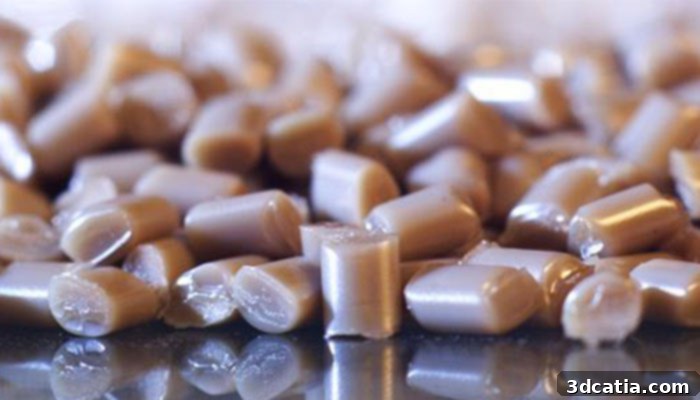
FossiLabs uses PEEK filaments manufactured by Evonik. Before being turned into filament, PEEK is in the form of pellets | Credits: Evonik
3DN: How do you see the future of 3D printed implants?
“This is truly just the beginning of an incredible revolution in medical technology. The field of 3D printed implants, and additive manufacturing in medicine in general, is experiencing unprecedented growth and innovation. We are seeing many different 3D printing technologies gaining significant momentum, each contributing unique capabilities to the medical landscape. It is an exceptionally exciting time to witness these technologies advancing at hyper-speed, transforming what we thought was possible in patient care.
Beyond our current work with PEEK, some particularly interesting advances are emerging. These include the development of bioceramic Sr-HT-Gahnite applications, which promise new levels of biocompatibility and mechanical performance for specific orthopedic needs. Another monumental shift is the increasing prevalence of patient-specific implants. These customized devices, precisely tailored to an individual patient’s anatomy based on medical imaging, offer unparalleled fit, comfort, and efficacy, significantly improving surgical outcomes and accelerating recovery times compared to off-the-shelf solutions. Looking further into the future, the most ambitious and transformative frontiers include 3D printed tissues and organs. While still in early stages, the potential to bioprint functional human tissues for repair or replacement, and even complex organs, promises to fundamentally change transplant medicine and regenerative therapies, offering hope to millions facing organ failure or severe tissue damage. The ability to precisely control material deposition and create complex biological architectures at a cellular level opens up possibilities that were once confined to science fiction. The convergence of materials science, advanced manufacturing, and biological engineering ensures that the future of 3D printed implants will continue to push boundaries, offering increasingly sophisticated and personalized solutions for a vast array of medical challenges.”
3DN: Any last words for our readers?
“Stay tuned, as there is much more exciting innovation to come from FossiLabs and the wider field of medical additive manufacturing! We are committed to pushing the boundaries and will continue to share our progress.”
What do you think of FossiLabs’ pioneering use of additive manufacturing to offer advanced medical implants that actively promote bone growth and accelerate patient recovery? We encourage you to share your thoughts and insights in a comment below or join the conversation on our Facebook and Twitter pages! Don’t miss out on the latest advancements and news in the world of 3D printing; sign up for our free weekly Newsletter to receive all the cutting-edge updates straight to your inbox!