
Revolutionizing Patient Care: How 3D Printed Prosthetics Are Transforming Lives at Tan Tock Seng Hospital
The landscape of medical prosthetics is undergoing a remarkable transformation, largely thanks to advancements in 3D printing technology. At the forefront of this innovation is Tan Tock Seng Hospital (TTSH) in Singapore, where a pioneering Medical 3D Printing Center is leveraging additive manufacturing to create highly functional, custom-fit, and cost-effective prosthetics that are significantly improving patients’ quality of life. This cutting-edge approach addresses long-standing challenges associated with traditional prosthetic solutions, offering renewed hope and enhanced capabilities for individuals who have suffered severe injuries or undergone complex surgical procedures.
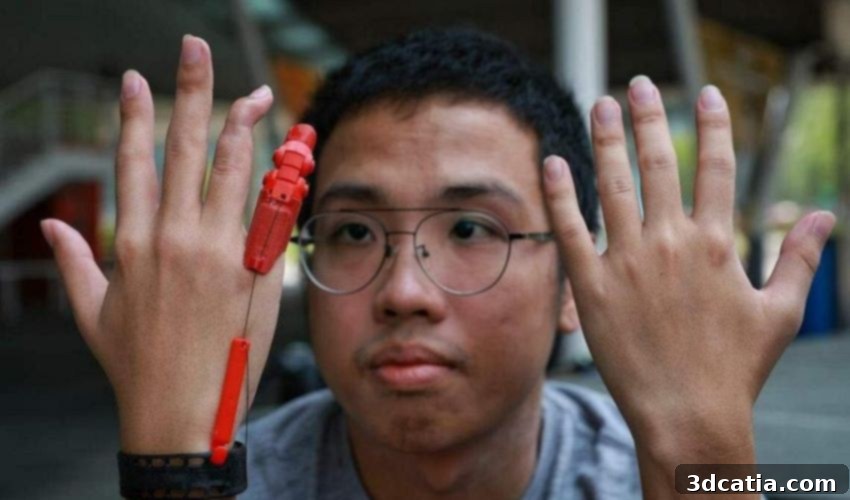
One compelling example of this life-changing technology is the story of Russel Ko. A dedicated engineering student at the Republic Polytechnic College in Woodlands, Singapore, Mr. Ko endured a severe and life-altering injury in October of last year. A motorcycle accident tragically resulted in his left hand becoming trapped in the vehicle’s wheel, leading to the complete severance of both his pinky and ring fingers. Following the traumatic incident, Mr. Ko was rushed to Tan Tock Seng Hospital, where a team of skilled doctors made valiant efforts to reattach the retrieved fingers. Despite their best efforts, only his ring finger could be successfully saved, leaving him with significant functional impairment. However, fate intervened in a positive way when Mr. Ko qualified for a groundbreaking pilot study initiated by TTSH. This study focused on the development and application of functional finger prosthetics meticulously crafted using advanced 3D printing technology, a project prominently featured as part of the hospital’s media display showcasing the extensive capabilities of its Medical 3D Printing Center.
The Growing Need for Advanced Finger Prosthetics
The need for effective and accessible finger prosthetics is alarmingly high. In the United States alone, an estimated 45,000 finger amputations occur annually, primarily stemming from a variety of traffic and industrial-related accidents. This statistic underscores the widespread impact such injuries have on individuals’ lives and the broader healthcare system. Dr. Bernice Heng, a distinguished professional within TTSH’s renowned hand and reconstructive microsurgery department, highlights the local prevalence of these injuries, noting that their hospital frequently receives a substantial number of patients—at least 20 to 30 individuals each year—presenting with finger amputations. Traditionally, patients faced limited options. The standard treatment method typically involved offering a cosmetic finger prosthesis. While these prosthetics are designed to aesthetically imitate a real finger, they fundamentally lack functionality, offering little in terms of practical use for daily tasks. This often left patients feeling incomplete and significantly hindered in their ability to perform everyday activities.
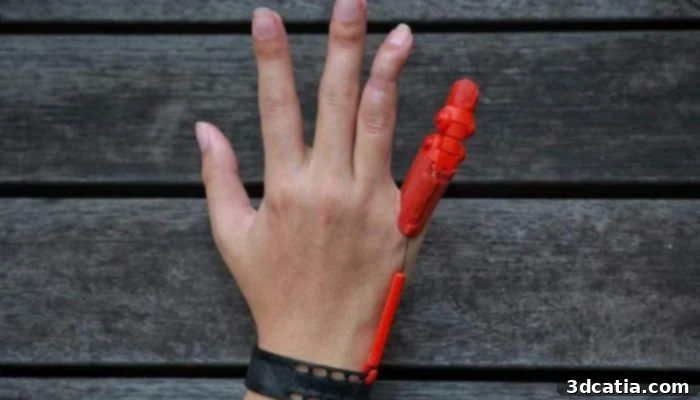
A cheaper 3D printed finger prosthesis alternative (Photo credits: Kevin Lim)
The advent of 3D printing at TTSH’s Medical 3D Printing Center has introduced a paradigm shift in this area. Unlike their traditional counterparts, the 3D printed prosthetics developed here feature intricate, movable joints. This innovative design allows patients to regain a near-normal range of motion and functionality, empowering them to perform a wide array of tasks that would otherwise be impossible. Beyond the crucial aspect of functionality, these 3D printed prosthetics offer numerous other compelling advantages. They are highly customizable, meticulously tailored to the individual patient’s anatomy and specific needs, ensuring a comfortable and precise fit. This level of personalization is virtually impossible with mass-produced prosthetics. Furthermore, their flexibility in design allows for continuous refinement and adaptation. Crucially, 3D printed prosthetics present a significantly more cost-effective option, making advanced prosthetic care more accessible to a broader patient population.
Cost-Effectiveness and Patient Preference: The Advantages of 3D Printing
The financial implications of prosthetic treatment can be a substantial burden for many patients. In a stark comparison, a traditional cosmetic prosthesis can cost several thousand dollars, placing it out of reach for numerous individuals. In stark contrast, its 3D printed counterpart can be produced for only a few hundred dollars, representing a dramatic reduction in cost. This affordability alone makes 3D printed prosthetics a game-changer, breaking down financial barriers to high-quality care. Dr. Heng enthusiastically describes the 3D printed finger prosthesis as both “lightweight and functional,” two qualities that are paramount for patient acceptance and long-term use. She notes that patients tend to adapt to these innovative prosthetics much better than to larger, more cumbersome myoelectric prostheses. Myoelectric devices, while offering advanced functionality by using muscle activity to power movement, are often heavy, complex, and can be uncomfortable, leading to lower patient satisfaction and compliance rates. The simplicity, comfort, and natural feel of 3D printed prosthetics thus make them a preferred choice for many.
For Russel Ko, the promise of a custom-tailored prosthetic represents a beacon of hope for regaining independence in his daily life. The Medical 3D Printing Center is diligently working on developing his personalized pinky prosthetic, and he eagerly anticipates its arrival. Mr. Ko articulates the profound impact of his injury on his everyday existence: “I am definitely looking forward to receiving my pinky. There are some difficulties in daily activities like opening a bottle… or carrying heavy stuff. As an engineering student, I also have to use some tools to do work. Without the pinky, my hand is less stable.” His words powerfully underscore the critical role even a single finger plays in fine motor skills, grip strength, and overall hand stability, particularly for someone engaged in technical work. The absence of his pinky not only affects mundane tasks but also poses professional challenges, highlighting the immense value that a functional 3D printed prosthetic will bring to his academic and future career endeavors.
Beyond Finger Prosthetics: Pioneering 3D Printed Cranial Caps
The innovative spirit at Tan Tock Seng Hospital extends far beyond finger prosthetics. The institution is continuously pushing the boundaries of prosthetic projects usingadditive manufacturing, exploring its potential to address other complex medical needs. Patients who have undergone craniectomy — a critical, life-saving surgical procedure involving the temporary removal of a part of the skull to alleviate dangerous pressure on the brain following conditions such as a severe stroke or a traumatic brain injury — are now benefiting from another pioneering 3D printing initiative. In the period following a craniectomy, patients typically face a waiting period, often extending up to a year, before they can undergo a second procedure (cranioplasty) to repair or replace the skull bone. During this crucial interim, protecting the exposed brain is paramount. Traditionally, these patients are required to wear a protective helmet. However, these conventional helmets come with significant drawbacks. They are frequently described as stuffy, heavy, and inherently uncomfortable, particularly in warm and humid climates like Singapore. This discomfort can exacerbate an already challenging recovery period for patients.
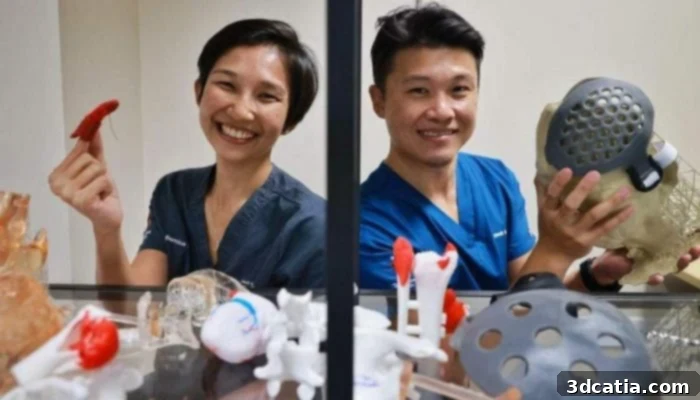
Dr Bernice Heng with a 3D-printed finger prosthesis and Dr Michael Yam, holding a cranial cap. (Photo credit: Kevin Lim)
This is precisely where the innovative 3D printed cranial caps emerge as an incredibly valuable and thoughtful substitute. Leveraging the precision of modern medical imaging, a dedicated team of professors at TTSH is designing highly customized skull caps. These caps are meticulously tailored to fit each patient’s unique head contours, utilizing detailed CT scans and advanced imaging data. This ensures an unparalleled level of fit and comfort, a stark contrast to the generic nature of traditional helmets. The team is actively collaborating with the Medical 3D Printing Center to significantly expand the reach and capabilities of this groundbreaking program, aiming to benefit more patients. A particularly noteworthy design improvement focuses on enhancing usability for stroke victims, who often experience weakness on one side of their bodies. The cranial cap’s design has been refined to allow for effortless donning and removal using just one hand, a crucial feature that promotes independence and reduces frustration during recovery. The positive feedback received from the majority of patients who have tried this new solution unequivocally affirms the success of these design improvements and the immense benefits they offer. Recognizing the profound potential of this innovation, the hospital has taken a proactive step by submitting an intellectual property application for the cap, with the strategic goal of eventually extending its availability and positive impact to other medical institutions both locally and internationally. It is conceivable that, sooner than we might expect, this advanced, lighter, and custom-fit appliance will widely replace the traditional, bulkier helmets, setting a new standard for post-craniectomy patient care. For those interested in the original report, you can check it out HERE.
The Future of Medical 3D Printing and Patient Empowerment
The initiatives at Tan Tock Seng Hospital represent a powerful testament to the transformative potential of 3D printing in the medical field. By moving beyond traditional methods, TTSH is not only providing advanced physical solutions but also empowering patients to regain confidence, independence, and a higher quality of life. The ability to rapidly prototype, customize, and produce intricate medical devices at a fraction of the cost makes 3D printing an indispensable tool for modern healthcare. This technology facilitates a patient-centric approach, where each prosthetic is not just a device, but a tailored extension designed to seamlessly integrate with the individual’s body and lifestyle. From intricate finger prosthetics that restore dexterity to comfortable cranial caps that protect and heal, 3D printing is bridging critical gaps in patient care, reducing recovery times, and offering a future where medical solutions are as unique as the patients they serve. The commitment of TTSH to innovation ensures that Singapore remains at the forefront of medical technology, continuously pushing the boundaries of what is possible in rehabilitation and patient support.
What are your thoughts on these incredible advancements in 3D printed prosthetics and their impact on patient care? We invite you to share your perspectives and engage in the conversation by leaving a comment below, or by connecting with us on our social media channels, including LinkedIn, Facebook, and Twitter. To stay informed about the latest developments and breaking news in the exciting world of 3D printing, don’t forget to sign up for our free weekly Newsletter here, delivered straight to your inbox! Additionally, you can explore all our insightful videos and in-depth content on our YouTube channel, where we continually highlight the most significant innovations in additive manufacturing.
*Cover photo credit: Kevin Lim