
Cornell University’s New 3D Printing Robot: Paving the Way for Sustainable Civil Infrastructure
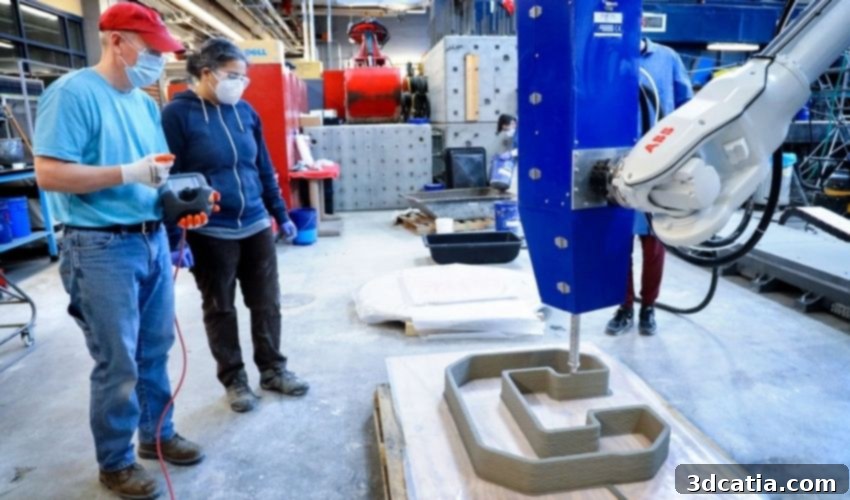
The future of construction is undergoing a radical transformation, driven by advancements in robotics and additive manufacturing. At the forefront of this revolution is Cornell University, which recently made a significant investment in cutting-edge technology. The Bovay Civil Infrastructure Laboratory Complex, nestled in the basement of Thurston Hall on Cornell’s New York campus, has acquired an industrial 3D printing robot. This formidable machine, weighing approximately 6,000 pounds, possesses the remarkable capability to 3D print large-scale structures – a development poised to fundamentally reshape the construction industry and usher in a new era of sustainable infrastructure.
The myriad benefits of 3D printing have long been recognized across various industrial sectors. From utilizing sustainable materials and achieving unparalleled production speeds to drastically reducing waste, additive manufacturing offers a compelling alternative to traditional methods. These advantages have prompted numerous industries to integrate 3D printing into their daily operations, with a relentless pursuit of even more innovative applications for future projects. Over the past few years, 3D printing has experienced significant growth, becoming an integral part of car manufacturing, aerospace engineering, and even the biomedical industry, enabling breakthroughs previously thought impossible.
However, when it comes to the concrete printing sector specifically, the state of additive manufacturing is not yet as universally advanced as it is in these other fields. While many pioneering projects have already been realized globally, construction engineers and researchers continue to grapple with fundamental questions. Key concerns revolve around the long-term durability and structural integrity of 3D-printed structures. How will these innovative buildings and components withstand the test of time, various environmental stressors, and significant loads over decades? What are the optimal material compositions for different applications? How do printed layers bond, and what are the implications for overall structural strength? These unanswered questions highlight a critical need for rigorous, scientific investigation to unlock the full potential of concrete 3D printing.
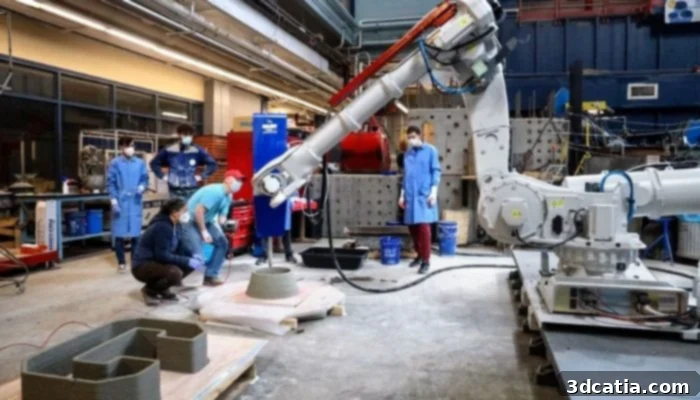
To address these pressing questions and propel the concrete 3D printing sector forward, the esteemed Ivy League university in Ithaca, NY, recently acquired its heavyweight industrial robot. This state-of-the-art machine is specifically intended to empower Cornell’s researchers to conduct comprehensive studies in the field of concrete additive manufacturing, bridging the gap between innovative concept and practical, reliable application. Professor Derek Warner, a distinguished expert in civil and environmental engineering at Cornell University, articulated the immense potential and the underlying rationale for this investment:
“Robotic masonry (brick laying), printing with recycled plastics and printing with metal at a large scale are all exciting areas with lots of room for growth, both in terms of science and understanding, as well as technology and engineering. The scaling of many of the phenomena controlling the build processes are such that they need to be studied at a scale near to that in which they will be used. The same applies to some of the phenomena controlling performance. Plus, there are always the unknown surprises that occur when up-scaling early-on with a new technology.”
Professor Warner’s insights underscore the multidisciplinary challenges and opportunities. The ability to experiment with varied materials, from recycled plastics to metals and various concrete composites, opens doors for developing truly sustainable and high-performance construction solutions. His emphasis on studying phenomena at “a scale near to that in which they will be used” is crucial. It highlights that laboratory-scale experiments, while valuable, cannot fully replicate the complexities and forces at play in real-world, large-scale structures. The new robot provides the unique capacity to test materials and processes under conditions that closely mimic actual construction environments, thereby yielding more reliable and applicable data. Furthermore, the acknowledgment of “unknown surprises” speaks to the inherent nature of pioneering research; new technologies invariably present unforeseen challenges that require dedicated exploration and problem-solving.
The Innovative Industrial Robot: A Game Changer for Research
The industrial 3D printing robot, specifically an IRB 6650S model, is indeed a marvel of modern engineering. As previously mentioned, this robust machine weighs approximately 6,000 pounds, making it a stable and powerful platform for heavy-duty additive manufacturing. Its impressive reach of approximately 13 feet, further enhanced by being mounted on a rail system that spans an additional 12 feet, gives it an expansive working envelope. This extensive reach and mobility are critical for printing large-scale structural elements, enabling researchers to fabricate components that truly represent real-world construction dimensions.
Having arrived at the Bovay Civil Infrastructure Laboratory Complex in early February, this high-tech machine bestows upon Cornell University a wealth of research opportunities that are currently available to only a select few educational institutions across the nation. This exclusive access positions Cornell at the forefront of additive manufacturing research for civil infrastructure. Beyond its direct research capabilities, the system also plays a pivotal role in education. It provides students at the College of Engineering faculty with an invaluable chance to engage in hands-on robotic construction research, offering them direct, first-hand experience with cutting-edge technologies that will define their future careers.
Sriramya Nair, an assistant professor of civil and environmental engineering, highlighted the profound impact of this acquisition on student learning and future innovation. She articulated:
“We are giving them an opportunity to learn something that’s cutting edge and happening right now, the more they know, the more they can be champions of change, but also know what the limitations could be.”
Professor Nair’s statement emphasizes the dual role of this technology in education: empowering students to drive innovation (“champions of change”) while also instilling a crucial understanding of the inherent limitations and challenges of emerging technologies. This holistic approach ensures that future engineers are not only proficient in using advanced tools but also critically aware of their capabilities and constraints.
Referencing the robotic system itself, she further elaborated on its remarkable versatility:
“The robotic system is versatile and flexible. One of the ways we are using it is for 3D-printing of concrete, but it can be used in other ways, too. You can attach a welder or laser system. You can stack bricks or tie rebar. Many tedious processes can be automated.”
This versatility is a key feature of the IRB 6650S. While its initial primary application at Cornell is concrete 3D printing, the ability to swap out end-effectors means it can perform a multitude of tasks. Imagine a single robotic platform capable of not only printing concrete walls but also automatically laying bricks (robotic masonry), precisely welding metal components for hybrid structures, or even tying rebar for reinforced concrete – tasks traditionally labor-intensive and time-consuming. This multi-functionality allows for exploring integrated construction processes, where automation can streamline entire building sequences, significantly improving efficiency, safety, and precision on construction sites.
Transforming Research and Education in Civil Engineering
The Bovay Civil Infrastructure Laboratory Complex’s new 3D printing robot is set to become a focal point for a wide array of research initiatives. Researchers will delve into material science, developing new concrete mixes optimized for 3D printing, potentially incorporating recycled aggregates or novel binding agents to enhance sustainability. Investigations into the mechanical properties of printed structures – including compressive strength, tensile strength, and flexural strength – will be crucial for validating their structural integrity. Scientists will also explore how different printing parameters, such as print speed, layer height, and nozzle design, affect the final properties of the material and structure.
Beyond materials, the robot will facilitate research into structural engineering challenges. This includes understanding the behavior of 3D-printed elements under various loading conditions, from static weights to dynamic forces like seismic activity. The ability to print complex, non-standard geometries opens up possibilities for optimized structural designs that use less material while maintaining or even exceeding traditional strength requirements. This innovative approach can lead to more efficient and aesthetically diverse architectural solutions.
Furthermore, the robot’s presence will drive advancements in automation and process optimization within construction. Students and faculty can develop sophisticated algorithms for robot path planning, error detection, and real-time process control. This not only makes 3D printing more reliable but also paves the way for integrating other automated construction processes, creating a fully robotic construction ecosystem. The potential extends to addressing challenges such as construction in hazardous environments or remote locations, where human access is limited or dangerous.
For students, this means unparalleled opportunities to gain practical experience in a rapidly evolving field. They will learn to operate advanced robotic systems, understand the intricacies of additive manufacturing, and contribute directly to research that has real-world implications. This hands-on training ensures that Cornell graduates are not just theoretically proficient but also practically skilled, ready to lead the industry into its automated future. The experience gained here will be invaluable for careers in advanced manufacturing, construction technology, material development, and civil engineering consultancy.
The acquisition of the IRB 6650S robot signifies Cornell University’s commitment to pushing the boundaries of civil engineering and construction. By tackling the fundamental questions surrounding large-scale concrete 3D printing, the Bovay Civil Infrastructure Laboratory Complex is poised to generate crucial knowledge that will inform industry standards, accelerate adoption, and foster the development of truly sustainable, efficient, and resilient infrastructure for generations to come. This investment represents a tangible step towards a future where construction is smarter, safer, and more environmentally responsible.
To find out more about this groundbreaking initiative and Cornell’s work in sustainable construction, visit the Cornell University’s official website HERE. What are your thoughts on Cornell University’s new 3D printing robot and its potential impact on the future of construction? Share your insights by leaving a comment below or engaging with us on our LinkedIn, Facebook, and Twitter pages! Don’t forget to sign up for our free weekly Newsletter here to get the latest 3D printing news delivered straight to your inbox! You can also find all our engaging videos on our YouTube channel.
*All Photo Credits: Charissa King-O’Brien