

Polyformer: Transforming Plastic Bottles into 3D Printer Filament for a Sustainable Future
Imagine a world where the ubiquitous plastic bottle, often discarded after a single use, could be reborn as a valuable resource for innovation. What if you could take that seemingly worthless plastic and transform it into high-quality filaments for 3D printers, actively participating in the global effort to reduce plastic waste? This groundbreaking vision is precisely what drives the open-source Polyformer machine, an ingenious creation by designer Reiten Cheng. Conceived with the dual goals of sustainability and accessibility, Polyformer is more than just a device; it’s a tangible solution built from 3D printed parts made of recycled PET, embodying the very principles it champions. It’s specifically designed for the growing community of makers, innovators, and environmentalists who are eager to grant plastic a second, purposeful life. The core objective is profoundly simple yet powerful: to facilitate the creation of new objects from recycled materials, thereby significantly curbing our reliance on virgin plastic and fostering a more responsible consumption cycle.
One of the inherent strengths of additive manufacturing, commonly known as 3D printing, lies in its remarkable efficiency. By precisely depositing material layer by layer, it minimizes waste compared to traditional subtractive manufacturing methods, using only the necessary amount of material for each part. However, its potential extends far beyond mere waste reduction. 3D printing also possesses the unique capability to infuse value into what was once considered waste, granting it a renewed purpose and extending its lifecycle—a fundamental principle of the “circular economy.” In recent years, numerous pioneering projects have emerged with the ambitious goal of converting used plastic into functional 3D-printed components. While Polyformer is not the inaugural machine of its kind to tackle plastic recycling, its true distinction lies in its open-source nature. This design philosophy is critical, as it aims to democratize and proliferate the reuse of our ever-growing plastic waste through the accessible and innovative medium of additive manufacturing. By making the design freely available, Polyformer empowers individuals and communities worldwide to become active participants in the circular economy, transforming local waste into local resources.
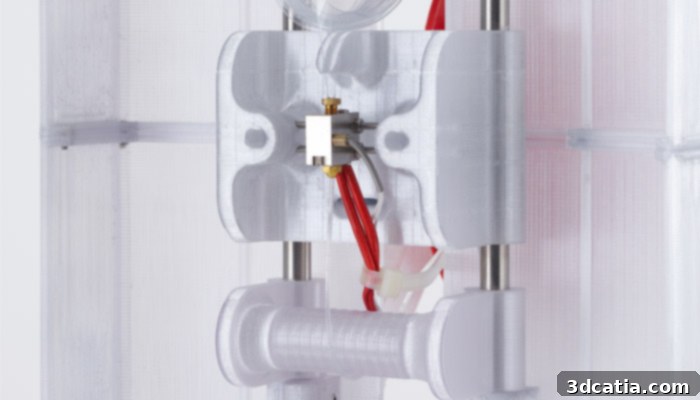
The interior of the machine (photo credits: Reiten Cheng)
The Polyformer machine itself is a marvel of ingenious design and accessible engineering. Characterized by its distinctive L-shape, its construction primarily relies on 3D printed parts, complemented by readily available components commonly found in conventional 3D printers. This approach underscores its open-source ethos, ensuring that aspiring builders can source materials without exorbitant costs or specialized manufacturing processes. The choice of recycled PET bottles as the primary raw material for its own structure lends the machine a unique, almost poetic, translucent appearance, visibly demonstrating its commitment to recycling from its very foundation. At the heart of the Polyformer’s transformation process is a meticulously designed slicing tool. This innovative component is engineered to precisely cut plastic bottles into long, continuous ribbons or threads. These ribbons, uniform in width and thickness, are then directed into a heated end of the machine. Here, controlled thermal energy melts the plastic to a molten state, carefully preparing it for the next crucial phase. The molten plastic is then extruded through a precision brass nozzle, which meticulously shapes it into a standardized 1.75mm filament—the most common diameter for FDM (Fused Deposition Modeling) 3D printers. This entire process, from bottle to filament, exemplifies how a simple, discarded item can be given a high-value, functional rebirth.
Further enhancing its user-friendliness and efficiency, Polyformer is equipped with a sophisticated red motorized spooling mechanism. This integral component is responsible for gently pulling the newly formed plastic ribbon from the extrusion nozzle, maintaining consistent tension, and meticulously winding the finished filament onto a detachable spool. This automated process ensures that the filament is wound evenly and without tangles, crucial for smooth operation in a 3D printer. Once a spool is completely filled with the freshly extruded 3D printer filament, it can be effortlessly removed from the Polyformer. This convenience means that users can immediately transfer their recycled, self-made filament to any standard FDM 3D printer, ready to breathe new life into designs and prototypes. The ability to produce filament on demand from readily available plastic waste offers unprecedented levels of autonomy and cost-effectiveness for hobbyists, educators, and small businesses alike, fostering a truly self-sufficient 3D printing ecosystem. This streamlined workflow eliminates the need for purchasing expensive commercial filaments, dramatically lowering the barrier to entry for sustainable 3D printing.
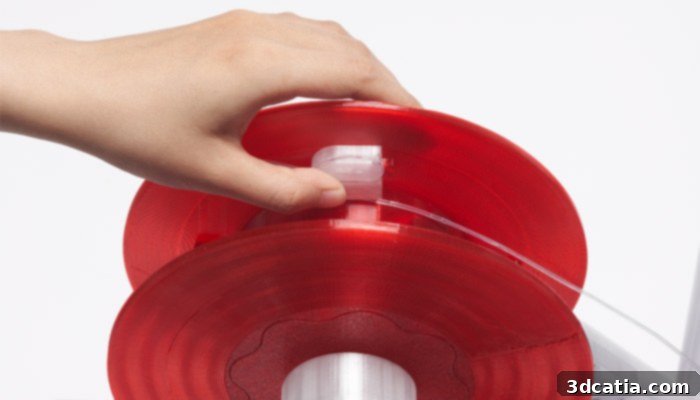
The spool makes it easy to retrieve the created filament (photo credits: Reiten Cheng)
The success of Polyformer is a testament to the power of open-source collaboration and community engagement. To date, an impressive number of approximately 100 makers from across the globe have taken on the challenge of building their own Polyformer machines. More significantly, this dedicated community actively contributes invaluable feedback to Reiten Cheng, the original designer. This iterative process of constructive criticism and collaborative improvement is vital to refining the solution, addressing potential issues, and enhancing the machine’s overall performance and accessibility. This collective effort ensures that Polyformer evolves not just as a piece of hardware, but as a robust and community-driven platform for sustainable innovation. Reiten Cheng’s concluding remarks offer a profound glimpse into the long-term vision driving this project: “I am imagining a future where products can be manufactured at home or in a community center and be recycled into things at the end of their life that can be used again to manufacture new products right on-site. The technology might not be there yet but I believe it’s not far from possible if we keep developing and implementing it as a community.” This statement beautifully encapsulates the aspirational goal of Polyformer: to decentralize manufacturing and recycling, creating self-sustaining local economies that minimize waste and maximize resource utility. It’s a call to action for collective innovation, believing that through shared effort, a truly circular and sustainable future for manufacturing is within reach.
The potential impact of Polyformer extends far beyond individual recycling efforts. By providing an accessible tool for converting plastic waste into usable 3D printer filament, it encourages a paradigm shift in how we perceive and manage resources. Educational institutions can integrate Polyformer into STEAM curricula, teaching students about engineering, material science, and environmental responsibility. Small businesses and design studios can experiment with sustainable product development, reducing their carbon footprint and offering eco-conscious solutions to consumers. Furthermore, in developing regions, Polyformer could represent a low-cost, high-impact solution for waste management and local manufacturing, fostering economic opportunities while simultaneously addressing pollution challenges. It champions the idea that innovation doesn’t always require massive industrial complexes; sometimes, it thrives best within the hands of a passionate global community, armed with open designs and a shared vision for a better planet. To delve deeper into the fascinating journey and technical specifications of Polyformer, including detailed build guides and community contributions, we highly recommend exploring the comprehensive resources available by clicking HERE.
What are your thoughts on this revolutionary open-source machine and its potential to reshape our approach to plastic waste and additive manufacturing? We invite you to share your insights and engage in the conversation by leaving a comment below or joining us on our social media channels: Linkedin, Facebook, and Twitter! Stay informed about the latest advancements in 3D printing technology and sustainable practices by subscribing to our free weekly Newsletter here – delivered directly to your inbox. You can also explore a wealth of informative videos and captivating content on our official YouTube channel, showcasing the incredible possibilities of additive manufacturing.