
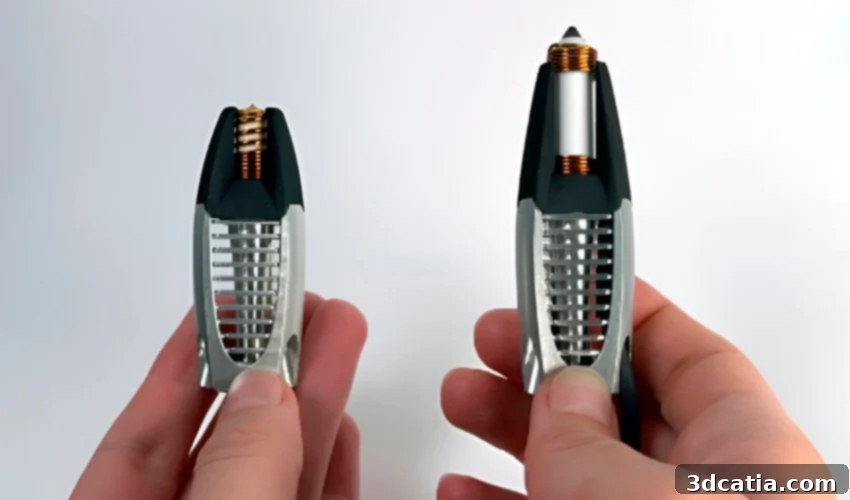
Plasmics Pioneers Next-Gen FDM 3D Printing: Unveiling the Enhanced INo Trident Induction Hotend and FourRunner Extruder for Industrial Applications
In the intricate world of additive manufacturing, seemingly minor details often dictate monumental differences in final product quality and efficiency. When it comes to FDM 3D printing, the fundamental choice of a 3D printer is crucial, yet its true capabilities are intrinsically linked to the performance of its core components. Recognizing this profound interplay, Plasmics has dedicated its innovation efforts to developing holistic, high-performance solutions designed to meet and exceed the demands of diverse customer applications. Central to Plasmics’ advanced FDM ecosystem are the state-of-the-art Plasmics DeltaS FDM printer, and its revolutionary heart: the INo Trident induction hotend and the robust FourRunner extruder. These cutting-edge components are not only integral to Plasmics’ own systems but are also available for separate purchase, offering unparalleled upgrade potential and broad compatibility with a wide array of existing 3D printers on the market, thereby democratizing access to industrial-grade printing capabilities.
Plasmics distinguishes itself by prioritizing intelligent, user-friendly solutions meticulously engineered to align with specific customer requirements. A prime example of this philosophy is the INo Trident hotend, which boasts an exceptionally low thermal mass. This design marvel enables a groundbreaking ability to transition between drastically different temperatures at lightning-fast speeds – a feature that redefines possibilities in FDM printing. This rapid temperature modulation is particularly transformative for specialized applications such as printing with foaming filaments, where precise temperature control dictates material expansion and final part density. Furthermore, it offers significant advantages for creating predetermined breaking points, such as those found in complex support structures, making post-processing vastly simpler and more efficient. The ability to instantly adjust temperatures opens new avenues for material science in 3D printing, moving beyond the static temperature profiles of conventional hotends.
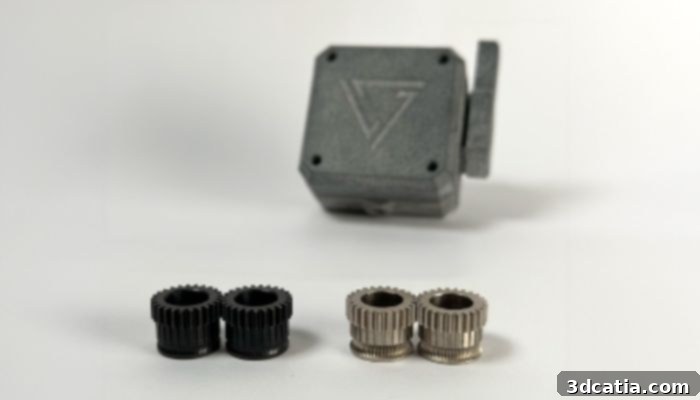
The Plasmics FourRunner extruder – engineered for precision and reliability.
To further solidify its position and cater more effectively to the evolving needs of the demanding B2B market, Plasmics has recently introduced significant revisions to its flagship products. Both the acclaimed INo Trident induction hotend and the high-performance FourRunner extruder have been refined and are now available in new, optimized versions specifically tailored to address the unique challenges and requirements of industrial and professional clientele. These enhancements reflect Plasmics’ commitment to continuous innovation and its responsiveness to market feedback, ensuring that businesses can leverage the most advanced and reliable 3D printing components available.
A pivotal enhancement in the new versions of the INo Trident hotend lies in its expanded capability to process filaments with a larger diameter. While the original hotend was engineered for the widely used 1.75 mm filament, the latest iteration features a thoroughly revised overall geometry. This allows the new INo Trident to now flawlessly handle 2.85 mm filaments, which are often preferred in industrial settings for their increased strength, faster deposition rates, and perceived greater process stability. Understanding these distinctions is crucial for B2B customers, as the choice of filament diameter can significantly impact print speed, part integrity, and material handling. Therefore, a closer examination of the core features of both the original INo Trident and its advanced new version is essential to fully appreciate the benefits tailored for professional applications.
INo Trident: Unlocking Optimized Printing Time and Unparalleled Material Diversity
The INo Trident induction hotend is a masterpiece of engineering, meticulously constructed from robust components designed for durability and peak performance. It comprises a standard mounting flange, ensuring broad compatibility with various 3D printer architectures, an advanced aluminum housing for efficient heat dissipation, a precisely wound induction coil, and a robust nozzle crafted from hardened tool steel. This selection of materials not only guarantees longevity but also facilitates the processing of abrasive and high-performance filaments without premature wear. Weighing in at a mere 30 grams, the INo Trident’s lightweight design is a significant advantage. This low mass directly translates into reduced inertia during rapid printhead movements, leading to faster acceleration, minimized vibrations, and ultimately, higher print speeds and superior surface finishes – critical factors for industrial throughput and quality.
At the core of the INo Trident’s revolutionary performance is its groundbreaking induction heating system. Unlike traditional hotends that rely on resistive heating elements, the INo Trident heats the nozzle directly and almost instantaneously. This innovative approach allows the hotend to reach an operational temperature of 200°C in an astonishing four seconds. Furthermore, it can achieve a maximum temperature of 500°C, opening the door to printing with a vast range of high-performance engineering plastics. Equally impressive is its cooling capability: the INo Trident cools down five times faster than a conventional 30 W hotend. This unparalleled speed in both heating and cooling cycles dramatically reduces overall printing time, especially in scenarios involving multi-material prints or filaments with highly temperature-dependent properties. The efficiency gained from these rapid thermal transitions translates directly into increased productivity and reduced manufacturing lead times for businesses.
Another substantial benefit derived from the INo Trident’s induction heating principle is its exceptional energy efficiency. Traditional hotends typically heat a large thermal mass, such as a heating block, which then transfers heat to the nozzle. The INo Trident, by contrast, directly heats the nozzle itself via induction, bypassing the need to heat extraneous components. This targeted heating mechanism means significantly less energy is consumed overall, as there’s less thermal mass to heat, precisely control, and subsequently cool down. For industrial operations, this translates into tangible cost savings on electricity and contributes to a more sustainable manufacturing process, aligning with modern corporate environmental responsibility initiatives.
Beyond speed and efficiency, the INo Trident offers unparalleled precision in filament temperature control. This granular control over the extrusion temperature is paramount when working with high-performance and engineering-grade materials, where even slight temperature deviations can compromise part integrity and mechanical properties. The INo Trident’s advanced capabilities make it ideally suited for printing an expansive range of demanding materials, including glass fiber (GF) reinforced, carbon fiber (CF) reinforced, and even PEEK filaments – materials known for their superior strength, chemical resistance, and thermal stability. Its design ensures compatibility with virtually all common filaments available on the market and facilitates easy integration onto standard FDM 3D printers, providing a powerful upgrade path for existing setups and enabling users to unlock new material possibilities.
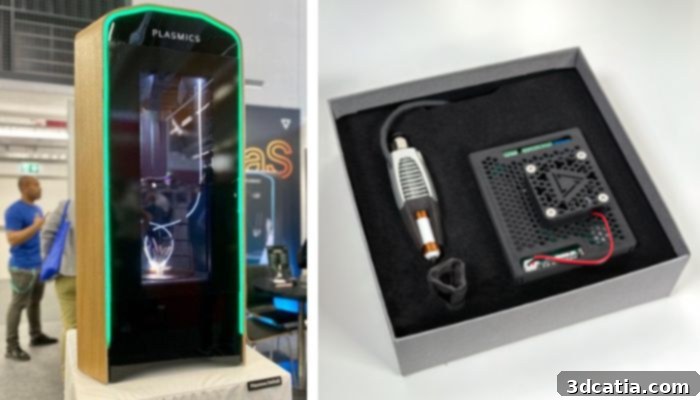
Left: Plasmics showcasing innovation at Formnext; Right: The new INo Trident hotend specifically designed for 2.85 mm filaments.
Historically, Plasmics’ initial INo Trident model offered nozzle diameters ranging from 0.4 to 0.6 mm, primarily optimized for 1.75 mm filaments. While this configuration proved immensely popular and highly effective for the B2C market and many prototyping applications, there was an increasing and persistent demand from B2B customers for a larger version. Industrial users frequently operate with 2.85 mm filaments, which are often preferred for their robustness, higher flow rates, and improved dimensional stability in large-scale or demanding applications. Plasmics, attentive to its professional customer base, responded to this critical need by developing a thoroughly revised hotend specifically engineered for maximum service life and performance within challenging industrial environments, demonstrating a clear commitment to industrial-grade additive manufacturing.
The newly introduced INo Trident hotend for 2.85 mm filaments now supports a wider range of nozzle diameters, from 0.6 mm up to a substantial 1.0 mm. This expanded capability provides greater control over the filament extrusion process, allowing for both fine detail and rapid deposition, depending on the application. Furthermore, the induction heating technology continues to shine with the larger filament diameter, offering even faster thermal cycles. The filament can be heated from room temperature to 250°C in just 15–20 seconds, while the hotend cools below the crucial glass transition temperature in a mere five to eight seconds. This incredible speed has a profound positive impact on overall printing time and quality, significantly reducing issues like stringing or oozing. Customers have expressed particular enthusiasm for this enhanced temperature control, as it effectively prevents these common print defects, leading to cleaner, more precise parts and reducing material waste.
The inherent characteristics of the INo Trident – including its rapid heating and cooling capabilities, exceptional temperature control, and lightweight design – make it an ideal solution for variable temperature printing strategies. This technology facilitates the use of a diverse range of materials, each optimized for specific applications and properties. By enabling precise temperature shifts during a print, the INo Trident minimizes faulty prints, thereby boosting success rates and reducing material costs. It significantly simplifies the production of parts featuring different material properties within a single print, or gradient properties that vary along the print path. This capability is especially beneficial for industries such as aerospace and construction, where the production of stronger, more resilient parts with tailored mechanical properties is paramount. Moreover, the INo Trident is perfectly suited for advanced materials like Varioshore, which exhibit dynamic property changes in response to temperature variations, allowing users to fully exploit their unique characteristics.
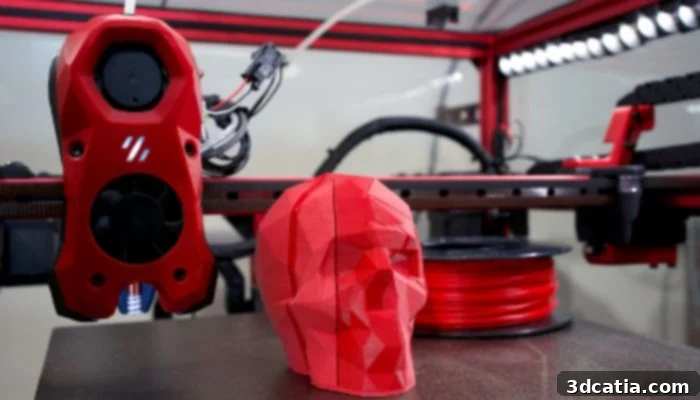
The INo Trident’s precise control makes it ideal for printing with variable temperatures, opening new material possibilities.
The industrial readiness of these new versions of the hotend and extruder is already being validated through extensive customer testing. For instance, at the esteemed University of Brno, the 2.85 mm INo Trident hotend has been rigorously tested in conjunction with a 5-axis robot, showcasing its adaptability and robust performance in complex industrial automation setups. Plasmics reports overwhelmingly positive feedback on the 2.85 mm version. Users particularly highlight the achievement of greater process stability, largely attributed to the inherently smaller deviations in diameter accuracy commonly found with 2.85 mm filaments compared to their 1.75 mm counterparts. This enhanced stability is a critical factor for consistent, high-quality production in demanding industrial applications where reliability is paramount.
Complementing the innovative INo Trident hotend, the FourRunner extruder – available as a twin pack with the hotend – also delivers exceptional performance. Its advanced design features a doubling of synchronized gears, which in turn doubles the contact surfaces gripping the filament. This ingenious mechanism provides significantly improved production parameters, translating directly into superior filament control and dramatically reduced slip. The enhanced grip ensures a more consistent and precise filament flow, which is crucial for achieving high-quality prints, especially with challenging materials like flexibles or abrasives. Plasmics is also actively engaged in developing a high-torque version of the FourRunner extruder specifically optimized for Bowden configurations, promising to further enhance filament delivery and control for a broader range of 3D printer setups. We eagerly anticipate providing further updates as Plasmics releases more information on this exciting development.
To delve deeper into Plasmics’ continuous advancements and explore their innovative solutions, we invite you to visit the company’s official website HERE. For a firsthand experience and to engage directly with the Plasmics team, make sure to visit their exhibit at Formnext from November 19 to 22, 2024. Plasmics will be showcasing their cutting-edge developments live at a joint stand with OnShape, providing an excellent opportunity to marvel at their technology and discuss how their solutions can elevate your additive manufacturing capabilities.
What are your thoughts on the groundbreaking INo Trident induction hotend and the robust FourRunner extruder? We encourage you to share your insights and feedback in a comment below, or engage with us on our social media channels: LinkedIn, Facebook, and Twitter! Don’t miss out on the latest advancements in the world of 3D printing; sign up for our free weekly newsletter here to receive direct updates to your inbox. You can also explore all our insightful videos and content on our dedicated YouTube channel.
*All Photo Credits: Plasmics