
Revolutionizing Social Housing: How 3D Printed Homes are Conquering Colombia’s Toughest Terrain
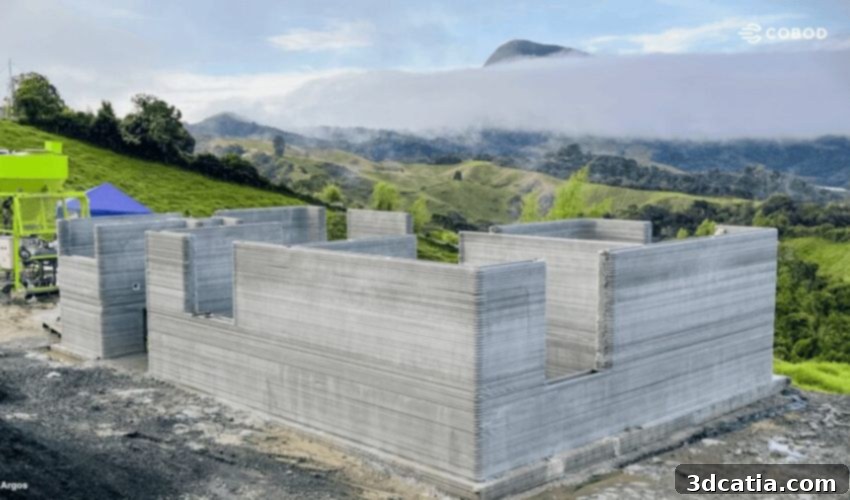
The global quest for affordable, durable, and sustainable housing faces numerous obstacles, from soaring material costs and labor shortages to logistical nightmares in remote locations. However, a revolutionary technology is emerging as a powerful solution: construction 3D printing. This innovative approach promises to reduce build times, minimize waste, and create unique architectural designs. A groundbreaking project in the heart of South America is showcasing this potential in one of the most challenging environments imaginable. In the mountainous region of La Unión, in Colombia’s western Antioquia department, the company Cementos Argos, in collaboration with the non-profit Fundación Berta Martínez, has successfully constructed the continent’s first 3D printed social housing project, proving that even the most difficult terrain can be overcome with cutting-edge technology.
This pioneering initiative involved navigating significant logistical hurdles, including transporting the massive COBOD Bod2 printer and specialized building materials through rugged, mountainous landscapes and during periods of heavy rainfall. The success of this project not only provides dignified housing for local families but also establishes a powerful new blueprint for humanitarian construction efforts in isolated communities worldwide. Let’s delve into the specifics of these remarkable homes and the innovative process that brought them to life.
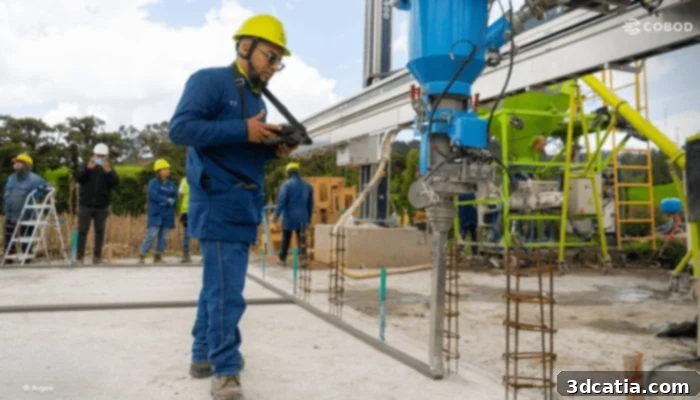
The COBOD Bod2 3D printer in operation, constructing the walls of a social house in Colombia.
A New Paradigm in Construction Speed and Efficiency
The project delivered two single-story houses, each thoughtfully designed with a 63-square-meter floor plan. Far from being basic shelters, these homes are fully functional residences designed for family life, featuring two bedrooms, a comfortable living room, a modern kitchen, a full bathroom, a dedicated laundry area, and a welcoming porch. The 2.2-meter-high 3D printed walls provide a robust foundation for a traditional timber roof, blending advanced manufacturing with conventional building techniques.
What is truly astonishing is the speed of construction. The core structure of these homes was printed directly on-site in a mere 16 hours of printing time, spread across just three days. This represents a monumental leap in efficiency. According to COBOD, the manufacturer of the printer, this additive manufacturing process is approximately 30% faster than traditional construction methods. This speed is not just a matter of convenience; in humanitarian contexts or disaster relief scenarios, the ability to build safe, permanent housing in days instead of weeks or months can be life-changing. Furthermore, the precision of the 3D printing process leads to significant resource conservation, generating 15–30% less construction waste and reducing material costs by an estimated 20%.
The Science of a Specialized, Sustainable Mortar
A key element of this project’s success and sustainability lies in the innovative material used for printing. Cementos Argos developed a custom mortar mixture specifically for this application, with a remarkable 99% of its raw materials sourced locally. This strategy dramatically reduces the project’s carbon footprint by minimizing transportation emissions and also bolsters the local economy. The resulting material is not only eco-friendly but also incredibly strong. The printed walls exhibit a compressive strength exceeding 35 MPa (megapascals), or 5,076 psi, a figure comparable to high-strength conventional concrete, ensuring the homes are durable and long-lasting.
To ensure compliance with stringent local building codes, especially the region’s seismic resistance standards, the structural design underwent a rigorous approval process by the Municipal Planning Office. In an interview with Global Construction Review, Daniel Duque, the R&D Director at Cementos Argos, elaborated on the material’s advanced properties: “The dry mix contains fibres and chemical additives that provide resistance to plastic shrinkage stresses, preventing cracking caused by wind, humidity and temperature fluctuations in the region.” This specialized formulation was tested extensively over several months to perfect its mechanical properties, guarantee strong adhesion between layers, and precisely evaluate the curing process and overall structural behavior.
Further enhancing the design, the walls are constructed with a double-layered or cavity wall structure. This intelligent design creates an intermediate air chamber within the walls, which acts as a natural thermal insulator. This feature helps maintain a more stable and comfortable indoor temperature year-round, reducing the need for heating or cooling and thereby lowering energy costs for the resident families—a critical aspect of sustainable and affordable living.
From Proof of Concept to a Scalable Housing Solution
While the construction of these first two houses is a historic achievement, Cementos Argos and its partners view it as just the beginning. The project has served as an invaluable proof of concept, demonstrating the viability of 3D printing technology in even the most demanding conditions. Duque revealed that the team is already designing a much larger project: a community of 20 clustered social housing units. “This will allow us to scale the technology and optimise the structural and architectural design, as well as the printing process, to make this technology economically viable,” he explained.
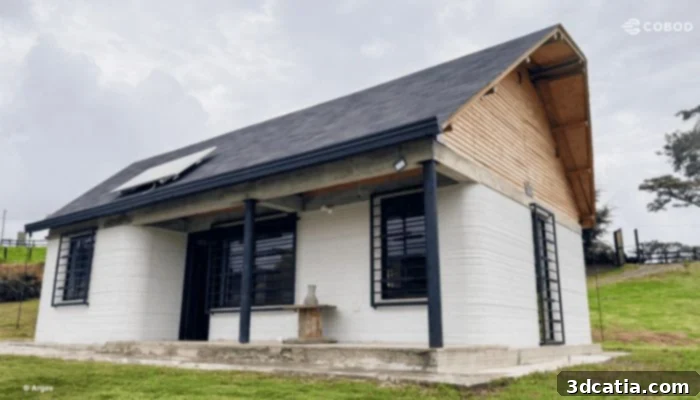
The completed 3D printed house from Cementos Argos, a model for future projects.
For this larger-scale development, the team is exploring a different operational model, which involves printing the walls offsite in a controlled factory environment. This approach could further streamline the process and reduce costs associated with on-site printer installation, which for the initial project required five small trucks to transport the disassembled printer. However, what sets this first project apart is its inherent adaptability. “The design of this project is notable for its flexible interior layout and the potential for future lateral expansion of the house,” Duque noted. This forward-thinking design allows families to expand their homes as their needs grow, a crucial feature for long-term social housing solutions.
The vision and funding provided by the Fundación Berta Martínez were instrumental to this project’s success. The foundation is dedicated to making a holistic impact on rural areas by strategically leveraging social investment and catalytic capital. The partnership demonstrates how corporate innovation and non-profit missions can align to create powerful, positive change. This project is a testament to how 3D printing is not just a technology for rapid prototyping or niche manufacturing but a transformative tool for addressing fundamental human needs. To learn more about this incredible construction project, you can find further details HERE.
What are your thoughts on the future of 3D printed social housing in challenging environments like La Unión? Share your perspective in the comments below or on our LinkedIn or Facebook pages. Don’t forget to sign up for our free weekly Newsletter to receive the latest 3D printing news directly in your inbox. You can also explore all our videos on our YouTube channel.
*All Photo Credits: Cementos Argos