
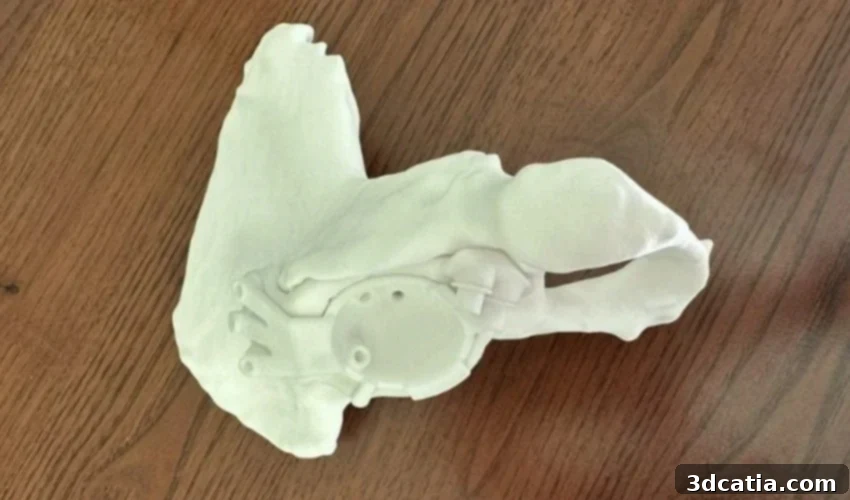
Revolutionizing Orthopedic Care: Poland Pioneers First Custom 3D Printed Hip Prosthesis
Additive manufacturing, commonly known as 3D printing, is rapidly emerging as a transformative force across various industries, with its impact in medicine being particularly profound. This innovative technology allows for the creation of perfectly tailored parts, a critical advantage, especially when it comes to intricate medical devices like prostheses. The ability to customize implants precisely to individual patient anatomy addresses complex challenges that traditional manufacturing methods often struggle to overcome. This personalized approach ensures optimal fit, enhances functionality, and can significantly improve patient outcomes and recovery times. A recent landmark achievement at a hospital in Lublin, Poland, vividly demonstrates this potential, where 3D printing was successfully utilized for the first time in the region to produce and implant a highly customized hip prosthesis, marking a significant milestone in orthopedic surgery.
The medical team at the Lublin hospital faced a challenging scenario involving a patient who had developed severe complications with her previously implanted steel prosthesis. The loosening of conventional implants is a well-documented issue in orthopedics, often leading to pain, instability, and considerable bone loss. In this particular case, the previous prosthesis had failed, resulting in a substantial defect in the patient’s pelvic bones, presenting a complex surgical puzzle. Dr. Andrzej Atras, who heads the hospital’s traumatology-orthopedics department, described the gravity of the situation: “As a result of the loosening of the earlier placed prosthesis of the hip joint, in this particular female patient, there came to be a large defect in the pelvic bones.” He emphasized that such revision surgeries are notoriously difficult due to the compromised bone structure and the critical need for precise force distribution within the bone socket. Improper load distribution can lead to future degeneration of bone tissue, hindering long-term success. The primary objective was not merely to replace the implant but to foster the reconstruction and regeneration of the surrounding bone bed. Dr. Atras further elaborated on their meticulous requirements, stating, “We had to use a specially expanded implant which would allow for stable embedding in the bone with the use of the remaining regions which contained good quality fragments of bone.” The unique challenges demanded an equally unique solution, and a custom-designed, 3D printed hip prosthesis emerged as the optimal path forward.
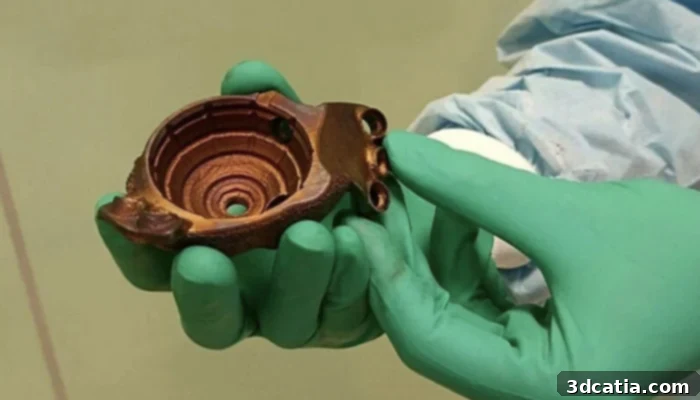
The original steel prosthesis loosened over time, necessitating a personalized approach (photo credits: Dziennik Wschodni)
The Precision of Additive Manufacturing: Designing the Custom Hip Prosthesis
The journey to create the specialized hip prosthesis was a testament to interdisciplinary collaboration and the power of advanced technology. Working closely with the orthopedic company Medgal, the medical team embarked on designing a 3D printed implant perfectly tailored to the patient’s intricate anatomical requirements. The process began with highly detailed diagnostic imaging, including X-rays and high-resolution computerized tomography (CT) scans. These scans provided an exhaustive, three-dimensional digital model of the patient’s pelvis and hip joint, offering an unprecedented level of insight into the extent of the bone defects and damage. This digital blueprint was crucial for doctors to meticulously assess the compromised areas and, in collaboration with a dedicated team of engineers and orthopedic surgeons, to begin the complex design phase of the implant.
The development of the implant was an iterative and highly precise endeavor. The goal was to create an acetabular component—the socket part of the hip joint—that would not only fit the remaining acetabulum flawlessly but also promote long-term stability and bone integration. Dr. Atras highlighted the intensity of this design period: “We worked on that socket for two months, to give it the correct geometry and biocompatibility with the patient’s body. It often required several hour long consultations and an evaluation of many variants of the construction in order to select the most optimal one.” This rigorous two-month process involved countless hours of virtual modeling, simulations, and expert consultations, ensuring that every curve and contour of the implant was perfectly aligned with the patient’s unique anatomy. This meticulous approach is a hallmark of personalized medicine enabled by 3D printing, contrasting sharply with the limitations of off-the-shelf implants that offer limited customization.
Advanced Materials and Biocompatibility for Enhanced Bone Integration
Beyond the precise geometric fit, the material composition and surface treatment of the 3D printed hip prosthesis were paramount to its success. The customized socket was engineered with an open-pored coating, a sophisticated composite of titanium, carbon, and silicone. This advanced coating was specifically chosen because its porous architecture closely mimics the natural cancellous bone structure, creating an ideal environment for osteointegration—the direct structural and functional connection between living bone and the surface of a load-bearing implant. The open-pored design facilitates the ingrowth of new bone tissue into the implant’s structure, providing biological fixation that is far superior to mechanical anchoring alone. This integration is vital for the long-term stability and success of the prosthesis, minimizing the risk of future loosening and promoting natural healing processes.
Furthermore, the selected coating materials offer distinct advantages. Titanium is renowned for its excellent biocompatibility, strength-to-weight ratio, and corrosion resistance, making it an ideal choice for medical implants. The addition of carbon and silicone enhances the surface properties, contributing to both biocompatibility and the crucial antibacterial effect. The presence of antibacterial properties is a significant advantage in preventing implant-related infections, which can be devastating for patients and notoriously difficult to treat. While the specific 3D printing technology used for the final metallic implant was not explicitly detailed, it is highly probable that advanced metal additive manufacturing techniques such as Direct Metal Laser Sintering (DMLS) or Electron Beam Melting (EBM) were employed. These methods are capable of producing complex titanium geometries with controlled porosity, fulfilling the stringent requirements for orthopedic implants. After the successful surgical implantation, which demonstrated the efficacy of this innovative approach, the medical team in Lublin expressed strong confidence in the future of 3D-printed prostheses. They anticipate a growing number of operations utilizing these personalized implants, marking a new era for orthopedic care.
The Impact and Future of Personalized Orthopedic Solutions
The successful implantation of the first custom 3D printed hip prosthesis in Lublin represents more than just a single surgical triumph; it signifies a pivotal moment in the evolution of orthopedic medicine. This case underscores the immense potential of additive manufacturing to address some of the most challenging clinical situations, offering hope and improved quality of life for patients who might otherwise face limited options. By enabling the creation of implants that are perfectly adapted to each patient’s unique anatomy and pathological condition, 3D printing moves us closer to a truly personalized healthcare system. This approach minimizes complications associated with ill-fitting standard implants, such as pain, instability, and the need for revision surgeries, which are often more complex and carry higher risks.
The enhanced bone regeneration facilitated by the porous, biocompatible coating is a crucial element of this innovation. Faster and more robust integration of the implant into the natural bone structure means quicker patient recovery, reduced rehabilitation times, and ultimately, a more durable and functional outcome. Patients can regain mobility and return to their daily activities with greater confidence and comfort. The success in Lublin serves as a powerful proof-of-concept, likely inspiring other medical institutions globally to explore and adopt similar advanced manufacturing techniques. As the technology continues to evolve, we can expect to see even more sophisticated materials and printing methods, further expanding the applications of 3D printing in joint replacements, spinal implants, craniofacial reconstruction, and beyond. This pioneering effort not only showcases Poland’s commitment to medical innovation but also paves the way for a future where highly personalized, patient-specific implants become the gold standard in orthopedic care, ultimately improving countless lives.
What are your thoughts on this groundbreaking 3D printed hip prosthesis and its potential to revolutionize orthopedic surgery? Share your insights and join the conversation in a comment below or connect with us on our LinkedIn, Facebook, and Twitter pages! Don’t forget to sign up for our free weekly Newsletter here to receive the latest 3D printing news straight to your inbox! You can also find all our videos and in-depth discussions on our YouTube channel, offering a visual dive into the world of additive manufacturing.
*Cover Photo credits: Dziennik Wschodni Zeitung