
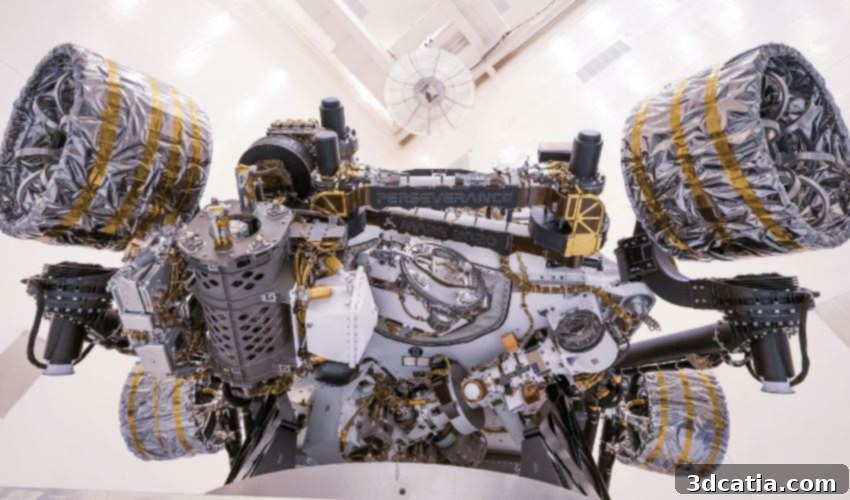
NASA’s Perseverance Rover: Pioneering Mars Exploration with Advanced 3D Printed Components
The National Aeronautics and Space Administration (NASA), a vanguard in space exploration and technological innovation, has consistently championed the integration of advanced manufacturing techniques, particularly 3D printing. For several years, NASA has made substantial investments in additive manufacturing technologies, not only by developing and producing critical parts in-house at its various centers but also by awarding multi-million dollar contracts to pioneering external companies and research institutions. This strategic approach underlines NASA’s commitment to leveraging cutting-edge solutions for the myriad challenges of space travel and planetary exploration. Notable examples of this commitment include the development of rocket engines featuring intricate 3D printed components, utilizing innovative launch vehicles like Relativity Space’s entirely 3D printed rocket for future missions, and financing ambitious projects such as ICON’s initiative to additively manufacture robust infrastructure directly on the lunar surface. These endeavors collectively underscore the transformative potential of 3D printing in making space missions more efficient, cost-effective, and ultimately, more achievable.
Most recently, NASA proudly announced that its state-of-the-art Perseverance rover, currently en route to the Red Planet, is equipped with an impressive eleven 3D printed metal parts. These meticulously engineered components are integral to the rover’s mission to Mars, showcasing the increasing trust and reliability placed in additive manufacturing for critical space applications. The development of these specialized 3D printed components was a collaborative effort, involving NASA’s world-renowned Jet Propulsion Laboratory (JPL) at the California Institute of Technology, a hub of deep space mission development and advanced robotics. This partnership highlights how fundamental research and innovative engineering come together to push the boundaries of what’s possible in space exploration.
While the Perseverance rover represents a significant leap forward, it is, interestingly, not the first Mars-bound spacecraft to incorporate 3D printed elements. Its predecessor, the Curiosity rover, which successfully landed on Mars back in 2012, carried a crucial 3D printed ceramic part within its Sample Analysis at Mars (SAM) instrument. This initial, cautious integration marked a pivotal moment, paving the way for more widespread adoption. Since then, NASA has diligently continued to test and refine 3D printing applications for spacecraft, focusing intensely on understanding and validating the reliability and performance of these additively manufactured parts under the extreme conditions of space. This rigorous qualification process is paramount to ensuring mission success and astronaut safety. Over the eight years between Curiosity’s launch and Perseverance’s development, the number of 3D printed parts on NASA’s Mars-bound rovers has escalated from one to eleven, a testament to the rapid advancements in additive manufacturing technology and materials science. Crucially, these parts are currently classified as secondary structures, meaning their failure would not jeopardize the overall mission. However, as Andre Pate, the respected group lead for additive manufacturing at NASA’s JPL, eloquently stated, “Flying these parts to Mars is a huge milestone that opens the door a little more for additive manufacturing in the space industry.” This sentiment captures the profound significance of these components, not just for the Perseverance mission, but for the future trajectory of space exploration, hinting at a time when primary, load-bearing structures could also be 3D printed.
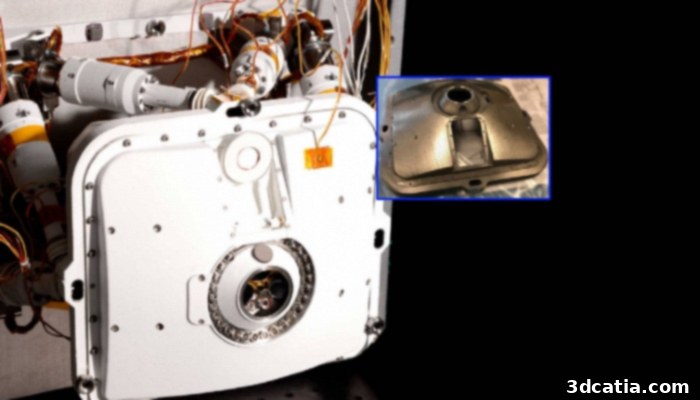
The outer shell of PIXL, one of the instruments aboard NASA’s Perseverance Mars rover, includes several parts that were made of 3D printed titanium. (Image credits: NASA/JPL-Caltech)
Perseverance’s Advanced Instruments: PIXL and MOXIE Feature Critical 3D Printed Parts
Among the eleven innovative 3D printed components destined for the Martian surface, five are ingeniously integrated into Perseverance’s Planetary Instrument for X-ray Lithochemistry, or PIXL. This sophisticated device is a cornerstone of the rover’s scientific payload, designed to meticulously search for signs of ancient fossilized microbial life. PIXL achieves this by precisely targeting rock surfaces with X-ray beams, enabling it to analyze their elemental composition and identify potential biosignatures. The scientific objectives of PIXL demanded an instrument that was not only incredibly precise but also exceptionally lightweight, a challenge that 3D printing proved uniquely capable of overcoming.
To meet the stringent mass requirements, the engineering team at JPL embarked on a groundbreaking design process for PIXL’s housing. They conceived a two-piece titanium shell, a robust mounting frame, and two vital support struts that securely fasten the shell to the rover’s robotic arm. The brilliance of this design lay in its ability to be both hollow and extremely thin, a feat largely unattainable through conventional manufacturing methods. These intricate parts were brought to life through advanced metal 3D printing by Carpenter Additive, a leading vendor in additive manufacturing solutions. The resulting components boast an astonishing mass reduction, being three to four times lighter than if they had been produced using traditional fabrication techniques. This significant weight saving is not merely an advantage; it was a fundamental requirement for the mission. As Michael Schein, PIXL’s lead mechanical engineer at JPL, emphasized, “In a very real sense, 3D printing made this instrument possible. These techniques allowed us to achieve a low mass and high-precision pointing that could not be made with conventional fabrication.” The ability of additive manufacturing to create complex geometries, internal lattice structures, and optimized designs directly contributed to PIXL’s feasibility, ensuring its ability to perform critical scientific analysis under the harsh Martian conditions.
The remaining six 3D printed components on the Perseverance rover are located within another revolutionary instrument: the Mars Oxygen In-Situ Resource Utilization Experiment, or MOXIE. This pioneering device is designed to demonstrate a technology that could fundamentally transform future human missions to Mars. MOXIE’s primary objective is to test the feasibility of producing industrial quantities of oxygen from the Martian atmosphere, which is predominantly carbon dioxide. This oxygen would serve a dual purpose: first, as breathable air for future astronaut habitats, and critically, as an oxidizer for rocket propellant, enabling astronauts to generate their return fuel directly on Mars, drastically reducing the launch mass and cost of missions from Earth. Inside MOXIE, these six crucial parts manifest as sophisticated heat exchangers—intricately designed nickel-alloy plates. Their essential function is to shield and protect other sensitive parts of the instrument from the incredibly high temperatures generated during the oxygen production process.
The choice of material for these heat exchangers is critical. These specialized nickel components are known as superalloys, a class of metallic alloys that exhibit exceptional mechanical strength, creep resistance, and oxidation resistance, even at very high temperatures. Their ability to maintain structural integrity and performance under extreme thermal loads makes them indispensable for applications where traditional metals would fail. Such superalloys are commonly found in demanding environments like the hot sections of jet engines, where they endure immense heat and stress, or within power-generating turbines, where efficiency depends on robust high-temperature performance. For MOXIE, 3D printing allowed for the creation of complex internal geometries within these heat exchangers, maximizing their surface area and optimizing heat transfer efficiency – a design complexity that would be impractical, if not impossible, to achieve with conventional machining. This capability is paramount for MOXIE’s success, directly impacting its ability to efficiently convert Martian CO2 into precious oxygen, thereby paving the way for sustained human presence on the Red Planet.
Currently, the Perseverance rover is making its journey through the vastness of space, steadily approaching its destination. Its highly anticipated landing on Mars is scheduled for February 18, 2021. The rover’s overarching mission is multi-faceted: to meticulously search for signs of ancient microbial life, particularly in the Jezero Crater, a site believed to have once harbored a lake and river delta. Beyond the quest for biosignatures, Perseverance will extensively characterize the Red Planet’s geology and its past climate, gathering invaluable data that will deepen our understanding of Mars’s evolutionary history and potential habitability. Furthermore, the mission acts as a vital precursor, paving the way for future human exploration by testing crucial technologies like MOXIE and collecting samples that could eventually be returned to Earth for more in-depth analysis. The successful integration of numerous 3D printed components into this pioneering mission underscores a new era of space engineering, demonstrating how advanced manufacturing is becoming indispensable for enabling humanity’s boldest ventures beyond Earth.
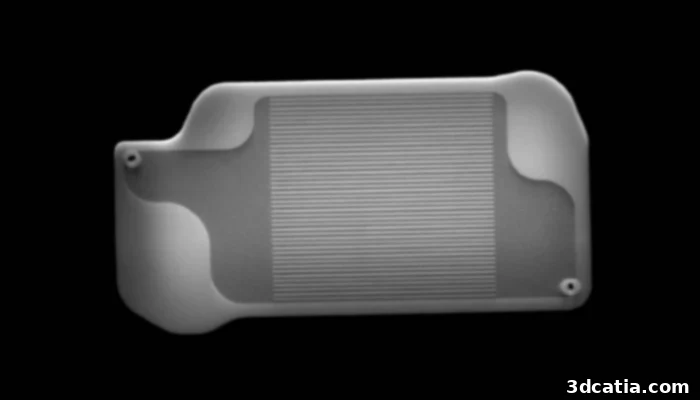
The X-ray image shows the interior of a 3D printed heat exchanger in Perseverance’s MOXIE instrument. X-ray images like these are used to check for defects within parts. (Image credits: NASA/JPL-Caltech)
The successful deployment of sophisticated metal 3D printed parts on NASA’s Perseverance rover marks a monumental achievement in space exploration and additive manufacturing. From the lightweight, high-precision titanium components in PIXL to the heat-resistant nickel superalloys in MOXIE, 3D printing is enabling scientific instruments and future-proofing technologies that would be impossible with traditional fabrication. This mission not only seeks to unravel the mysteries of Mars’s past but also actively shapes the future of human presence in space. The increasing reliance on additive manufacturing, moving from a single ceramic part on Curiosity to eleven critical metal components on Perseverance, clearly demonstrates a growing confidence in the robustness and reliability of this technology for the most demanding applications in the cosmos. It truly “opens the door” for even more complex, primary structures to be 3D printed for future spacecraft, pushing the boundaries of design freedom, performance, and mission capability.
What are your thoughts on the groundbreaking integration of metal 3D printed parts into the Perseverance rover’s mission to Mars? We invite you to share your insights and comments below, or engage with us on our Facebook and Twitter pages. Don’t miss out on the latest advancements and news in the world of 3D printing; sign up for our free weekly Newsletter and have all the crucial updates delivered straight to your inbox!