
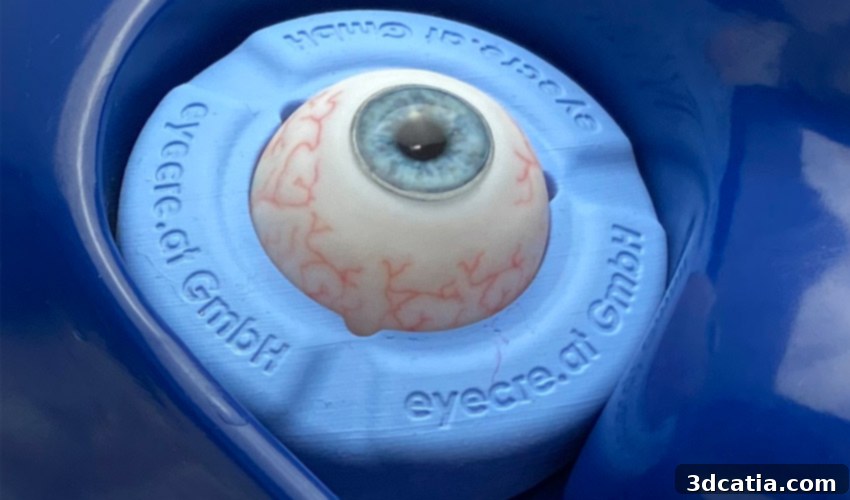
Revolutionizing Ophthalmic Surgery: Addion’s Ultra-Realistic 3D Printed Eye Models for Advanced Training
The field of medical training, particularly for intricate surgical procedures, constantly seeks innovative methods to enhance preparedness and improve patient outcomes. In this quest, Stratasys PolyJet technology has emerged as a transformative solution, enabling the creation of incredibly lifelike anatomical models. Austrian 3D printing service, Addion GmbH, a specialist in medical device production, is at the forefront of this innovation. By leveraging Stratasys’ advanced PolyJet capabilities, Addion is designing ultra-realistic 3D printed surgical eye models, fundamentally changing how surgeons prepare for critical ophthalmic operations. This multi-material, multi-color additive manufacturing process allows Addion to achieve an unprecedented level of realism, offering a significant and invaluable benefit for training in complex surgeries.
Ophthalmology, the study of eye diseases and surgery, presents unique challenges in creating effective training models. The human eye is an extraordinarily complex and delicate organ, characterized by a unique combination of soft, watery tissues, transparent structures, and intricate nerve networks. Traditionally, replicating these characteristics in surgical training models has been notoriously difficult. Many conventional models often lack the necessary realism, especially concerning haptic feedback (touch sensation), accurate color representation, and crucial transparency needed for simulating procedures on the cornea and lens. These limitations can hinder a surgeon’s ability to develop the precise motor skills and tactile sensitivity required for ophthalmic surgery. The traditional methods for creating such detailed models are often time-consuming, expensive, and frequently fail to capture the full physiological complexity. While additive manufacturing has shown promise in creating custom surgical models, not all technologies can meet the diverse requirements, particularly regarding material variety, varying levels of transparency, and accurate color matching. This is precisely where material jetting, especially Stratasys’ PolyJet technology, becomes indispensable. Its ability to combine multiple photopolymers and colors allows for the creation of ultra-realistic parts that truly mimic the intricate structure and feel of biological tissues.
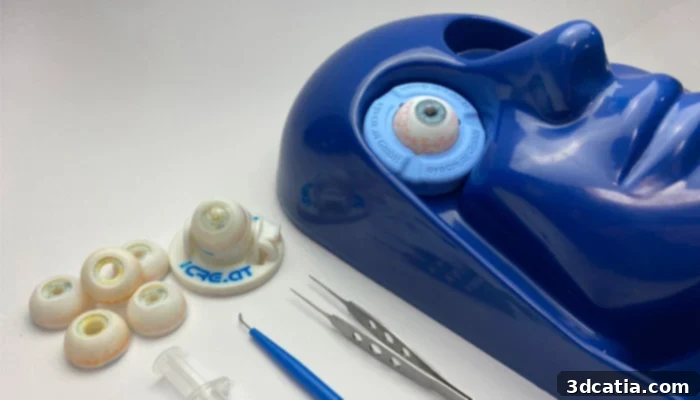
Photo Credits: Addion/Stratasys
Addion Pioneers Custom 3D Printed Eye Models with Unprecedented Realism
Addion GmbH has embraced the advanced capabilities of Stratasys’ Digital Anatomy Printer, a cutting-edge solution specifically engineered for the medical sector to precisely reproduce the biomechanical behavior of human tissue. This innovative machine enables Addion to overcome the long-standing challenges of creating realistic ophthalmic models. By utilizing specialized materials such as TissueMatrix™ and GelMatrix™, the company can expertly mimic the soft, watery, and delicate appearance of the human eye, achieving an unparalleled level of anatomical realism. This capability extends beyond mere aesthetics, providing critical tactile feedback essential for surgical training.
Alexander Hechenberger, CEO of Addion, elaborates on the remarkable precision achieved: “The skin layer on the model is one-tenth of a millimeter and is detached with very small, fine instruments, implanted, and then reattached. This level of detail was previously unimaginable.” This micro-level accuracy is crucial for simulating the delicate maneuvers required in actual eye surgery. For instance, Addion’s technology enables the production of surgical models where the cornea can be easily removed and reattached. This allows doctors to meticulously simulate complex operations, better prepare for potential complications, and fundamentally enhance their understanding of the eye’s intricate mechanics. Such realistic simulation significantly reduces the learning curve associated with new surgical techniques and procedures, ultimately leading to improved patient safety and outcomes.
The implications of this technology extend far beyond current applications, as Alexander Hechenberger further emphasizes: “For us, the possibilities with the Digital Anatomy Printer are endless, and despite the incredible results we’ve enjoyed to date, we are still just scratching the surface in terms of the technology’s potential. There are hardly any comparable alternatives for eye model production in our industry, particularly in the complex recreation of soft tissue with realistic colors and the variety of materials.” This statement underscores the revolutionary nature of the Digital Anatomy Printer and Addion’s expertise in leveraging its capabilities. The ability to simulate the diverse material properties, colors, and textures of the human eye in such a precise manner is unparalleled. Traditional training methods, such as cadaveric dissection, while valuable, often present limitations in availability, consistency, and the ethical considerations involved. Animal models also have physiological differences that limit their utility for human-specific training. The Digital Anatomy Printer offers a consistent, repeatable, and customizable platform for surgical education.
Addion’s vision for the future of medical modeling is expansive. The Austrian company already has concrete plans to test and integrate other advanced materials from Stratasys’ portfolio. This includes exploring the potential of BoneMatrix™ for the creation of intricate bone structures, which could revolutionize orthopedic and maxillofacial surgical training. Furthermore, they plan to utilize TissueMatrix for the development of highly realistic vascular structures, enabling surgeons to practice delicate procedures involving blood vessels, such as microsurgery or aneurysm repair. These future developments highlight a broader trend towards creating comprehensive, multi-organ, and multi-system anatomical models for diverse medical training needs. Such advancements promise to elevate medical education and surgical preparedness across numerous specialties, ensuring that practitioners are equipped with the highest level of skill before operating on live patients. This continuous innovation positions Addion and Stratasys at the forefront of medical simulation technology, paving the way for a new era in healthcare training. More details on these groundbreaking developments can be found in the official press release HERE.

Using additive manufacturing, doctors can better understand the structure of the eye (photo credit: Addion/Stratasys)
The advent of these ultra-realistic 3D printed eye models marks a significant leap forward in medical simulation and surgical education. They not only provide an invaluable tool for surgeons to hone their skills in a risk-free environment but also contribute to a deeper understanding of human anatomy for medical students. By mimicking the exact feel and appearance of biological tissues, these models bridge the gap between theoretical knowledge and practical application. This innovation ensures that when surgeons enter the operating room, they are not only knowledgeable but also supremely confident and skilled, ultimately leading to safer and more effective patient care. The collaboration between Addion and Stratasys exemplifies how advanced 3D printing technologies are transforming the landscape of medical training, pushing the boundaries of what is possible in preparing healthcare professionals for the most challenging procedures.
What are your thoughts on these groundbreaking ultra-realistic 3D printed eye models and their potential impact on surgical training? We invite you to share your insights and comments below, or engage with us on our Facebook and Twitter pages. Don’t miss out on the latest advancements and news in the world of additive manufacturing – be sure to sign up for our free weekly newsletter, delivering all the essential updates in 3D printing directly to your inbox!