
Exploring the Cutting Edge: Top 5 Additive Manufacturing Innovations This Week
Hello esteemed readers and welcome to our weekly showcase of the most compelling and educational 3D printing videos! In the rapidly evolving world of additive manufacturing, staying informed about the latest breakthroughs, research, and applications is crucial. This week, we’ve curated an exceptional selection of video content that promises to enlighten and inspire. Our journey takes us from groundbreaking industrial processes like cold spray technology, through insightful interviews with leading academics on the role of 3D printing in research, to specific regional advancements—highlighting Singapore’s innovative adoption of additive manufacturing in healthcare. We also bring you an exclusive 3Dnatives lab review of the much-anticipated UltiMaker S7, offering an in-depth look at its capabilities. Each video provides a unique window into the diverse and impactful ways 3D printing is shaping our future, from enhancing manufacturing efficiencies to revolutionizing medical treatments and even contributing to ecological conservation efforts. Join us as we explore these fascinating developments and uncover the potential of additive manufacturing.
Top 1: Additive Manufacturing Using Cold Spray Technology
Our first pick this week introduces a fascinating and highly effective method for metal additive manufacturing: cold spray technology. This video, presented by the University of Technology of Belfort-Montbéliard (UTBM), a renowned engineering school in France, delves into their pioneering work in this field. Cold spray additive manufacturing is a unique technique that utilizes metal powder particles to form a robust coating or part. Unlike conventional thermal spraying or fusion-based 3D printing methods that involve melting materials, cold spray relies on ‘ballistic impingement.’ This process involves accelerating metal powder particles to extremely high velocities, causing them to impact a substrate with such force that they plastically deform and adhere to the surface without melting. This solid-state bonding process eliminates many of the heat-related issues commonly associated with other metal 3D printing techniques.
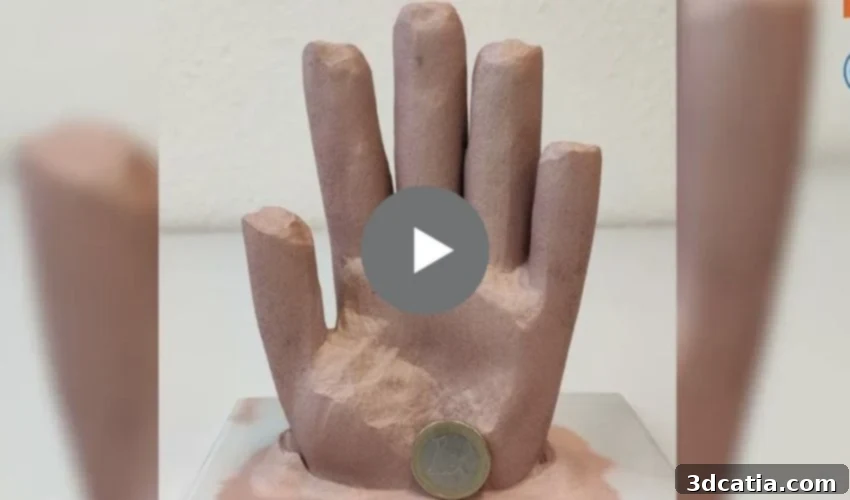
The advantages of cold spray technology are numerous and significant. It enables the production of incredibly strong, dense metal parts, exemplified in the video by a detailed model of a human hand. Moreover, it boasts faster build rates compared to many other additive manufacturing processes, significantly reducing production times. The technology also requires minimal surface preparation, streamlining the manufacturing workflow. Crucially, because heat is not involved in the bonding process, common problems such as thermal distortion, residual stresses, and changes in material microstructure are largely mitigated. This preserves the original properties of the materials, leading to superior performance and integrity of the final product. Furthermore, cold spray proves invaluable for part repair and restoration, as new material can be added to existing components without compromising their heat-sensitive properties. This makes it an ideal solution for extending the lifespan of critical components in various industries, from aerospace to automotive and defense, opening up new possibilities for maintenance, repair, and overhaul (MRO) operations.
Top 2: How Singapore Uses 3D Printing In Healthcare
Next on our list is an compelling video that shines a spotlight on Singapore’s progressive adoption of 3D printing within its healthcare sector. This feature provides fascinating country-specific examples, illustrating how this advanced technology is revolutionizing patient care and medical innovation. One notable case highlighted is from as early as 2003, detailing how Professor Chua Chee Kai successfully treated a patient suffering from nose cancer. By utilizing a precisely 3D-printed surgical model, Professor Chua was able to plan and execute a complex surgical procedure with unprecedented accuracy, leading to improved patient outcomes. This early adoption underscores Singapore’s foresight and commitment to integrating cutting-edge technologies into its medical practices.
Beyond individual patient stories, the video also introduces us to the ambitious vision behind the Singapore Centre for 3D Printing (SC3DP). This state-of-the-art research facility aims to position itself as the world’s leading institute for 3D printing research and technologies, particularly within the medical field. The SC3DP is a hub of innovation, focusing on developing new materials, processes, and applications for 3D printing that can directly benefit healthcare. Their work spans personalized implants, advanced prosthetics, and even bioprinting research, pushing the boundaries of what is medically possible. It is abundantly clear that Singapore recognizes the immense potential of 3D printing to significantly strengthen its manufacturing and engineering capabilities, especially in the medical device and pharmaceutical industries. The nation is actively working to establish itself as a formidable global player in this advanced manufacturing landscape, investing heavily in research, infrastructure, and talent development. For those eager to delve deeper into the specific strategies and successes of Singapore’s strategic embrace of 3D printing in healthcare, the video below offers a comprehensive and inspiring overview.
Top 3: What Did 3Dnatives Think of the UltiMaker S7?
At 3Dnatives, our commitment extends beyond merely providing the latest research and news; we firmly believe in the value of hands-on testing and unbiased reviews of new 3D printers, scanners, and other innovative products for our audience. This week, we bring you exactly that with our comprehensive review of the UltiMaker S7. This particular printer holds significant importance as it marks the first major release from the company following the impactful merger between Ultimaker and MakerBot, two giants in the desktop 3D printing industry. The UltiMaker S7 represents a substantial advancement over previous FDM printers in its lineage, promising enhanced performance and user experience.
Our expert reviewer, Elliot, put the UltiMaker S7 through a rigorous testing process, meticulously evaluating its every aspect. He scrutinized the printer for its new and improved features, assessing everything from its user-friendliness and intuitive interface to its overall print quality, precision, and reliability across various materials. The review delves into critical elements such as the build volume, temperature control, compatibility with different filaments, and the ease of maintenance. Understanding that a printer’s real-world performance is paramount, Elliot also provided his candid overall impression of the product, weighing its strengths against any potential drawbacks. For anyone considering an upgrade or new investment in an FDM printer, this detailed review offers invaluable insights. You’ll find all the specifics, including test results and Elliot’s final verdict, in the video embedded below. For a deeper dive into his written analysis, his comprehensive article on the printer is also available here, providing even more technical details and observations.
Top 4: A Scientist’s Perspective On 3D Printing for Biological Research
Interviews serve as an invaluable method for gaining deep, accessible, and engaging insights into complex topics, especially within the realms of manufacturing and science – and this video perfectly exemplifies that! In this captivating clip, we hear directly from Quinton Smith, a distinguished researcher at the University of California Irvine (UCI). Dr. Smith shares fascinating details about several of his groundbreaking research projects, particularly focusing on the innovative use of 3D printing in biological applications. His work includes pioneering techniques for assembling tissues necessary for organ growth, offering hope for patients suffering from severe conditions like liver diseases. The potential to grow functional human tissues and organs outside the body represents a monumental leap in medical science.
The discussion naturally leads to bioprinting, undoubtedly one of the most exciting and transformative applications of 3D printing. Dr. Smith elaborates on how bioprinting leverages advanced additive manufacturing techniques to precisely deposit biological materials, layer by layer, to create functional living tissues and organs. This revolutionary field holds immense promise, with the potential to fundamentally change how we approach organ failure and disease treatment. Imagine a future where personalized organs can be printed on demand, completely eliminating the long waiting lists and immunological rejection risks associated with traditional organ transplants. Furthermore, bioprinting is not only limited to organ creation; it is also being explored for drug testing platforms, allowing for more accurate and ethical screening of pharmaceuticals, and for developing new regenerative therapies for various injuries and conditions. This interview provides a unique glimpse into the cutting-edge research that is paving the way for a healthier future, showcasing the incredible synergy between 3D printing technology and biological science.
Top 5: Ceramic 3D Printing For Conservation
While we have previously explored ceramic 3D printing for its remarkable ability to produce distinctive art and design pieces, this week’s final video uncovers another incredibly impactful application: environmental conservation. This captivating feature demonstrates precisely how ceramic additive manufacturing is being harnessed to protect our planet’s fragile ecosystems. The video showcases the technology’s use in creating a series of intricate reef tiles, meticulously designed to mimic the complex structures of natural coral reefs. These artificial reefs play a crucial role in providing new habitats for marine life and supporting the regeneration of damaged ecosystems.
As we learn from the accompanying description, these specially engineered reef tiles serve a vital purpose in preventing the buildup of sediment, a major environmental concern that significantly threatens coral health and survival. Sediment accumulation can smother corals, block sunlight, and impede their ability to feed, leading to widespread reef degradation. By deploying these 3D-printed ceramic structures, conservationists can create stable environments that encourage coral larvae settlement and growth, actively mitigating the effects of sedimentation. The pieces highlighted in the video were expertly crafted using terracotta clay, a material chosen for its natural properties and durability in marine environments. Following their precise 3D printing, these ceramic structures were fired at an extremely high temperature of 1125 degrees Celsius, a process that vitrifies the clay, making the tiles incredibly strong, inert, and long-lasting underwater. This innovative application underscores the versatility of 3D printing and its profound potential to contribute to critical environmental efforts, merging advanced technology with ecological preservation to safeguard our natural heritage.
We hope you’ve enjoyed this week’s dive into the fascinating world of 3D printing, covering everything from innovative cold spray technology for robust metal parts to the crucial role of additive manufacturing in healthcare, academic research, product reviews, and even vital conservation efforts. The diversity and impact of these applications truly highlight the transformative power of 3D printing. We’re always eager to hear your thoughts, so what did you think of our top 5 videos? Let us know in a comment below or connect with us on ourLinkedIn,Facebook, andTwitter pages! To ensure you never miss out on the latest 3D printing news and insights delivered straight to your inbox, don’t forget to sign up for our free weeklyNewsletter here. You can also find all our compelling video content and more by subscribing to our dedicatedYouTube channel. Stay tuned for more innovations!