

Revolutionizing 3D Printing: NIST’s Breakthrough in Polymerization Control for Unprecedented Accuracy
The pursuit of precision and consistency in additive manufacturing, particularly within the realm of 3D printing, remains a critical challenge. Parts produced using many 3D printing techniques, especially those based on photo-polymerization, frequently exhibit deviations from their intended designs. These inaccuracies, though sometimes subtle, can render components unusable for high-stakes applications. However, a groundbreaking discovery by researchers at the National Institute of Standards and Technology (NIST) promises to transform this landscape. They have unveiled a novel method for precisely measuring and controlling photo-polymerization-based 3D printing processes, paving the way for the production of significantly more accurate and uniform parts. This innovative approach centers on enhancing control over two fundamental aspects: polymerization and diffusion, which are crucial to the material’s transformation from liquid resin to solid object. The implications of this research are vast, particularly for sectors where uncompromising accuracy is paramount, such as the medical sector. Here, the integrity of personalized prosthetics, intricate surgical guides, and bespoke dental materials directly impacts patient outcomes and quality of life. Beyond improved precision, the NIST method also offers a substantial economic advantage, enabling the cost-effective development and testing of new resin formulations by requiring only a few microliters of material per test, dramatically reducing waste and research expenses.
Understanding the intricacies of photo-polymerization is key to appreciating NIST’s breakthrough. Photo-polymerization is a foundational additive manufacturing technology where liquid resins are solidified, or “cured,” through exposure to light. Technologies like Stereolithography (SLA), Digital Light Processing (DLP), and Material Jetting (PolyJet) all fall under this umbrella. In these processes, specialized light-activated resins, often referred to as photo-polymers, contain photoinitiators that, upon absorbing light (typically ultraviolet or UV), trigger a chemical reaction. This reaction causes monomers within the resin to link together, forming long polymer chains and solidifying the material. In SLA, a laser precisely traces each layer of the part, while DLP uses a digital light projector to cure an entire layer simultaneously. The process is inherently layer-by-layer, gradually building the 3D object from the bottom up. However, despite the apparent precision of light-curing, achieving high-resolution parts that perfectly match their digital blueprints has been a persistent challenge. Factors such as light scattering, uncontrolled polymerization kinetics, and resin properties often lead to features that are slightly oversized, undersized, or distorted, compromising the mechanical integrity and functional performance of the final product. This is particularly problematic for micro-scale components or parts with extremely fine details, where even minute deviations can render them useless.
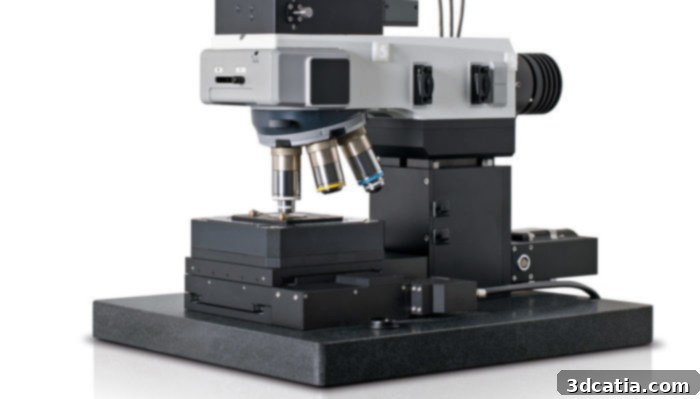
Atomic Force Microscope (AFM) by WITec (Image: WITec GmbH)
To address these fundamental limitations, the NIST research team developed a sophisticated measurement technique utilizing a custom-built atomic force microscope (AFM). This specialized AFM was equipped with a nanometer-scale, cylinder-shaped tip, offering unprecedented insight into the curing process. Unlike conventional methods that might only provide macroscopic observations or post-curing analysis, this AFM allowed researchers to directly observe and quantify the complex transformation of liquid resins into solid polymers as they reacted under controlled light exposure. The ingenious aspect of their setup involved surrounding a vibrating cylindrical AFM probe with a constant flow of liquid resin. As the resin undergoes polymerization, its properties, particularly its viscosity, change dramatically. The probe’s vibrations are highly sensitive to these changes; specifically, the vibrations are measurable and their reduction is directly proportional to the length of the cylinder and the viscosity of the surrounding liquid resin. By meticulously measuring how the probe’s vibrations altered as the resin became less viscous during polymerization, the NIST researchers were able to precisely determine the polymer’s evolution both in space (where it was forming) and in time (how quickly it was forming). This real-time, nanoscale measurement of critical parameters like viscosity, diffusion, and conversion rate provided a window into the polymerization kinetics that was previously unavailable, offering crucial data for understanding and ultimately controlling the 3D printing process at its most fundamental level.
The detailed observations made possible by the custom AFM led to several critical insights. Perhaps most notably, the researchers discovered that achieving superior part accuracy necessitates precise control not only over the amount of light energy delivered to the resin but also over the extent to which the nascent polymer diffuses during curing. Diffusion, in this context, refers to the movement of uncured resin molecules into the partially cured regions, which can lead to blurring of features and dimensional inaccuracies. To investigate this further, the NIST team augmented their AFM with a light modulator capable of directing patterned light from an LED source directly onto the resin sample. This setup allowed them to systematically examine the impact of the light pattern’s size on the polymerization process. Their findings were revealing: they observed that wider light features resulted in a higher conversion rate for a given light intensity and duration. This suggests an optimal light geometry for efficient curing. More significantly, their observations challenged a long-held assumption in the field. It was commonly believed that only the total optical energy applied controlled the extent of polymer diffusion. However, the NIST study demonstrated that the *overall light exposure* – encompassing duration, intensity, and pattern – is the dominant factor dictating how far the polymer diffuses during 3D printing. This distinction is crucial because simply increasing light intensity, while it might seem like a straightforward way to speed up curing or ensure complete solidification, actually carries a significant risk: it can lead to excessive polymer diffusion, resulting in the distortion of the final part’s shape. This means that features can “bleed” beyond their intended boundaries, leading to loss of detail, dimensional inaccuracies, and ultimately, a part that fails to meet specifications. This finding underscores the importance of a nuanced approach to light control, moving beyond simple energy budgets to consider the dynamic interplay of light parameters and material response.

Colorized plot of measurements from the AFM probe of the light-assisted curing of a polymer over five seconds. Darker colors indicate a higher level of conversion. The magenta block represents the light source. (Credit: NIST)
Armed with these unprecedented insights into the fundamental mechanisms of photo-polymerization, the NIST research team proceeded to develop sophisticated models. Utilizing computational fluid dynamics (CFD), a powerful tool for simulating complex fluid flows and related phenomena, they were able to model the rate of conversion for various exposure conditions and levels of material motion. This computational model is a game-changer for the additive manufacturing industry. It provides a robust framework that can be directly applied to optimize stereolithography and other photo-polymerization processes. Manufacturers can now leverage this model to precisely determine the most appropriate levels of light intensity, light exposure duration, and pattern size, tailored to specific parameters relating to desired part quality and production time. For instance, if a manufacturer requires extremely fine features, the model can predict the optimal low-intensity, short-duration light exposure to prevent over-curing and diffusion. Conversely, for parts requiring higher mechanical strength in certain areas, the model can guide adjustments to ensure complete and robust polymerization. This predictive capability significantly reduces the need for extensive trial-and-error experimentation, which is traditionally time-consuming and expensive. The ability to simulate and predict material behavior under different printing conditions accelerates the development cycle for new resins and printing processes, making high-precision additive manufacturing more accessible and efficient. This advancement pushes the boundaries of what is achievable with current 3D printing technologies, fostering innovation across industries from medical devices to aerospace components where performance and reliability are non-negotiable. You can delve into the comprehensive details of their pioneering findings by accessing the full research paper HERE.
The NIST research represents a significant leap forward in the quest for precision in additive manufacturing. By providing a deeper, nanoscale understanding of photo-polymerization kinetics and the critical roles of light exposure and polymer diffusion, this work offers a clear pathway to overcome long-standing challenges in 3D printing accuracy. The development of a real-time measurement technique using a customized AFM, coupled with advanced computational modeling, empowers manufacturers with the tools needed to refine their processes, develop superior materials, and produce parts with unparalleled fidelity to their digital designs. This will undoubtedly drive innovation, particularly in sensitive applications like personalized medical implants and high-performance engineering components, where the reliability and integrity of 3D printed parts are paramount. As additive manufacturing continues to evolve, foundational research like that conducted by NIST will be instrumental in unlocking its full potential, transforming what is possible in design, production, and functionality across countless industries.
What do you think of our explanation of NIST’s groundbreaking research and its potential impact on the future of 3D printing? We encourage you to share your thoughts and insights by leaving a comment below or by engaging with us on our Facebook and Twitter pages! For all the latest news, trends, and innovations in the dynamic world of 3D printing, don’t forget to sign up for our free weekly Newsletter, delivered straight to your inbox.