

Yale University’s Ceremonial Mace: A Masterpiece Forged by Incus Metal 3D Printing and Traditional Craftsmanship
In a remarkable demonstration of how historical artistry can seamlessly merge with cutting-edge technology, Incus GmbH, a leader in metal additive manufacturing, has collaborated with acclaimed engineer and artist Jacob Eldred to craft a unique ceremonial mace for Yale University. This project stands as a powerful symbol of modern engineering innovation, meticulously blending time-honored techniques with the revolutionary capabilities of metal 3D printing. As Incus proudly announced, their advanced metal 3D printing process was instrumental in realizing the mace’s intricate design, which is intended to reflect the rich historical development and future trajectory of engineering itself. The mace’s form, surface texture, and material composition are a testament to this ambitious vision, integrating traditional processes alongside advanced methodologies like additive manufacturing.
The ceremonial mace is far more than a decorative object; it is a narrative woven through materials and processes. Its foundation begins with a robust, hand-carved wooden base, paying homage to the artisanal skills that laid the groundwork for engineering. This organic base gracefully transitions into a more complex mid-section, expertly fabricated from brass and copper, materials historically significant in industrial development. The mace culminates in a geometrically sophisticated and visually stunning top component. This upper section, crafted from a combination of aluminum and steel, required a sophisticated manufacturing approach, utilizing both precision CNC machining and advanced 3D printing technology. At the heart of this intricate cap lies the critical 316L stainless steel component, meticulously produced by Incus using their proprietary Lithography-based Metal Manufacturing (LMM) technology. This specific part is not merely an aesthetic flourish but a structural and symbolic cornerstone, demonstrating the unparalleled design freedom offered by contemporary additive manufacturing.
Incus LMM Technology: Pushing the Boundaries of Metal Additive Manufacturing

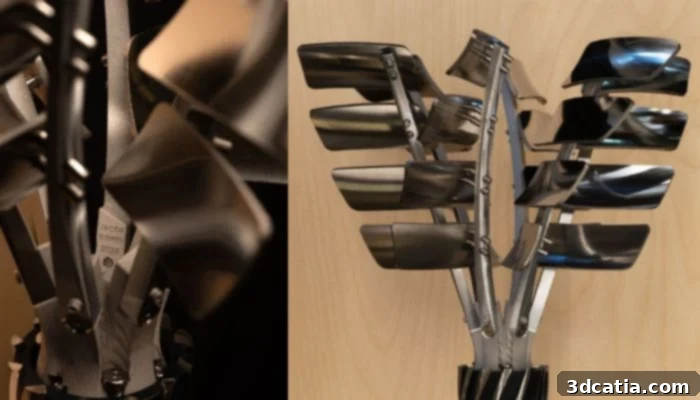
Left: Incus technology works in a similar way to stereolithography, leveraging light to cure metal-laden paste (photo credits: Incus GmbH). Right: The intricate 3D-printed part, a critical element of Yale’s mace, could not have been produced using other traditional manufacturing methods (photo credits: Jacob Eldred and Kristin Wagner)
The success of Yale University’s ceremonial mace project is largely attributable to Incus’s groundbreaking LMM technology. This innovative metal additive manufacturing process distinguishes itself by being based on stereolithography, a method renowned for its precision and fine detail. Unlike conventional laser powder bed fusion techniques, LMM operates through a unique two-stage process, significantly expanding the range of metals that can be processed. Instead of relying on metal powders directly, LMM utilizes metal particles suspended in a photopolymer resin as its raw material, which is then solidified layer by layer by light. This allows for a wider array of material options and often results in superior surface finishes and denser parts.
Incus emphasizes the exceptional consistency and flexible possibilities offered by its LMM technology. These attributes proved critically compelling for Jacob Eldred, whose artistic and engineering vision demanded a manufacturing process capable of translating highly complex designs into durable metal components. The consistency ensures repeatable quality and precision, vital for a ceremonial object of such significance. Moreover, the flexibility of LMM enabled Eldred to explore design paradigms previously impossible with traditional metalworking methods, opening new avenues for intricate geometries and complex internal structures.
Jacob Eldred’s Vision: Harmonizing Art, Engineering, and Nature
Jacob Eldred utilized the power of 3D printing not merely as a production tool but as a narrative device to highlight the profound possibilities of additive manufacturing. His aim was to visually demonstrate the extraordinary achievements attainable with Incus’s LMM technology. The Incus 3D-printed component is strategically positioned on the ceremonial mace where the main shaft symbolically transitions into individual, branching elements. This placement is not only critical for the structural integrity and balance of the mace but also central to its allegorical meaning.
The part itself is a marvel of engineering and design, captivating with its highly complex internal geometry and fluid curvatures. Such an intricate design, especially in metal, would be utterly unattainable using conventional manufacturing processes like casting, machining, or forging. The tip of the mace, crowned by this additive manufacturing masterpiece, thus symbolizes the zenith of engineering achievement from today’s perspective and offers a glimpse into the boundless potential of its future. It represents a forward-thinking approach that embraces complexity and pushes the boundaries of what is manufacturable.
Eldred’s design philosophy for the mace drew deep inspiration from nature, meticulously integrating organic forms while simultaneously respecting traditional shapes and finishes. He articulated his vision, stating: “These organic shapes were replaced by flat planes and cylinders during the Industrial Revolution due to the limitations of early machine tools. Now, with advanced automation and 3D printing, we can create elaborate curves, overhangs, and lattices. By producing these complex shapes with the Hammer Lab35 printer in my sculpture, I’m continuing the tradition of sculptors pushing technological boundaries. I’m excited to see how engineers will begin to think in these complex forms as they adopt advanced manufacturing techniques.” His words underscore the cyclical nature of innovation – how new technologies enable a return to and re-imagination of artistic forms that were once limited by industrial constraints.
A Blend of Heritage and Innovation: The Mace’s Symbolic Significance
The ceremonial mace, a collaborative effort between Incus and Jacob Eldred, beautifully combines traditional methods and cutting-edge 3D printing to create a timeless symbol (photo credits: Jacob Eldred and Kristin Wagner)
Beyond integrating historical shapes and advanced manufacturing techniques, Jacob Eldred was deeply committed to incorporating traditional materials into his ceremonial mace, creating a harmonious dialogue between past and present. As an artist who also possesses a profound understanding of engineering, Eldred articulates his fascination: “As an artist and engineer, I’m fascinated by the reappearance of natural flowing shapes in manufacturing today. In the past, craftsmen competed to create the most intricate and natural forms from wood, ivory, and silver, as seen in princely collections in Dresden and Vienna, which I was inspired by.” This statement highlights a universal aspiration among artisans throughout history – to emulate the organic perfection of nature. The mace, through its diverse material palette and manufacturing approaches, becomes a physical manifestation of this enduring pursuit, now empowered by twenty-first-century tools.
The creation of Yale University’s ceremonial mace is more than just a successful manufacturing project; it’s a profound statement about the future of engineering education and practice. It emphasizes the importance of interdisciplinary collaboration, where artistic vision informs engineering execution and technological advancement enables artistic expression. For Yale, a leading institution renowned for its contributions to science and humanities, this mace serves as a tangible symbol of its commitment to innovation, blending the esteemed traditions of academic ceremony with the dynamic progress of modern technology. It illustrates how additive manufacturing is not just about creating parts, but about forging new pathways for design, challenging existing paradigms, and inspiring the next generation of engineers to think without conventional constraints. The choice of materials—wood, brass, copper, aluminum, steel, and 3D-printed stainless steel—each represents a significant epoch in human ingenuity, culminating in a piece that is simultaneously historical, contemporary, and futuristic.
The Broader Impact of Hybrid Manufacturing and Metal 3D Printing
The Yale University mace project brilliantly showcases the potential of hybrid manufacturing, where the strengths of various techniques, both traditional and advanced, are leveraged for optimal results. While the mace itself is a unique, ceremonial artifact, the underlying principles demonstrated by Incus’s LMM technology have far-reaching implications across numerous industries. Metal 3D printing, and LMM specifically, offers unprecedented design freedom, enabling the creation of complex geometries, lightweight structures, and parts with integrated functionalities that are impossible or cost-prohibitive to produce with conventional methods. This opens doors for innovation in sectors such as aerospace for lighter, more efficient components, in medical for custom implants and surgical tools, and in automotive for optimized engine parts and tooling. The ability to rapidly prototype and customize designs also significantly reduces development cycles and allows for on-demand manufacturing, revolutionizing supply chains and product development processes globally. The mace, in this context, becomes a microcosm of a larger manufacturing revolution, demonstrating how personalized, high-performance objects can be conceived and brought to life through intelligent application of technology.
In conclusion, the collaboration between Incus GmbH and Jacob Eldred for Yale University’s ceremonial mace stands as a beacon of engineering evolution. It elegantly bridges centuries of craftsmanship with the vanguard of additive manufacturing, creating an object that is rich in symbolism and technologically advanced. This project not only celebrates Yale’s legacy but also heralds a future where the boundaries of design and production are continually expanded by innovative technologies like Incus’s LMM. It invites us to ponder the exciting possibilities when artistic vision meets engineering prowess, shaping a new era of manufacturing where complexity is embraced and innovation knows no bounds.
What do you think of the ceremonial mace made using 3D printing for Yale University? We’d love to hear your thoughts! Let us know in a comment below or join the conversation on our LinkedIn, Facebook, and Twitter pages! Don’t forget to sign up for our free weekly newsletter here for the latest 3D printing news straight to your inbox! You can also find all our videos on our YouTube channel, offering deeper dives into the world of additive manufacturing.
*Cover Photo Credits: Jacob Eldred and Kristin Wagner