
Daimler Buses Revolutionizes Spare Parts Logistics with Innovative Mobile 3D Printing Centers
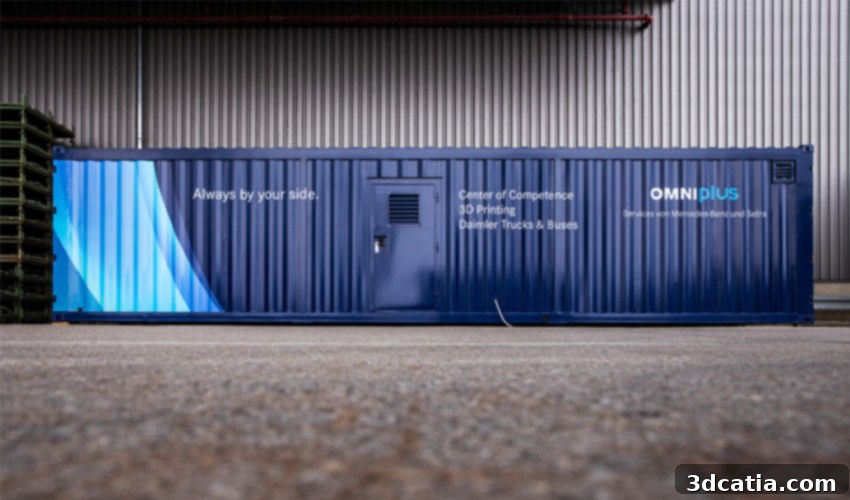
In a groundbreaking move set to redefine spare parts logistics and supply chain efficiency, the renowned German automotive manufacturer Daimler, through its dedicated subsidiary Daimler Buses, has unveiled a pioneering pilot project focused intently on the additive manufacturing of spare parts. This ambitious initiative, spearheaded by its comprehensive service brand Omniplus, introduces a highly innovative mobile container designed to function as a fully operational, on-demand 3D printing micro-factory. Measuring a compact yet highly efficient 36 square meters (approximately 387.501 square feet), this self-contained unit integrates advanced additive manufacturing solutions specifically tailored for the agile production of bus components and spare parts as they are needed. This strategic development aims to significantly reduce lead times, optimize inventory management, and enhance overall service responsiveness for Daimler Buses’ extensive global customer base. Initially, this cutting-edge manufacturing space will commence operations at BusWorld Home (BWH) in Hamburg, Germany, serving as a critical testing ground for the broader deployment of this visionary concept. The manufacturer’s ultimate objective extends beyond just localized production; it aims to substantially increase its catalog of digitized and 3D printable parts, culminating in the future offering of online 3D printing licenses. This innovative model would empower customers to purchase licenses, subsequently enabling the on-demand production of their required parts at any certified Daimler Buses additive manufacturing center, thereby democratizing access to high-quality, authentic spare parts.
Daimler’s long-standing commitment to advanced manufacturing technologies is well-documented. For several decades, the German company has been a proponent of additive manufacturing, utilizing the technology extensively in the production of prototypes for over 30 years. This rich history has provided invaluable expertise, paving the way for the current advancements that now position 3D printing as an exceptionally efficient and reliable method for creating functional spare parts for buses. The evolution of materials, machinery, and design methodologies has transformed what was once a prototyping tool into a robust solution for end-use production. At present, Daimler Buses proudly reports a significant milestone, having successfully 3D printed more than 40,000 spare parts. This impressive figure underscores the technology’s readiness and the company’s capability in leveraging it for practical applications. Furthermore, the dedication to expanding this digital inventory continues unabated, with the company actively working on digitizing and validating approximately 7,000 additional models. This continuous effort is rapidly building an incredibly comprehensive library of 3D files, promising an unprecedented range of parts available for on-demand production. By conceptualizing and developing these mobile micro-factories, Daimler Buses is not merely adopting additive manufacturing; it is strategically expanding its utility. This expansion aims to deliver a manufacturing solution that is not only faster and more localized but also significantly more environmentally responsible, aligning with global trends towards sustainable industrial practices.
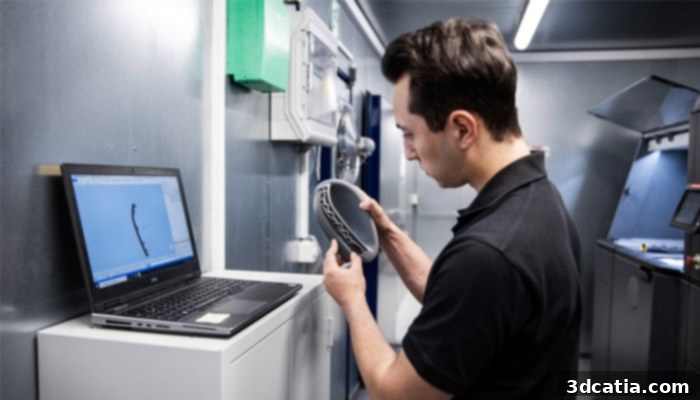
Thanks to additive manufacturing, Daimler Buses can store numerous digital spare parts and print them on demand (photo credits: Daimler Buses)
Daimler Buses and its Revolutionary Mobile Manufacturing Units: A Deep Dive
The innovative mobile manufacturing unit designed by Daimler Buses represents a paradigm shift in decentralized production. This twelve-by-three-meter container is engineered for effortless transportability by truck, making it highly versatile and adaptable to various operational demands and geographical locations. Its self-sufficient design requires only an electricity supply and an internet connection to become fully operational, minimizing infrastructure requirements and enabling rapid deployment wherever needed. The container is intelligently partitioned into distinct, specialized units to ensure a seamless end-to-end additive manufacturing process. The primary section is equipped with an advanced HP Jet Fusion 4200 machine, a leading industrial-grade 3D printer known for its Multi Jet Fusion (MJF) technology. This cutting-edge machine is complemented by a sophisticated processing unit specifically designed to manage the delicate tasks of material handling, including the precise mixing and loading of the polymer powder used in the printing process. Crucially, this unit also facilitates the rapid cooling of printed parts, a vital step that significantly reduces post-processing time and enhances overall throughput. This integration ensures that parts can be produced quickly and efficiently, maintaining high standards of quality.
Complementing the printing capabilities, the second section of the mobile unit is meticulously equipped with comprehensive post-processing solutions. This includes a dedicated powder removal system, which is essential for cleaning newly printed parts and recycling unused powder, contributing to both efficiency and sustainability. An integrated air filter system ensures a clean operational environment by effectively managing airborne particles, while a robust air conditioning system maintains optimal temperature and humidity levels within the container. This controlled environment is paramount for consistent print quality and the longevity of the sensitive equipment. The overarching goal behind this highly integrated and modular design is to consolidate every necessary resource and capability required to design and produce high-quality components, from initial digital modeling through to final post-processing, all within a compact, mobile footprint. This end-to-end approach ensures that Daimler Buses can maintain stringent quality control and accelerate the delivery of crucial spare parts, significantly enhancing customer satisfaction and operational efficiency.
Bernd Mack, the esteemed Head of Customer Service and Parts at Daimler Buses, articulates the profound impact of this innovation, stating: “Thanks to the mobile 3D printing centre, we can exploit the advantages of 3D printing to a greater extent and further increase the speed at which we supply spare parts. Decentralised production of parts as required avoids warehousing costs and reduces transportation routes. Thus, 3D printing not only allows us to react fast, flexibly and economically to customer requirements but to also improve our ecological footprint for the production of spare parts.” Mack’s statement perfectly encapsulates the multi-faceted benefits of this strategic shift. The primary advantage lies in the dramatic acceleration of spare part availability. By moving production closer to the point of need, Daimler Buses can drastically cut down on delivery times, a critical factor in minimizing vehicle downtime and ensuring operational continuity for bus operators. Furthermore, the decentralized nature of this production model inherently eliminates the substantial costs associated with maintaining large physical warehouses and extensive inventories. This ‘just-in-time’ manufacturing approach means parts are produced only when required, leading to significant cost savings in storage, inventory management, and obsolescence. The reduction in transportation routes, a direct consequence of localized production, not only contributes to logistical efficiency but also forms a cornerstone of Daimler Buses’ commitment to environmental stewardship. By minimizing long-distance shipping, the company significantly lowers its carbon emissions, enhancing its overall ecological footprint. This blend of rapid, flexible, and economically viable responses to customer demands, coupled with a strong emphasis on sustainability, positions Daimler Buses at the forefront of modern, responsible manufacturing practices.
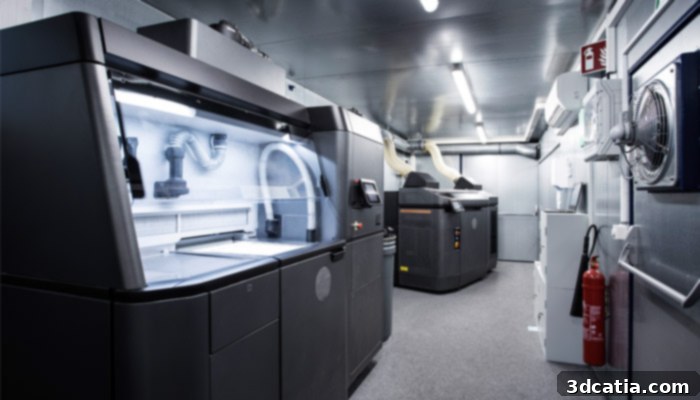
The equipment present in each unit (photo credits: Daimler Buses)
Once again, additive manufacturing emphatically demonstrates its unparalleled advantages, particularly in the realms of on-demand, local, and highly efficient production. This technology is proving to be a game-changer, enabling industries to respond with unprecedented agility to market demands and operational challenges. At the heart of Daimler Buses’ additive manufacturing strategy is its specialized “Center of Competence 3D-Printing” team. This dedicated group of experts is currently engaged in a massive undertaking: the digitization of an additional 7,000 new parts. This ambitious project aims to exponentially expand the manufacturer’s already impressive digital stock, creating a virtual warehouse of components that can be printed at a moment’s notice. The beauty of this digital inventory lies in its inherent flexibility and infinite scalability, unconstrained by physical storage limitations. Each of these meticulously prepared 3D files will not merely contain the geometric data of the part; crucially, it will also incorporate detailed printing instructions. These embedded instructions are designed to streamline the manufacturing process, ensuring consistency and further increasing the speed and efficiency with which parts can be produced. This comprehensive approach, from design to production parameters within a single digital file, minimizes human error and optimizes machine performance. By centralizing knowledge and processes, Daimler Buses is building a robust and responsive manufacturing ecosystem that leverages the full potential of additive technologies.
Looking ahead, Daimler Buses envisions a truly integrated and customer-centric ecosystem for spare parts. In the near future, customers will gain the ability to purchase 3D printing licenses directly from the ‘Omniplus On’ website, Daimler Buses’ dedicated digital portal. This innovative licensing model will empower customers to request the precise manufacture of their required part, leveraging the network of mobile manufacturing units or certified additive manufacturing centers. This objective of Daimler Buses aims to democratize the use of these mobile containers, transforming them from mere pilot projects into widely accessible, distributed production hubs. This initiative represents a significant leap towards a future where spare parts are not stored in static warehouses but exist as digital assets, ready to be materialized on demand, precisely where and when they are needed. This shift promises to enhance operational resilience, drastically reduce lead times, and offer an unprecedented level of customization and responsiveness to customer needs. It’s a strategic move that not only embraces technological advancement but also reinforces Daimler Buses’ commitment to unparalleled customer service and sustainable business practices. More comprehensive details regarding this forward-thinking initiative can be found in the official press release from Daimler. This bold step by Daimler Buses illustrates a clear vision for the future of manufacturing and logistics in the automotive sector, setting a new benchmark for efficiency, sustainability, and customer engagement through the power of additive manufacturing.
* Cover photo credits: Daimler Buses
What do you think of these pioneering mobile manufacturing units and Daimler Buses’ vision for the future of spare parts? Let us know your thoughts in a comment below or connect with us on ourFacebook,Twitter andLinkedIn pages! Don’t miss out on the latest advancements in 3D printing; sign up for our free weeklyNewsletter here to get all the cutting-edge 3D printing news delivered straight to your inbox!