
nScrypt Unveils Revolutionary Metal 3D Printing Solution for High-Precision Industrial Manufacturing
nScrypt, a trailblazer in high-precision industrial micro-dispensing and direct digital manufacturing equipment, has announced a significant advancement in additive manufacturing: the development of a cutting-edge metal 3D printing solution. Headquartered in Orlando, Florida, the company is poised to redefine the production of intricate metal parts, promising unparalleled detail, repeatability, and structural integrity. This groundbreaking technology is specifically engineered to cater to the rigorous demands of critical sectors such as aerospace, defense, and medical fields, where precision, reliability, and material performance are paramount.
The advent of nScrypt’s metal 3D printing capability marks a pivotal moment, leveraging years of expertise in advanced micro-dispensing techniques. The company’s commitment to innovation is evident in its continuous pursuit of manufacturing solutions that push the boundaries of what’s possible with metal additive manufacturing. This new offering aims to address long-standing challenges in producing complex metal geometries with the consistency and quality required for high-stakes applications, ultimately enabling manufacturers to create lighter, stronger, and more functionally integrated components.
Revolutionizing Additive Manufacturing: nScrypt’s Patented High-Speed Micro Technology
The foundation of nScrypt’s advanced metal 3D printing capability lies in its patented high-speed micro additive manufacturing method, which received a patent last October. This innovative technology stands apart from conventional methods, offering a distinct approach to material deposition. Unlike many additive processes that rely on heat or laser sintering, nScrypt’s technique deposits minuscule droplets of material, typically less than one microliter in volume, building up structures layer by layer with exceptional control. This unique methodology provides several key advantages that are crucial for high-performance applications.
A significant differentiator of nScrypt’s patented technology is its remarkable versatility in material compatibility. The technique is designed to work with an extensive array of materials, from conductive inks and liquid epoxies to pastes and various viscous compounds, making it suitable for a diverse range of industrial needs. Furthermore, the absence of heat-dependent melting processes during deposition is a critical benefit. This prevents thermal stress, warping, and material degradation that can often occur in high-temperature additive manufacturing techniques, ensuring the structural integrity and optimal properties of the final printed part. This non-thermal approach also expands the range of printable materials, including those sensitive to heat, further enhancing its applicability across different sectors.
Ken Church, CEO of nScrypt, eloquently highlighted the pressing industry need that their technology addresses: “There is a real need for a high-speed 3D printing method that can produce patterns on flat or conformal surfaces and to build 3D structures with multiple materials in multiple layers, some which may be conductive.” This statement perfectly encapsulates the core strengths of nScrypt’s solution. The ability to print onto a wide range of shaped, or “conformal,” surfaces opens up possibilities for integrating functionalities directly onto existing components or non-flat substrates, which is a game-changer for electronics, sensors, and structural applications. Moreover, the multi-material and multi-layer printing capabilities, especially with conductive materials, enable the creation of highly functional parts with integrated circuitry or varied material properties within a single print cycle, significantly streamlining manufacturing processes and fostering innovation in product design.
The SmartPump: Driving Material Versatility and Precision
At the heart of nScrypt’s patented micro additive manufacturing technology is its proprietary SmartPump syringe-based dispenser. This revolutionary component is the engine behind the system’s unparalleled material versatility and precision. The SmartPump is engineered to handle an astonishing array of over 10,000 commercially available materials, spanning an impressive spectrum of viscosities. From extremely low-viscosity liquid inks used for fine electronic traces to high-viscosity pastes, robust epoxies, and even specialized conductive materials crucial for integrated functionalities, the SmartPump adapts effortlessly.
This extensive material compatibility, coupled with its precise volumetric control, enables manufacturers to push the boundaries of design and application. The SmartPump’s ability to switch between materials without requiring extensive cleaning or separate vats, unlike processes such as Stereolithography (SLA) that often necessitate distinct material baths, facilitates truly multi-lateral and multi-material 3D printing. This means a single part can be fabricated with varying material properties – for instance, a structural component with embedded conductive pathways or an object combining rigid and flexible elements – all within the same manufacturing sequence. This capability not only simplifies complex builds but also drastically reduces overall production time and material waste, making it an incredibly efficient and powerful tool for advanced manufacturing environments.
“Factory in a Tool”: Integrated Direct Digital Manufacturing for Metal Parts
The micro additive manufacturing technology, which nScrypt refers to as micro-dispensing, is the core method employed to precisely print intricate metal parts. To bring this capability to industrial scales, nScrypt leverages its sophisticated 3Dn-DDM Series, affectionately known as the “Factory in a Tool” (FiT) platform. This preconfigured Direct Digital Manufacturing (DDM) platform represents a paradigm shift in manufacturing, integrating multiple production capabilities into a single, cohesive system, thereby eliminating the need for separate machines and numerous tool changes.
The FiT platform is a comprehensive manufacturing ecosystem, outfitted with an array of functionalities designed for complete part fabrication. Its integrated capabilities include high-precision micro-dispensing for material deposition, advanced 3D printing for complex geometries, micro-milling for surface finishing and intricate feature creation, and pick-and-place functionality for embedding components or creating hybrid structures. Beyond these core processes, the platform also offers various post-processing options, enabling a complete end-to-end manufacturing solution from raw material to finished product.
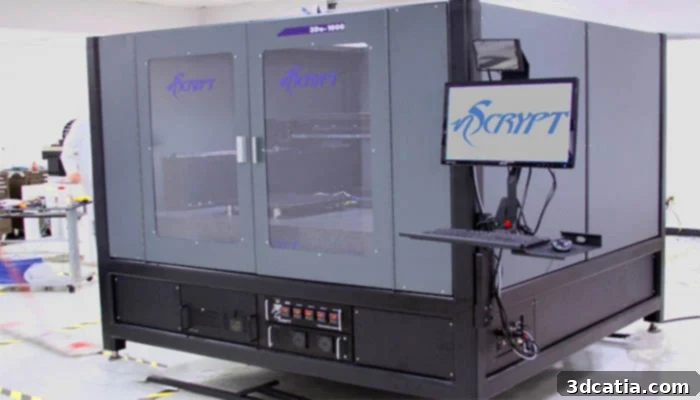
The 3Dn-1000 machine, an example of nScrypt’s Factory in a Tool platform | Photo Credits: nScrypt
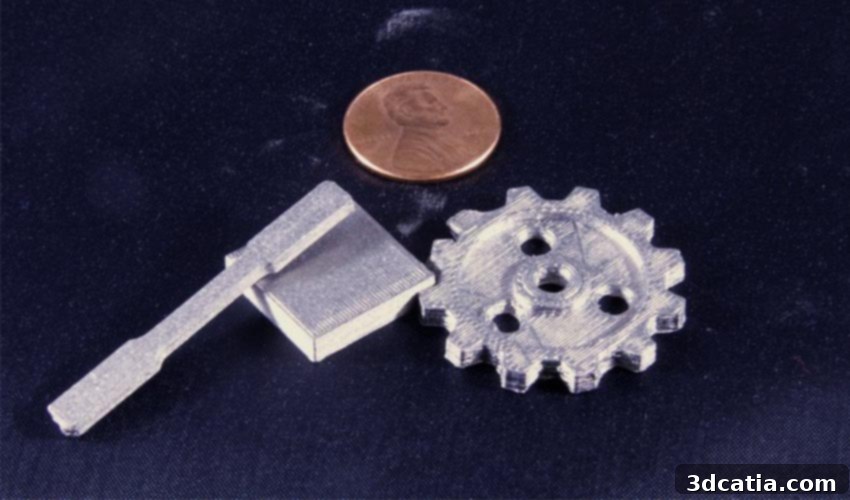
This integrated approach addresses a critical demand from industrial clients, as Ken Church explains: “Our customers want to be able to 3D print metal parts in the same machine that mills them, without tool changes, and do it without a powder bed, which is our factory in a tool. These titanium parts prove that concept.” This statement underscores the immense value proposition of the FiT platform. By consolidating multiple processes, nScrypt significantly reduces manufacturing lead times, minimizes material handling, and enhances overall precision. The elimination of a powder bed, which is common in many metal additive manufacturing systems, also simplifies post-processing, improves safety, and reduces material waste, making the FiT platform a more efficient, cleaner, and ultimately, more cost-effective solution for advanced metal part production.
Performance Validation: High-Strength Titanium Parts Rival Wrought Metal
To validate the efficacy and robustness of its metal 3D printing capabilities, nScrypt has conducted extensive initial tests on titanium parts produced using its micro additive manufacturing technology. The results have been nothing short of impressive, demonstrating the true potential of this innovative approach. The 3D printed titanium parts exhibited remarkable material properties, specifically achieving density and strength comparable to traditional wrought metal parts. This is a crucial benchmark in advanced manufacturing, as wrought metals are known for their superior mechanical properties achieved through deformation processes like forging or rolling.
Achieving wrought-metal comparable performance through additive manufacturing is a significant breakthrough. It signifies that nScrypt’s process can produce components that meet the stringent requirements of high-stress and critical applications, where material integrity and reliability are non-negotiable. For industries like aerospace, where components are subjected to extreme forces and environmental conditions, or medical, where implants must withstand physiological stresses for decades, such performance validation is paramount. These successful titanium tests not only prove the concept of nScrypt’s “Factory in a Tool” platform but also pave the way for broader adoption of its metal 3D printing solution in demanding industrial applications, offering designers and engineers new levels of freedom without compromising on performance.
Conclusion: The Future of High-Precision Metal Manufacturing
nScrypt’s foray into high-precision metal 3D printing represents a significant leap forward for industrial manufacturing. By leveraging its patented micro-dispensing technology and the versatile SmartPump system, the company is delivering a solution that offers unmatched material compatibility, multi-material printing capabilities, and the ability to fabricate parts on complex, conformal surfaces. The integrated “Factory in a Tool” platform further streamlines production, allowing for a seamless transition from printing to milling and post-processing, all within a single system and without the complexities of powder beds.
The successful validation with titanium parts, demonstrating properties on par with wrought metals, underscores the immense potential of nScrypt’s technology to meet the rigorous demands of sectors like aerospace, defense, and medical. This innovation promises to enable the creation of lighter, stronger, and more intricate metal components with greater efficiency and design freedom, ultimately empowering industries to push the boundaries of what is manufacturable. As nScrypt continues to refine and expand its metal 3D printing offerings, it is set to play a pivotal role in shaping the next generation of advanced manufacturing processes.
What are your thoughts on nScrypt’s pioneering metal 3D printing technology and its implications for the future of manufacturing? Share your insights and join the conversation by leaving a comment below, or connect with us on our Facebook and Twitter pages! For all the latest news and advancements in 3D printing, remember to sign up for our free weekly Newsletter, delivered straight to your inbox.