
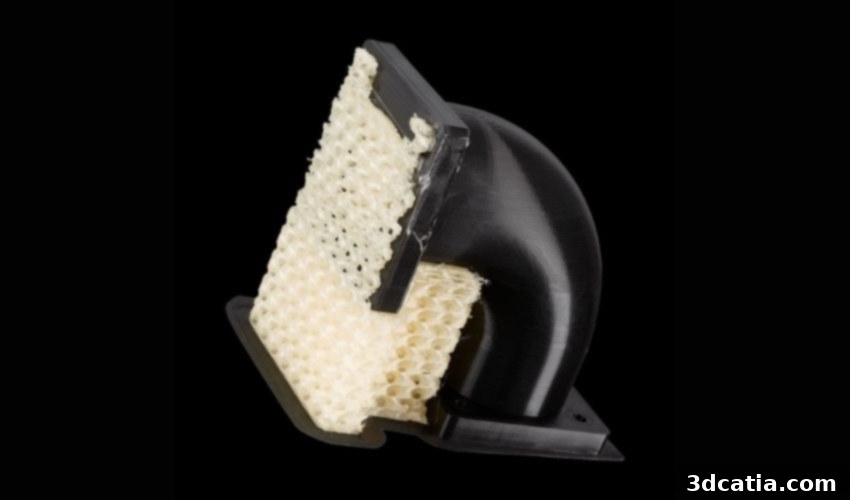
AquaSys GP: Revolutionizing 3D Printing Supports – The Next-Gen Water-Soluble Material Challenging PVA
Infinite Materials Solutions LLC (Infinite), a leading innovator in advanced materials for additive manufacturing, has officially unveiled a groundbreaking product poised to transform the landscape of 3D printing support materials. Named AquaSys General Purpose (AquaSys GP), this novel water-soluble support material has been engineered as a direct and superior competitor to the widely used industry standard, PVA (Polyvinyl Alcohol). Infinite asserts that AquaSys GP effectively addresses and overcomes many of the common frustrations associated with traditional support structures, offering significantly enhanced performance and expanded versatility for a broad spectrum of 3D printing applications.
Designed with extensive material compatibility as a core principle, AquaSys GP works seamlessly with most polyester-based filaments. This includes the incredibly popular PLA (Polylactic Acid) and PETG (Polyethylene Terephthalate Glycol), alongside other challenging materials. Infinite proudly highlights AquaSys GP’s key differentiator: its exceptional dissolution rate. When immersed in water, AquaSys GP dissolves an impressive 20% faster than conventional PVA, translating directly into more efficient post-processing and quicker turnaround times for finished 3D prints. This innovation is set to simplify workflows, boost productivity, and improve the overall user experience for everyone from hobbyists to industrial-scale professionals.
The Critical Role of Support Materials in 3D Printing
For anyone engaged in Fused Deposition Modeling (FDM) 3D printing, the necessity of support structures is a well-understood concept. These temporary, sacrificial structures are absolutely vital for the successful production of complex geometries, especially those featuring overhangs, bridges, or intricate details that would otherwise succumb to gravity during the layering process. Without adequate support, such features would inevitably collapse, deform, or fail to print accurately, leading to wasted material, invaluable time, and significant effort. Supports act as essential scaffolding, holding up unsupported sections of a print until the material solidifies, thereby ensuring the structural integrity and dimensional accuracy of the final part.
However, despite their critical role, working with support materials often introduces its own set of significant challenges. Traditional mechanical support removal can be a notoriously tedious and labor-intensive post-processing step. This method involves carefully breaking away support structures, which frequently risks damaging delicate features of the printed part, leaving unsightly marks, or necessitating extensive sanding and finishing. This process proves particularly challenging and time-consuming for users operating single-nozzle 3D printers, where the support material is often the same as the build material, making clean differentiation and removal exceptionally difficult.
Furthermore, the implementation of support structures inherently increases both material costs and the overall print duration. For single-extruder setups, meticulous optimization of support generation (e.g., minimizing contact points, utilizing tree supports) is paramount to mitigate these drawbacks. Nevertheless, for superior efficiency and unparalleled ease of use, dual extruder 3D printers offer a profound advantage. These advanced machines facilitate the use of a dedicated support material, printed from a separate nozzle, which can then be easily removed through specific methods post-print. Water-soluble support materials like PVA have long been a popular choice in this domain, providing a much simpler and significantly cleaner post-processing solution. Now, Infinite’s AquaSys GP enters the market, promising to set a new benchmark by overcoming common disadvantages associated with PVA.
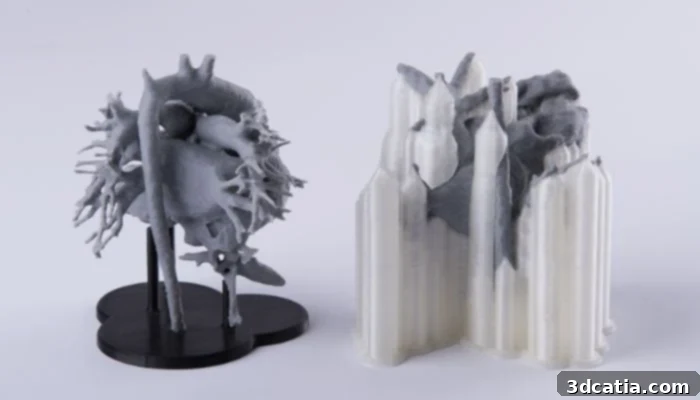
While PVA has been a popular support material, Infinite believes AquaSys GP is poised to become the new industry standard, offering superior performance and ease of use. (Photo credits: Zortrax)
AquaSys® General Purpose: A Game-Changer for 3D Printing
AquaSys GP not only builds upon the established benefits of water-soluble support materials but also strategically addresses the critical shortcomings that have plagued PVA users for years. At its core, AquaSys GP maintains the highly desirable trait of being dissolvable in water, effectively eliminating the need for abrasive mechanical removal or potentially hazardous chemical treatments. This fundamental characteristic alone ensures a cleaner, safer, and less damaging post-processing experience for delicate or intricately designed printed parts. However, Infinite has meticulously engineered AquaSys GP to go several steps further, positioning it as a truly next-generation support solution.
Rapid Dissolution for Unparalleled Efficiency
One of the most compelling and immediately noticeable advantages of AquaSys GP is its significantly accelerated dissolution rate. Infinite proudly states that AquaSys GP dissolves a remarkable 20% faster than conventional PVA when submerged in readily available room-temperature tap water. This is far more than a marginal improvement; it translates directly into substantial time savings during the crucial post-processing phase. For professional users and manufacturing facilities engaged in high-volume production, this accelerated removal time can dramatically enhance throughput and operational efficiency, thereby considerably reducing overall costs associated with labor and machine downtime. Even hobbyists will greatly appreciate the quicker gratification of seeing their finished prints without enduring lengthy waits for the support material to completely disappear.
Unprecedented Material Compatibility and Versatility
Beyond its impressive speed, AquaSys GP establishes a new benchmark for material compatibility. While PVA’s compatibility is generally confined to specific materials like PLA, AquaSys GP dramatically broadens the horizons for users. It is engineered to be compatible not only with PLA but also with materials such as PET and PETG, and a wider range of other polyesters that have historically presented significant compatibility challenges for PVA. PETG, in particular, is a favored choice for its superior strength, excellent durability, and relative ease of printing, yet its adhesion properties often made it difficult to pair with PVA supports without issues. AquaSys GP’s seamless integration with these diverse materials unlocks entirely new design possibilities and empowers users to leverage the full potential of a wider array of engineering filaments without any compromise on the ease and effectiveness of support removal.
Exceptional Resilience to Environmental Challenges: Freedom from Humidity Concerns
Perhaps one of PVA’s most widely recognized and frustrating drawbacks is its extreme hygroscopicity – its pronounced tendency to rapidly absorb moisture from the surrounding air. This characteristic necessitates very stringent storage conditions, frequently requiring specialized dry boxes or desiccants, and can lead to significant print quality degradation (e.g., bubbling, poor layer adhesion, nozzle clogging, stringing) if the material is not maintained in a perfectly dry state. Attempting to print with PVA in humid environments can quickly become a constant, losing battle, often resulting in failed prints and substantial material waste. AquaSys GP directly confronts this pervasive problem. It boasts superior resistance to humidity, allowing it to perform reliably and consistently even under challenging environmental conditions. This eliminates the persistent headache of constant moisture management, making AquaSys GP a far more user-friendly and forgiving material, particularly for those operating in less controlled environments or with less sophisticated storage solutions.
By meticulously overcoming these common pain points and limitations, AquaSys GP has been thoughtfully designed to appeal to an incredibly broad spectrum of 3D printing enthusiasts and professionals alike. From enthusiastic beginners and hobbyists seeking an easier entry into multi-material printing to seasoned engineers demanding reliable and high-performance support for their most demanding applications, AquaSys GP offers an accessible, robust, and high-performance solution. Its superior properties and inherent ease of use make it an ideal choice even for more budget-friendly dual-extruder printers, effectively democratizing advanced support removal techniques for a wider audience.
Setting a New Standard for the FDM Market
Jeff Feddersen, Senior Sales Manager at Infinite Materials Solutions, passionately highlights the company’s unwavering commitment to directly addressing critical user needs: “We’ve been listening to our customers for years and have heard their frustrations with the drawbacks of PVA materials. We’re happy to finally bring them AquaSys GP. Considering that PLA comprises a staggering 70% of all build materials used in the fused deposition modeling (FDM) market—we truly believe this is going to change everything and become the definitive standard by which all other support materials will be judged.” This powerful statement underscores the profound and transformative impact Infinite fully expects AquaSys GP to have across the entire additive manufacturing industry.
Given that PLA overwhelmingly dominates the FDM material market, the introduction of a support material that offers superior performance, significantly wider compatibility, and substantially greater ease of use – especially for PLA and other prevalent polyesters – possesses the immense potential to become a foundational cornerstone of the modern 3D printing workflow. AquaSys GP’s unparalleled ability to simplify post-processing, drastically reduce print failures attributable to support issues, and broaden the range of compatible materials means users can consistently achieve higher quality prints with considerably less hassle and enhanced reliability. This innovative material not only streamlines and optimizes the entire production process but also actively encourages greater experimentation with highly complex and intricate designs, effectively pushing the very boundaries of what is currently achievable with mainstream FDM technology.
The launch of AquaSys GP unequivocally signals a monumental step forward in making advanced 3D printing more accessible, efficient, and reliable for everyone involved. By offering a robust, exceptionally user-friendly, and high-performance alternative to PVA, Infinite Materials Solutions is definitively setting a new benchmark for dissolvable support materials. This revolutionary material has the distinct potential to become the default and preferred choice for dual-extrusion printing across the globe, simplifying the lives of countless 3D printing enthusiasts, professionals, and manufacturers, and ultimately fostering continued innovation and growth within the dynamic additive manufacturing space.
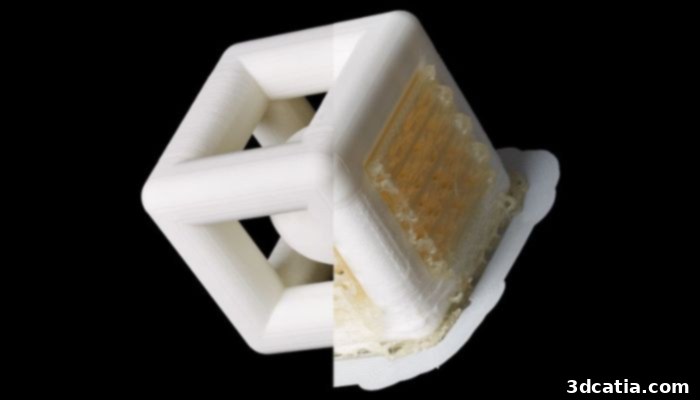
Observe the difference: A 3D printed part with AquaSys GP as a support before (right) and after (left) its complete dissolution, showcasing clean and effortless removal. (Photo credits: Infinite)
Eager to delve deeper and learn more about this revolutionary support material? You can explore further details, comprehensive specifications, and technical data directly on the Infinite Materials Solutions website by clicking HERE.
What are your initial thoughts on AquaSys GP? Do you firmly believe it possesses the transformative potential to truly replace PVA as the established industry standard for dissolvable support materials? We invite you to share your valuable opinions, insights, and experiences in a comment below, or alternatively, join the vibrant conversation on our LinkedIn, Facebook, and Twitter pages! Don’t miss out on the very latest advancements, cutting-edge news, and exciting developments in the dynamic world of 3D printing. Be sure to sign up for our completely free weekly Newsletter here to receive all the crucial updates directly in your inbox. Additionally, immerse yourself in our rich video content library by visiting our dedicated YouTube channel for compelling demonstrations, in-depth reviews, expert tutorials, and much more!