
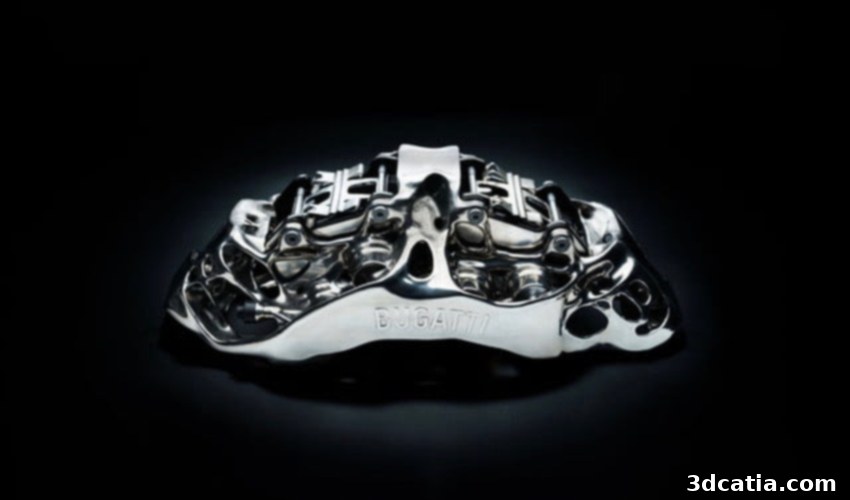
Bugatti’s Groundbreaking 3D Printed Titanium Brake Caliper: Redefining Hypercar Performance and Manufacturing
Bugatti, a name synonymous with unparalleled speed, exquisite luxury, and engineering brilliance, consistently pushes the boundaries of automotive innovation. Their vehicles are not merely cars; they are masterpieces of design and performance, where every single component is meticulously crafted to contribute to an extraordinary driving experience. In a significant leap forward, Bugatti announced a monumental achievement: the creation of the world’s first 3D printed brake caliper, crafted from robust titanium. This pioneering development showcases how cutting-edge additive manufacturing is revolutionizing the production of high-performance automotive components, promising a future where lighter, stronger, and more complex parts are the norm.
To truly appreciate the magnitude of this innovation, one must understand Bugatti’s unwavering philosophy. For a brand that produces some of the fastest and most luxurious hypercars on the planet, every gram saved and every fraction of a second gained is paramount. This relentless pursuit of marginal gains extends to every minute detail of their vehicles. Even a seemingly small component like a brake caliper undergoes rigorous engineering scrutiny. While the 3D printed titanium caliper might not drastically alter the car’s exterior, its internal composition and structural integrity represent a significant technological marvel. Bugatti proudly states that this piece is not only made from titanium but is also the largest functional component ever 3D printed from this challenging material, signifying a major breakthrough in metal additive manufacturing. As part of the expansive Volkswagen Group, this project also served as a powerful demonstration of 3D printing’s vast potential applications within the broader automotive industry.
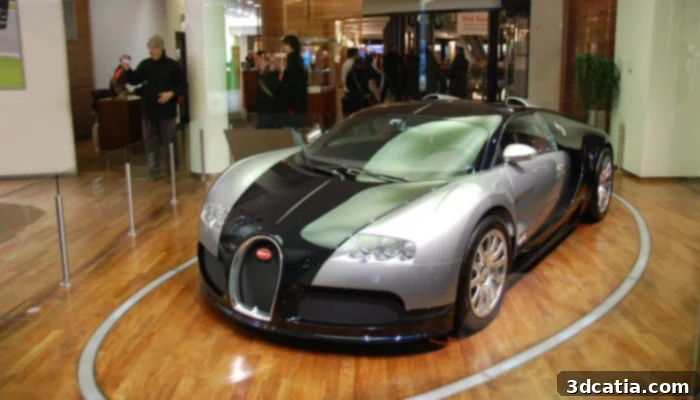
Bugatti vehicles are renowned for their incredible speed, luxurious interiors, and iconic design, establishing them as leaders in the hypercar segment.
The World’s First 3D Printed Titanium Brake Caliper: A Game Changer
Brake calipers are critical safety components in any vehicle, playing a pivotal role in the disc braking system by clamping down on a rotor attached to the wheel hubs, thereby decelerating the vehicle. Traditionally, these essential components are cast or forged from materials like aluminum, which offers a good balance of strength and weight for conventional vehicles. However, for a hypercar like a Bugatti, where extreme speeds demand exceptional braking performance and minimal unsprung mass, even aluminum has its limitations. The introduction of the prototype titanium 3D printed caliper heralded a new era, presenting profound advantages over its aluminum counterparts. Initial tests revealed that the titanium prototype was significantly stronger and, remarkably, weighed a staggering 40% less. This reduction in unsprung mass directly translates to improved handling, enhanced acceleration, and shorter braking distances – all vital attributes for a vehicle designed to break performance records.
Titanium, despite its superior strength-to-weight ratio and excellent heat resistance, has historically been a challenging material for traditional manufacturing processes like casting or machining. Its high melting point, reactivity, and tendency to gall make it expensive and difficult to work with, limiting its widespread application in complex components. This is precisely where metal 3D printing, or additive manufacturing, emerges as a transformative technology. Additive manufacturing offers unprecedented levels of design freedom, allowing for the creation of intricate internal structures, optimized geometries, and customized parts that are impossible to achieve with conventional methods. These capabilities enable engineers to design components that are not only lighter and stronger but also functionally superior. Bugatti harnessed this potential by collaborating with the German company Laser Zentrum to 3D print the titanium brake caliper.
The manufacturing process for such a sophisticated component is a testament to the precision and complexity of modern additive manufacturing. The printing of the titanium caliper took an intensive 45 hours, during which over 2,200 individual metal layers were meticulously fused together. This process, likely employing selective laser melting (SLM) or direct metal laser sintering (DMLS), builds the part layer by layer from a fine titanium powder, using high-powered lasers to melt and solidify the material according to a digital 3D model. Following the extensive printing phase, the component underwent crucial post-processing steps, including heat treatment to enhance its material properties, surface finishing, and rigorous quality control checks, ensuring it met Bugatti’s exacting standards for performance and durability. This entire process highlights the sophisticated interplay between advanced materials, digital design, and innovative manufacturing techniques.
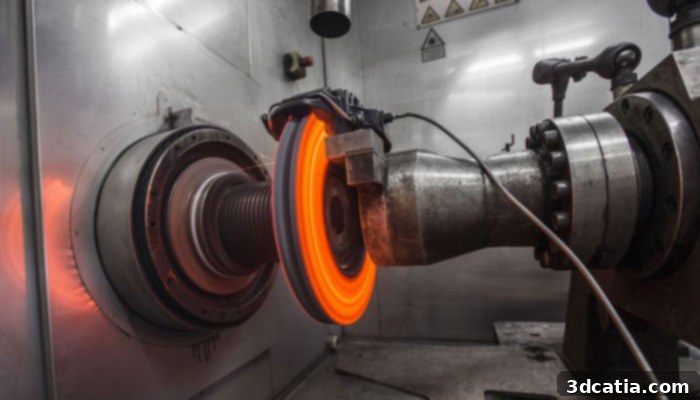
A detailed view captured during the precise 3D printing process of the titanium brake caliper, showcasing the intricate layering of metal powder.
3D Printing: Paving the Way for Future Automotive Innovation
While the initial tests of the 3D printed titanium brake caliper yielded exceptionally promising results, signaling a significant victory for additive manufacturing in the transportation sector, Bugatti’s initial announcement specified that the component was slated for testing in actual production cars in 2018. This pivotal phase marked a crucial step from prototype validation to real-world application, proving the technology’s readiness for integration into high-performance vehicles. The successful integration and performance of such a critical component would represent more than just an engineering feat for Bugatti; it would be a powerful endorsement of 3D printing’s viability and transformative potential across the entire automotive landscape. The implications of this success extend far beyond Bugatti’s exclusive hypercars.
The Volkswagen Group, Bugatti’s parent company, is a global automotive giant with a diverse portfolio of brands ranging from luxury sedans to mass-market vehicles. If the VW Group recognizes the profound effectiveness and advantages of 3D printing, particularly in creating lighter, stronger, and more efficiently designed car parts, it could pave the way for broader implementation across their other models. This isn’t just about high-performance braking; it’s about a paradigm shift in how automotive components are designed, manufactured, and supplied. Imagine the benefits: reduced manufacturing waste, the ability to produce on-demand spare parts, greater customization options for consumers, and the acceleration of research and development cycles. Additive manufacturing could enable the creation of consolidated components, replacing multiple traditionally manufactured parts with a single, complex 3D printed unit, leading to further weight savings, simplified assembly, and improved structural integrity.
The adoption of this innovative technology by a prestigious brand like Bugatti serves as a strong signal to the broader industry. It demonstrates that 3D printing is no longer confined to prototyping but is maturing into a robust method for producing high-quality, end-use parts, even for the most demanding applications. As the technology evolves, becoming faster and more cost-effective, we can anticipate a future where 3D printing plays an increasingly central role in automotive manufacturing. From specialized components for electric vehicles requiring novel thermal management solutions to lightweight chassis elements and interior parts, the possibilities are vast. This pioneering step by Bugatti is a testament to the ongoing evolution of automotive engineering, where innovation continues to redefine what is possible on the road and in the factory. We will undoubtedly witness how the widespread adoption of this transformative technology accelerates in the coming years, impacting everything from design and performance to sustainability and supply chain management.
What are your thoughts on Bugatti’s visionary adoption of 3D printing in its hypercars? How do you foresee this technology shaping the future of automotive design and manufacturing? Share your insights and join the conversation by leaving a comment below or connecting with us on our Facebook and Twitter pages! Don’t miss out on the latest advancements in 3D printing; sign up for our free weekly Newsletter to get all the cutting-edge news delivered straight to your inbox!