
The Future is Now: How 3D Printing is Shaping the Next Generation of Robots
Robotics, a dynamic and interdisciplinary field, stands at the intersection of various technologies – electronics, mechanics, computer science, and even biology – all converging to create autonomous machines capable of performing complex tasks. From the earliest conceptualizations to the sophisticated devices we see today, robotics has undergone a remarkable evolution. The iconic C-3PO from Star Wars, first gracing screens in 1973, sparked imaginations about what robots could be. Since then, roboticists have been on an unyielding quest for innovations that enhance speed, efficiency, and versatility. Today, the landscape of robotics is more advanced than ever, largely due to breakthroughs in artificial intelligence (AI), machine learning, and critically, additive manufacturing, more commonly known as 3D printing. This revolutionary technology has become an indispensable tool in the development of robots, from initial prototyping to final production, enabling engineers to reimagine structures, materials, and functionalities in ways previously impossible. The ability to rapidly iterate designs, create intricate geometries, and utilize novel materials has accelerated the pace of robotic innovation dramatically. This article delves into some of the most fascinating examples of 3D printed robots that have emerged, spanning from accessible DIY projects and sophisticated humanoids to cutting-edge research tools, offering a glimpse into the diverse applications and transformative power of additive manufacturing in the world of robotics.
Accessible DIY Robotics Projects with 3D Printing
The democratization of robotics has been significantly driven by 3D printing, allowing enthusiasts, students, and makers to bring their robotic visions to life without extensive industrial resources. These DIY projects harness the power of additive manufacturing to create affordable, customizable, and educational robotic platforms, fostering innovation from the ground up.
OpenBot: Turning Smartphones into Robots
The OpenBot Foundation is dedicated to making robotics universally accessible, embodying their motto: “Turning smartphones into robots.” Their flagship project is a small, wheeled robot designed to be controlled directly via a smartphone, leveraging its onboard processing power and sensors. This innovative approach allows users to build a sophisticated robot at home, offering a wide array of functions for exploration and learning. A significant portion of the OpenBot’s physical structure, particularly the vehicle’s body, is efficiently manufactured using FDM (Fused Deposition Modeling) 3D printing technology. This choice of additive manufacturing makes the project highly customizable and cost-effective, allowing for rapid iteration and personal modifications. Integrated sensors provide the robot with spatial awareness and safe handling capabilities, making it an excellent platform for learning about autonomous navigation and control. With various models available, priced between $100 and $400, OpenBot serves as an excellent entry point into the world of practical robotics for hobbyists and educators alike, showcasing how 3D printing can empower individuals to engage with advanced technology.
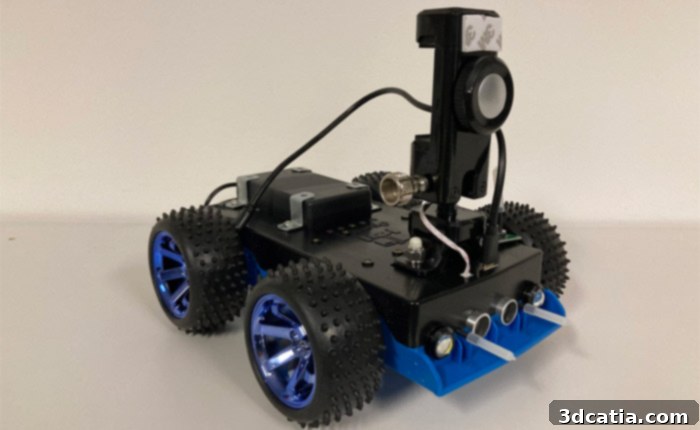
Photo Credits: OpenBot
X-KIT From AOSEED: Nurturing Creativity with 3D Printing and Coding
AOSEED’s X-KIT offers a remarkable opportunity for children and creative individuals of all ages to transform their imaginative ideas into tangible robotic creations. This comprehensive DIY project seamlessly integrates 3D design, 3D printing, and coding, providing a hands-on learning experience. The intuitive Hub anclever application simplifies the design process, allowing users to easily craft parts that can then be converted into 3D printable models. These models are compatible with virtually any 3D printer, emphasizing accessibility and broad usability. The versatility of the X-KIT is immense; whether aspiring to build intricate trucks or intelligent, interactive robots, the possibilities are limited only by one’s imagination. Furthermore, users are encouraged to modify and enhance existing models, fostering a deep understanding of design and engineering principles. The system features a modular 3D design library comprising over 650 robotic components, enabling the creation of new models through a simple drag-and-drop interface. For coding, two distinct modes cater to different levels of expertise, ensuring that both beginners and more experienced users can engage effectively. The finished robots can be controlled via the program and a dedicated console, providing immediate feedback and reinforcing learning. Currently, the Robot Creation Kit is available for $179, positioning it as an affordable and highly educational tool that leverages 3D printing to cultivate future innovators.
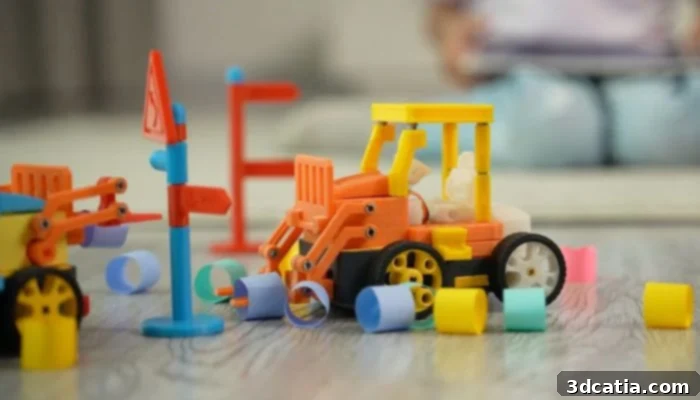
Photo Credits: AOSEED
TOPS: A 3D Printed Quadrupedal Robot Mimicking Nature
TOPS, an acronym for “Tranverser of Planar Surfaces” (or SPOT spelled backward), is an impressive 12-Degrees-of-Freedom (DOF) quadrupedal robot developed by Purdue University student Aaed Musa. This project, heavily inspired by James Bruton’s renowned openDogV3 robot, showcases the power of individual innovation combined with additive manufacturing. Taking approximately four months to build and costing around $3300, TOPS is a testament to dedicated engineering. Weighing in at 29.6 lbs (13.43 kg), a significant portion—approximately one-third or 9.98 lbs (4.53 kg)—of its mass is attributed to custom 3D printed parts. These components were fabricated using a Creality CP-01 3D printer, highlighting how accessible desktop FDM technology can be for complex robotics. Key 3D printed elements include custom Quick Disconnect Drive (QDD) actuators and a meticulously designed 9:1 planetary gearbox, crucial for the robot’s agile movements. Even the robot’s feet are 3D printed and then coated in silicone to enhance grip and mimic biological padding. TOPS was specifically engineered to emulate the natural gait of an actual dog, a challenging feat in biomechanics. The project was so successful that its creator was even able to program the robot to perform a dance routine, demonstrating both its mechanical precision and the expressive potential of biomimetic robotics. This project exemplifies how 3D printing enables students and researchers to rapidly prototype and test complex mechanical designs, making advanced robotics more achievable. Check out its incredible movements in the video below:
Otto DIY: Engaging Young Minds in Robotics and Coding
Otto DIY is much more than just a toy; it is an interactive and educational robot specifically designed to introduce children and young learners to the fundamental principles of robotics and coding in a fun and engaging way. Developed with strategic support from HP, Otto is thoughtfully offered in three distinct versions, each catering to different levels of engagement and access to technology. The HP Otto Builder kit provides users with pre-printed parts, allowing for immediate assembly and focus on the mechanics of fitting together wheels, motors, and additional tools that enable the robot to produce sounds and melodies. For those looking for a slightly more hands-on approach, the DIY Builder kit also includes 3D-printed parts, but tasks the user with assembling the electronics, providing a deeper insight into the robot’s internal workings. The most comprehensive option, the DIY Maker kit, is ideal for individuals or families who already possess a 3D printer. This kit comes with a detailed printing guide and open-source templates, empowering users to print their own parts and even customize their robot’s appearance and functionality. After the 3D printing phase, users simply install the supplied electronics and proceed to program Otto’s movements. This programming is made remarkably intuitive through a user-friendly browser application, making complex coding concepts accessible to beginners. Otto DIY not only provides an excellent introduction to the diverse world of robotics but also offers a rewarding and highly customizable experience that fosters problem-solving skills and creativity.
Cutting-Edge Humanoids: The Pinnacle of Robotic Engineering
Humanoid robots represent one of the most ambitious frontiers in robotics, aiming to mimic human form and movement. 3D printing has been instrumental in the development of these complex machines, enabling the creation of intricate internal structures, optimized components, and functional integration that would be challenging or impossible with traditional manufacturing methods.
Atlas by Boston Dynamics: Pushing the Boundaries of Agile Robotics
Boston Dynamics’ Atlas humanoid robots have captivated global attention with their astonishing agility, balance, and performance in obstacle courses. These highly advanced robots represent the forefront of bipedal locomotion and manipulation. While Atlas has already achieved remarkable feats, Boston Dynamics continues to relentlessly test the limits of what these machines can do, constantly developing new capabilities to ensure the robots can withstand and perform in extreme and unpredictable conditions. A critical factor in the rapid advancement and sophisticated design of Atlas robots has been the strategic reliance on 3D printed components. For instance, the intricate internal structure of Atlas’s legs is largely 3D printed. This additive manufacturing approach allowed engineers to seamlessly integrate hydraulic lines directly into the structural elements of the robot, reducing complexity, minimizing weight, and maximizing space efficiency. Furthermore, 3D printing has been indispensable for producing custom servo valves, which are crucial for the precise control of Atlas’s powerful hydraulic system. The ability to create complex, lightweight, and custom-fit parts through additive manufacturing has enabled Boston Dynamics to achieve the incredible performance, robustness, and humanoid agility that define Atlas, truly pushing the boundaries of what is possible in mobile robotics.
Reachy From Pollen Robotics: An Open-Source, Expressive Humanoid
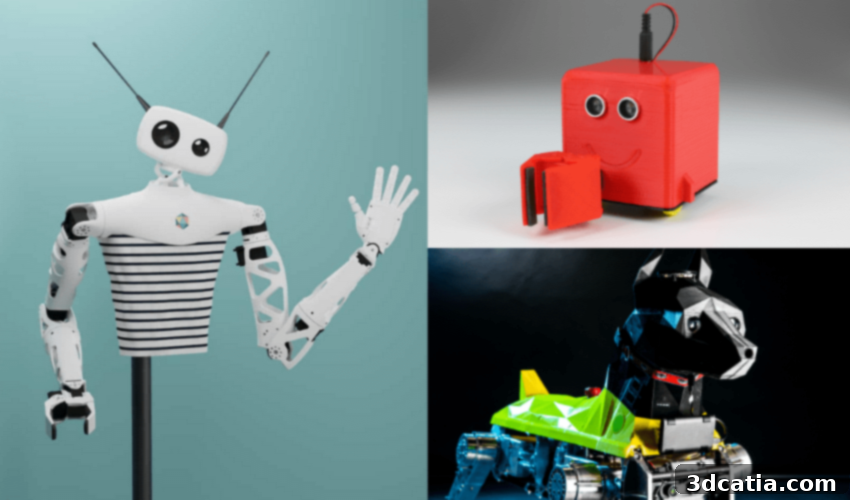
Pollen Robotics, a pioneering French company, has engineered Reachy, an open-source expressive humanoid robot that is both programmable in Python and significantly built using 3D printing technology. This versatile robot, featuring a torso, head, and articulated arms, excels in natural human-robot interaction and dexterous object manipulation. The profound innovation in Reachy’s recent development lies in its newly integrated mobile base, which bestows upon it the ability to move freely and fluidly within an environment. This mobile platform offers seamless navigation and incorporates automatic detection capabilities, enhancing Reachy’s autonomy. Equipped with three omnidirectional wheels, an array of sophisticated sensors, and LiDAR for accurate environmental mapping, Reachy can now access a much broader range of applications and operate within an extended workspace. Its head is designed for free movement, allowing it to convey engagement and attention, while its unique antennae are capable of transmitting a spectrum of emotions, enriching its interactive qualities. Moreover, Reachy’s arms are dimensioned and articulated to closely mimic those of an adult human, capable of lifting objects weighing up to 500 grams with precision. 3D printing plays a crucial role in enabling the rapid prototyping and customization of these complex mechanical parts, allowing Pollen Robotics to iterate designs quickly and integrate advanced functionalities like the mobile base and expressive features efficiently, making Reachy a leading example of accessible and adaptable humanoid robotics.
The 3D Printed Robot PIB: Empowering STEM Education at Home
The PIB, or Printable Intelligence Bot, is a groundbreaking 3D printable humanoid robot designed to be easily fabricated at home, democratizing access to advanced robotics and educational technology. Developed by the German company PIB.Rocks, this robot serves as an exceptionally versatile and customizable educational tool and platform, specifically engineered to captivate students and ignite their passion for STEM (Science, Technology, Engineering, and Mathematics) learning. PIB boasts a highly modular design, a key feature enabled by 3D printing, which allows users to effortlessly add, remove, and upgrade various components such as sensors, actuators, and controllers. This modularity facilitates a vast array of educational activities and projects, encouraging experimentation and creative problem-solving. Users can readily download upgrades and attachments directly from the company’s website, accompanied by comprehensive step-by-step guides and detailed tutorials that simplify the construction and customization process. Moreover, PIB is equipped with an intuitive graphical programming interface, ensuring accessibility for users across all proficiency levels, from absolute beginners to more experienced coders. By making complex robotics understandable and hands-on, the PIB aims to spark curiosity and creativity, transforming STEM education into an engaging and rewarding experience for young learners, all thanks to the flexibility and affordability offered by 3D printing.
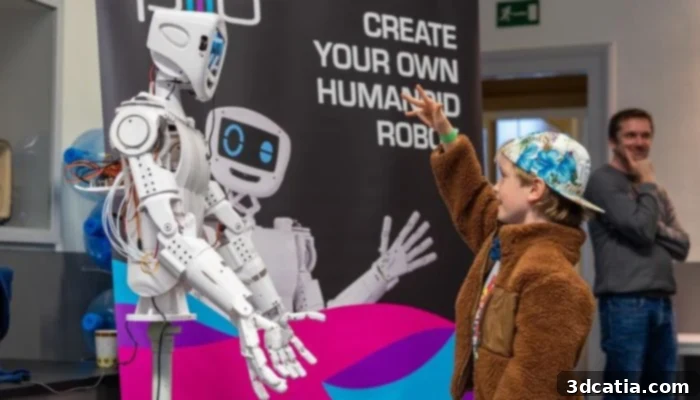
Photo Credits: Ron Hübner, NN
Advanced Research Projects: Pushing Scientific Boundaries with 3D Printed Robots
In the realm of scientific research, 3D printing has opened up unprecedented avenues for creating specialized robotic platforms. These research robots are often designed to mimic biological systems, operate at microscopic scales, or navigate challenging environments, providing invaluable tools for scientific discovery and technological advancement.
Pleurobot: An Amphibious 3D Printed Robot Mimicking a Salamander
Pleurobot is a groundbreaking 3D-printed amphibious robot meticulously designed by researchers at the Ecole Polytechnique Fédérale de Lausanne (EPFL) in Switzerland. Its unique design faithfully mimics the locomotion of a salamander, allowing it to both swim and walk. This biomimetic robot holds immense practical application and research potential across various scientific disciplines, benefiting neuroscientists, biomechanists, functional morphologists, paleontologists, and, of course, roboticists. For instance, Pleurobot is enabling pioneering research that could directly benefit quadriplegic patients. By studying the robot’s detailed movements and the underlying neurological control, researchers can gain profound insights into anatomical structures and motor skills, potentially informing new rehabilitation strategies. Furthermore, the robot facilitates studies into the evolution of locomotion, observing the transition from swimming to walking in a controlled, replicable manner. To achieve its remarkable fidelity, Swiss engineers conducted meticulous scans of a real salamander to replicate its complex nervous system using electronic components, which were then integrated into the 3D printed structure. Equipped with multiple motors and sophisticated controls, Pleurobot can authentically swim, crawl, and walk, precisely like its amphibian counterparts. The use of 3D printing was critical in achieving the precise anatomical replication and internal component integration necessary for such a complex biomimetic design, proving its value in cutting-edge biological and robotic research.
“Micro-Bristle-Bots”: Microscopic 3D Printed Robots for Collective Tasks
While the image of a robot often conjures up notions of large, complex machines, researchers at the Georgia Institute of Technology have pushed the boundaries of scale, developing microscopic 3D printed robots dubbed ‘micro-bristle-bots.’ These miniature marvels are barely discernible to the naked eye, representing a significant advancement in microrobotics. What makes them particularly innovative is their ability to be controlled by tiny vibrations, allowing for precise manipulation despite their minuscule size. Emulating the collective behavior observed in ant colonies, these microscopic robots are designed to work in teams, demonstrating the potential for coordinated material transport and other collaborative tasks at the micro-scale. To achieve the extraordinary precision required for manufacturing these ‘micro-bristle-bots,’ the Georgia Tech team utilized Nanoscribe’s Photonic Professional GT 3D printer. This specialized system employs a two-photon polymerization (TPP) process, a state-of-the-art additive manufacturing technique renowned for its ability to achieve exceptionally high levels of precision and intricate detail. This technology is ideally suited for micro-printing applications, enabling the creation of features with sub-micron resolution. The development of these micro-robots highlights the crucial role of advanced 3D printing in realizing complex designs at scales previously unimaginable, opening doors for applications in micro-assembly, targeted drug delivery, and environmental sensing.
3D Printed Soft Robots from UC San Diego Jacobs School of Engineering
At the prestigious University of California San Diego’s Jacobs School of Engineering, engineers are making significant strides in the burgeoning field of soft robotics. This area focuses on constructing robots from compliant, flexible materials, often drawing profound inspiration from the natural movements and structures of living organisms. One notable recent project involved researchers designing and rigorously testing 3D-printed insect-like robots. Utilizing readily available Fused Deposition Modeling (FDM) 3D printing technology and common filaments such as ABS or PLA, the team developed these bio-inspired robots using a novel “flexoskeleton” process. This innovative approach involved strategically adding rigid features to critical components of the otherwise flexible structures. This allowed the robots to maintain essential structural integrity and directional control while preserving their overall flexibility, closely mimicking the blend of rigid and soft tissues found in biological systems. This ingenious method enabled the creation of robots capable of complex, biologically inspired movements, demonstrating a clear advantage of additive manufacturing in achieving such intricate material integration. This insect-like robot project is just one of many cutting-edge 3D-printed soft robotics initiatives emerging from the UC San Diego Jacobs School of Engineering, with continuous advancements and more revolutionary designs anticipated in the future, showcasing the immense potential of 3D printing in creating adaptive and resilient robotic systems.
Micro-Robots From Purdue University: Tiny Navigators for Future Medicine
For several years, dedicated researchers at Purdue University in Indiana have been at the forefront of developing micro-robots with incredibly small dimensions, some no wider than a human hair. These diminutive robots exhibit impressive capabilities, including the ability to navigate through water at a speed of two millimeters per second, and crucially, they can be remotely controlled to precisely adjust their trajectory. A recent significant evolution in this research has been the development of 3D printed swimming micro-robots. Despite their deceptively simple appearance, typically featuring just a head and a tail, these micro-robots demonstrate considerable potential for revolutionary applications. Their tail, a critical component for propulsion, is ingeniously crafted from hydrogel, which acts as an efficient propeller. This hydrogel tail is fabricated using the advanced two-photon polymerization 3D printing technique. This sophisticated additive manufacturing approach enables the creation of highly intricate and functional structures at the micro-scale, allowing the micro-robot to adapt effectively to different fluidic environments while maintaining its propulsive efficiency. The long-term hope and vision for this innovative initiative is that it will continue to progress, paving the way for groundbreaking medical applications such as precise internal body navigation for diagnostics or highly targeted drug delivery, promising a future where micro-robots play a vital role in healthcare, all empowered by the precision of 3D printing.
Filobot and I-Seed: 3D Printed Robots Inspired by Nature for Exploration
The Genoa-based Italian Institute of Technology (IIT) has garnered significant recognition for its pioneering research into the application of 3D printing for designing advanced soft robots. Researchers at IIT are actively exploring the frontiers of soft robotics by harmoniously blending cutting-edge technological advancements with principles of biomimicry – drawing inspiration from the intricate designs and processes found in nature. Among their most celebrated projects is the I-Seed project, which aims to develop a new generation of miniaturized, flexible, autonomous, and remarkably biodegradable robots utilizing advanced 4D printing techniques. These robots, profoundly inspired by plant seeds, are engineered to monitor crucial environmental parameters such as temperature, soil and air humidity, and even detect various pollutants. The ability to create such complex, self-deploying, and environmentally responsive structures is a direct result of the design freedom afforded by 4D printing. Another groundbreaking project is Filobot, a unique self-generating robot whose growth mechanism is inspired by climbing plants. Equipped with a rotating head, Filobot autonomously deposits a thermoplastic filament to gradually form its own body, leveraging FDM 3D printing technology in real-time. Thanks to integrated motion sensors, Filobot can orient itself and move dynamically in response to a variety of external stimuli, including gravity, light, and shade, precisely mimicking the adaptive behavior of plants. For the researchers at IIT, these extraordinary advancements in 3D printed, nature-inspired robots hold the promise of opening up entirely new horizons for the exploration of areas that are hostile, dangerous, or otherwise difficult for humans to access, offering innovative solutions for environmental monitoring and beyond.
From accessible DIY kits that ignite curiosity in young minds to highly specialized research tools pushing the boundaries of scientific discovery, the diverse range of 3D-printed robots showcased here underscores the profound impact of additive manufacturing on the field of robotics. This technology has not only accelerated prototyping and reduced costs but has also enabled the creation of complex geometries, integrated functionalities, and novel material combinations that were once unattainable. The ability to rapidly iterate, customize, and innovate at every scale, from microscopic bristle-bots to agile humanoids, positions 3D printing as an indispensable catalyst for the future of robotics. As materials and printing processes continue to evolve, we can anticipate even more sophisticated, adaptable, and intelligent robotic systems emerging, further blurring the lines between fiction and reality. What are your thoughts on this fascinating selection of 3D-printed robots and the future they represent? We invite you to share your comments below or engage with us on our Facebook and Twitter pages. Don’t miss out on the latest advancements and insights in the additive manufacturing world; make sure to sign up for our free weekly newsletter, delivering all the crucial 3D printing news directly to your inbox!