
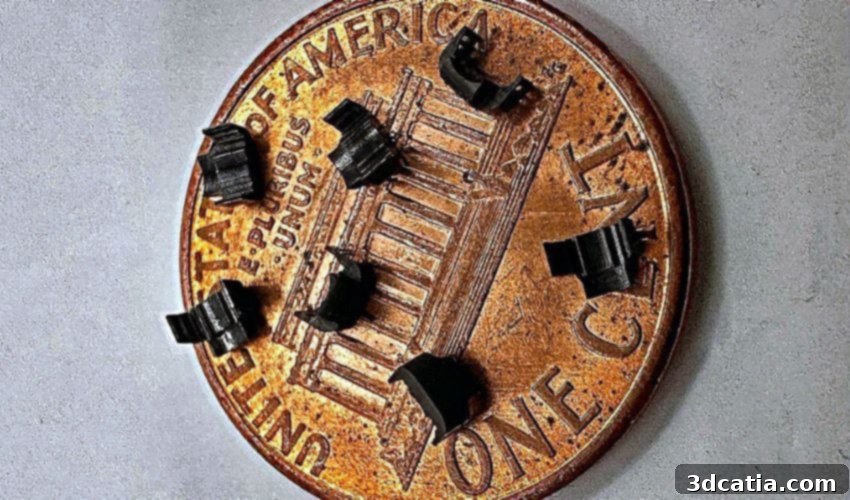
Revolutionizing Neuroscience: How Micro 3D Printing is Advancing Medical Device Manufacturing
The creation of sophisticated medical devices presents a formidable array of challenges, primarily due to their often minuscule dimensions, the necessity for hyper-precise measurements, and the intricate functionalities they must perform. These devices frequently operate in sensitive biological environments, demanding materials that are not only robust but also entirely biocompatible. Addressing these complex demands, Nano Dimension, a recognized leader in 3D printing solutions for electronics, recently embarked on a groundbreaking biomedical initiative. This ambitious project brought together Nano Dimension’s advanced technological capabilities with the expertise of three prominent research institutions across Canada and France. The central objective was to engineer a novel medical device utilizing cutting-edge micro 3D printing technology, specifically tailored for the accurate and non-invasive recording of neuronal activity in mice.
This innovative device is meticulously designed to delve into the complex neural mechanisms underpinning somatosensory processing. This includes fundamental biological functions such as the intricate perception of pain, the precise sensing of temperature variations, and the sophisticated awareness of body position. Understanding these processes is critical for advancing our knowledge of neurological disorders, developing more effective pain management strategies, and creating improved prosthetic interfaces. The manufacturing of this critical research tool was accomplished using the state-of-the-art Fabrica Micro 3D printer. This printer is uniquely engineered to meet the exceedingly precise micrometer-level specifications required for such miniature and complex medical instruments, including the device’s slender 2.7mm width. The Fabrica Micro 3D printer demonstrates exceptional precision, achieving an impressive 11µm tolerance for the embedded electrodes. This level of accuracy is a testament to its capabilities, which have already been rigorously proven in the production of highly intricate plastic components for demanding sectors like aerospace, automotive, and other specialized medical applications. Furthermore, the Fabrica Micro 3D printer offers remarkable versatility, supporting micro 3D printing not only with its proprietary range of high-performance, high-precision materials but also with a diverse selection of external resin options, providing researchers and manufacturers with unparalleled flexibility in material choice.
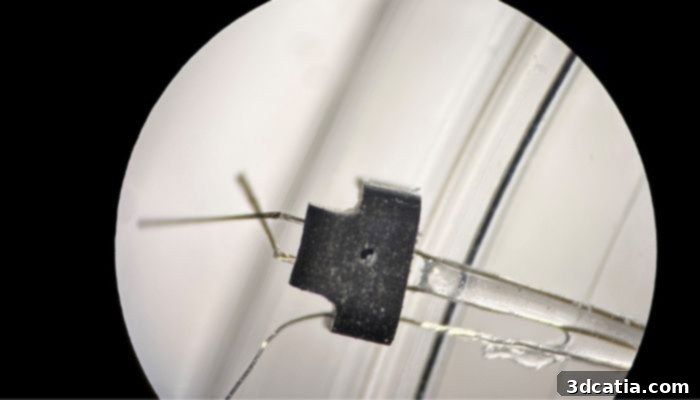
For this delicate application, the chosen material was the biocompatible Fabrica Medical M-810, specifically engineered for implantation purposes and rigorously verified as non-toxic. (Photo Credits: Nano Dimension)
The adoption of micro 3D printing technology for the fabrication of this neuronal activity device brings forth a multitude of significant advantages, fundamentally transforming the development cycle for advanced medical tools. One of the most striking benefits is the dramatically accelerated production timeline. The device, which would typically require several months to produce using conventional, subtractive manufacturing processes, was successfully fabricated within a single week through micro additive manufacturing. This rapid prototyping and production capability is invaluable in fast-paced research environments, allowing scientists to iterate designs quickly and push the boundaries of their investigations. According to Louison Brochoire from the esteemed University of Bordeaux, the transformative power of additive manufacturing lies in its ability to surmount numerous limitations inherent in traditional manufacturing paradigms. He articulated this point with conviction, stating, “The exceptional precision and ultra-high resolution offered by Nano Dimension’s micro-3D printing technology, combined with the strategic utilization of a certified biocompatible material, has empowered our team to successfully create an entirely new, indispensable tool. This innovative device is absolutely critical for us to achieve our primary research objectives in understanding complex neuronal mechanisms.” This statement underscores the synergistic power of advanced printing technology and material science in enabling breakthroughs in medical research.
Beyond the inherent manufacturing advantages, this biomedical project faced distinctive and significant experimental challenges. A notable hurdle was the scarcity of previous studies involving awake, unrestrained animals during critical examinations of neuronal activity. The natural, unpredictable movements of awake mice presented a considerable difficulty in accurately targeting and maintaining contact with specific points on their vertebrae, which is essential for precise neuronal recording. In such a demanding scenario, micro 3D printing technology emerged as an absolutely indispensable solution. It enabled the creation of a uniquely designed device that not only allowed the animals a degree of natural movement but, crucially, also ensured the stable positioning of the delicate electrodes inserted into incredibly tiny, specific holes. The Fabrica Micro 3D printer excelled in this task, consistently producing highly precise parts with exceptionally tight tolerances. It achieved an astonishing pixel size of just 4 µm and offered control over layer heights ranging from 1 to 10 µm. This unparalleled precision and resolution were not merely advantageous but absolutely crucial for the successful fabrication of such a minute and functionally critical medical device, ensuring that the electrodes remained perfectly aligned despite the animal’s natural physiological activities. This capability highlights how additive manufacturing can overcome complex biological and experimental limitations in neuroscience research.
The meticulous design and fabrication capabilities offered by Nano Dimension’s technology were pivotal to the project’s success. Louison Brochoire further emphasized the vital role of this precision, elaborating, “The ability to precisely create such incredibly small and accurate holes within the brace structure was not just beneficial but absolutely crucial for our experimental setup.” He continued to explain the profound impact of this design feature, stating, “This specific design element played a key role in minimizing artifacts—unwanted signals or disturbances—that would otherwise be caused by the animal’s natural breathing and movement. These physiological activities, if not accounted for, would have inevitably interfered with our delicate electrical signals, thereby significantly complicating the accurate analysis and interpretation of our critical research results.” Indeed, the device’s ability to maintain electrode stability and minimize signal interference in a dynamic biological environment represents a monumental achievement. With its unparalleled precision in production and its profound impact on experimental methodology, this project stands as a monumental leap forward in both the intricate study of neural mechanisms and the sophisticated manufacturing of advanced medical devices. Such pioneering advancements in micro 3D printing are poised to unlock a plethora of further applications, fundamentally transforming various facets of medical research and clinical practice in the foreseeable future. Researchers and innovators eager to explore more about Nano Dimension’s cutting-edge technologies and their extensive applications can find comprehensive information directly on their official website.
We are keen to hear your thoughts on the groundbreaking integration of micro 3D printing into the demanding field of neuronal mechanism research. Please share your insights and opinions in a comment below, or engage with our community on our LinkedIn, Facebook, and Twitter pages! For those who wish to stay at the forefront of additive manufacturing news, don’t miss out – sign up for our complimentary weekly newsletter here to receive the latest 3D printing developments directly in your inbox! Additionally, you can explore all our engaging video content and expert interviews on our dedicated YouTube channel.