
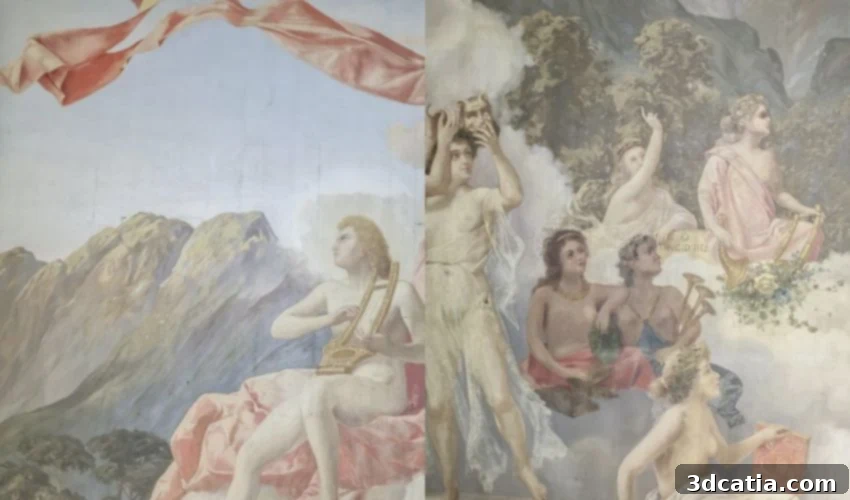
Revolutionizing Art Conservation: Uncovering the Secrets of Costa Rican Oil Paintings with 3D Technologies
In a testament to the ever-evolving intersection of science and art, a groundbreaking multi-disciplinary study has harnessed the power of advanced 3D modeling and printing technologies to meticulously examine two significant large-format oil paintings housed in Costa Rica. This pioneering research provided invaluable insights into their current state of conservation, revealing critical information about the artistic processes employed and the materials utilized in their creation. Such an approach not only safeguards these invaluable cultural artifacts but also enriches our understanding of art history and preservation methodologies.
The dedicated research team, spearheaded by P. Calderón-Mesén, Daniela Jaikel-Víquez, and M. D. Barrantes-Madrigal, embarked on a comprehensive series of observations, leveraging sophisticated 3D technologies to conduct their analysis. Their work involved diligent monitoring of the paintings’ environmental conditions, a crucial step in understanding potential degradation factors. Furthermore, they meticulously documented possible areas of biodeterioration across the canvases, a common threat to historic artworks. Beyond the macroscopic view, the team delved into the paintings’ composition, characterizing pigment colors based on the distribution and arrangement of crystalline structures, and even identifying nanofossils within the materials to ascertain the approximate time period of their origin. Throughout this intensive observation period, maintaining consistent meteorological conditions was paramount. The study rigorously controlled and monitored key environmental variables, including CO2 levels, temperature, humidity, and light intensity, recognizing their profound impact on the long-term stability and preservation of delicate artworks.
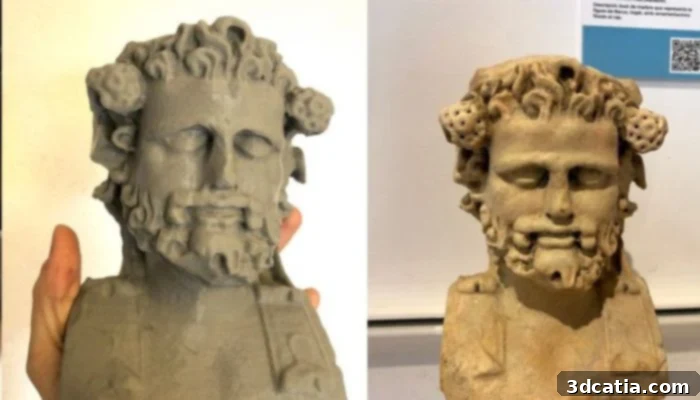
3D printing is commonly used for conservation in museums (Photo credit: Simplify3D)
How 3D Printing and Modeling Are Revolutionizing Art Conservation
The innovative application of 3D technology extended significantly beyond mere observation. To achieve a profound understanding of the intricate color palettes and material layers, researchers created highly detailed 3D representations of specific areas of the paintings. This digital replication allowed for an in-depth examination of microscopic samples using a light microscope, providing unprecedented clarity into the stratigraphy of the paintings – essentially, the successive layers of paint and primer that constitute the artwork’s historical build-up. Understanding this ‘rock succession’ within a painting is vital for conservators to comprehend the artist’s technique, identify previous restorations, and assess the artwork’s overall structural integrity.
A significant hurdle in art conservation is the precise and continuous monitoring of environmental conditions without disturbing the artwork or its historical setting. To address this, the research team engineered novel, low-cost, and remarkably versatile monitoring stations. These bespoke stations were not off-the-shelf solutions but custom-designed units, built and optimized for the specific requirements of the study and the unique environment of the National Theater of Costa Rica (NTCR), where the paintings are housed. Each station was equipped with a SCD30 sensor for accurate detection of ambient temperature, CO2 levels, and humidity; a TSL2591 sensor for measuring light intensity, which is critical for preventing UV and visible light damage; and a Real Time Clock for precise time-stamping of all collected data. All this information was meticulously stored by a compact microcontroller, ensuring continuous data capture. The entire design process for these stations was carried out using SolidWorks, a leading 3D CAD software, culminating in their physical production via 3D printing. While the specific material and 3D printing method were not detailed in the research paper, it was emphasized that these stations were conceived with a dual purpose: to be functionally robust for housing the sensitive sensors and microcontroller, and to possess a ‘harmonious’ aesthetic design that would blend seamlessly with the historic grandeur of the National Theater, thus minimizing visual intrusion in a culturally significant space. This exemplifies how 3D printing facilitates tailor-made solutions for highly specialized conservation challenges.
Revealing Pigment Secrets with Digital Reconstruction
Another critical facet of this comprehensive study involved an in-depth observation of the pigments embedded within the paintings. For this intricate analysis, the researchers digitally reconstructed sections of the artworks using computer modeling, specifically employing Blender 3D modeling software to process and visualize microscopic images. This sophisticated digital representation yielded a wealth of information previously unattainable. It provided precise data on the amount and average thickness of each paint layer, offering clues about the artist’s application techniques and the passage of time. Crucially, it also characterized the density of pigment present within the sampled areas. Such detailed insights into the material composition are indispensable for art conservators. They enable a clearer understanding of the original materials, identify areas of degradation or alteration, and guide future restoration efforts with unparalleled accuracy, ensuring that any intervention respects the historical integrity of the artwork.
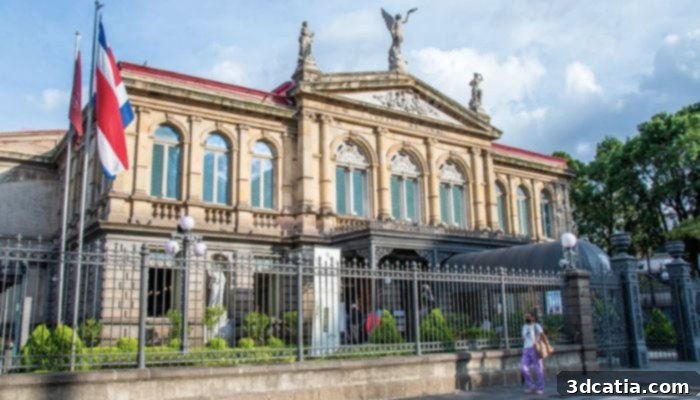
The National Theater of Costa Rica is located in the capital, San Jose (Photo credit: Costa Rica Travel Advice)
The Broader Impact of 3D Technologies in Safeguarding Cultural Heritage
The innovative use of 3D technologies for painting observation and analysis, as demonstrated by the Costa Rican study, is part of a growing global trend in cultural heritage preservation. Numerous similar initiatives highlight the transformative potential of these tools. For instance, Scan The World, a significant project, has been actively working to make 3D printable art accessible to a global audience by digitizing countless historical and artistic pieces. This not only preserves cultural heritage in digital form but also democratizes access, allowing anyone with a 3D printer to create replicas for educational purposes or personal enjoyment. Another compelling example involves the remarkable reconstruction of a previously unknown Picasso painting, a masterpiece that had remained hidden for an astonishing 118 years. In that instance, researchers employed advanced spectroscopic imaging and sophisticated image processing techniques to virtually peel back layers of history. Subsequently, artificial intelligence was utilized to retexture the painting digitally, bringing a lost work of art back to life in the digital realm. These examples underscore the profound capabilities of 3D technology, from meticulous scientific analysis to broad public engagement and the virtual resurrection of forgotten art. They showcase how digital tools are not just assisting traditional conservation methods but actively creating new paradigms for understanding, preserving, and sharing our shared cultural heritage.
The integration of 3D modeling and printing into art conservation marks a pivotal shift, moving beyond conventional preservation techniques to embrace precise, non-invasive, and highly detailed analytical methods. For large-format oil paintings, like those studied in Costa Rica, these technologies offer an unparalleled opportunity to assess structural integrity, identify material degradation at a microscopic level, and implement targeted conservation strategies. By creating digital twins of these masterpieces, conservators gain a permanent record of their condition, allowing for long-term monitoring and comparative analysis without the need for physical interaction that could cause further damage. Moreover, these digital models serve as invaluable educational tools, providing researchers, students, and the public with an immersive way to explore artworks in unprecedented detail. This blending of art, science, and technology ensures that the stories and beauty encapsulated within these historical paintings can be appreciated and protected for generations to come, truly revolutionizing the field of cultural heritage preservation.
You can find the comprehensive research paper detailing this groundbreaking work HERE.
What are your thoughts on the groundbreaking use of 3D technologies for painting conservation and the broader field of cultural heritage? We invite you to share your perspectives and engage with us! Let us know in a comment below or connect with us on ourLinkedIn,Facebook, andTwitter pages! To stay ahead with the latest advancements and news in the additive manufacturing sector, don’t forget to sign up for our free weeklyNewsletter here, delivering the most relevant 3D printing news straight to your inbox! You can also find all our insightful videos and in-depth discussions on our dedicatedYouTube channel, exploring the diverse applications and innovations within the 3D printing world.
*Cover photo: Musas I and II; credits: TNCR