
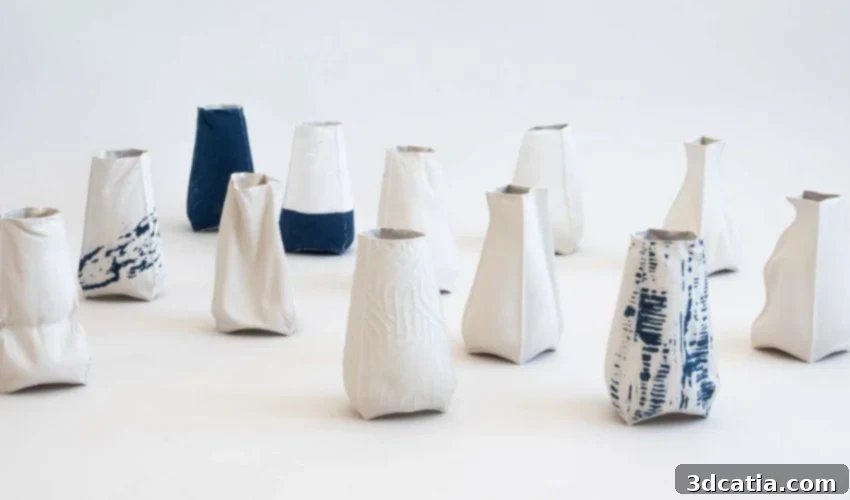
Innovating Vase Production: Nir Neria’s Forma Fabrica Blends 3D Printing with Traditional Slip Casting
The landscape of manufacturing and creative arts has been dramatically reshaped by the proliferation of additive manufacturing. What was once confined to industrial factories and rapid prototyping labs has now expanded its influence, finding a vibrant new home in art studios, design workshops, and educational institutions globally. The 3D printer, far from being just a tool, has emerged as a powerful medium, enabling artists, designers, and artisans to bring audacious new artistic, conceptual, and cultural creations to life. This technological shift isn’t merely about fabrication; it’s about reimagining possibilities, pushing the boundaries of material expression, and fostering unprecedented levels of customization and intricate detailing.
Beyond original creation, 3D scanning technologies have introduced revolutionary ways to interact with our past. These advanced scanners empower individuals and institutions worldwide to meticulously reconstruct masterful works of art, capturing every nuance and imperfection with incredible fidelity. More profoundly, they offer invaluable opportunities for digitally preserving global heritage, ensuring that invaluable cultural artifacts and historical sites can be documented, studied, and replicated for future generations, even in the face of environmental degradation or conflict. While the 3D printer often garners attention for its ability to produce final products, its true versatility often shines in its supporting roles. It is in these behind-the-scenes applications that 3D printing truly facilitates groundbreaking innovation, helping to create new designs and concepts that would be impossible or impractical with traditional methods. This supportive capacity has cemented the 3D printer’s status as an indispensable tool in the arsenals of contemporary designers, artists, and artisans seeking to innovate across various disciplines. A prime example of this innovative application is found in the latest work by acclaimed industrial designer and material translator, Nir Neria.
Nir Neria’s Forma Fabrica Collection: A Modern Take on Classic Porcelain
Nir Neria’s “Forma Fabrica” collection represents a compelling reinterpretation of the classical porcelain vase, pushing the boundaries of material interaction and design aesthetics. This collection is not just about creating beautiful objects; it’s an exploration into the symbiotic relationship between diverse materials and intricate forms, challenging conventional notions of ceramic production. At its core, the process involves a time-honored ceramic forming method known as slip casting. This technique is celebrated for its ability to produce highly complex and delicate shapes with consistent quality, a feat often difficult to achieve with other ceramic forming methods like wheel-throwing or hand-building.
Traditionally, slip casting relies heavily on multi-piece plaster molds. These molds are meticulously crafted and then filled with liquid porcelain slip, which is essentially a creamy suspension of clay particles in water. The porous nature of plaster is crucial here; it absorbs water from the slip, causing a layer of solid clay to form on the inner walls of the mold. Once this layer reaches the desired thickness, the excess slip is poured out, and the clay form is allowed to stiffen before the plaster mold is disassembled. While effective, traditional plaster molds come with significant drawbacks. They are often heavy, cumbersome, and inherently fragile, limiting their reusability. Furthermore, the creation of intricate plaster molds can be a laborious and time-consuming process, generating considerable waste and lacking the flexibility for rapid design iterations.
Recognizing these limitations, Nir Neria has ingeniously transformed this centuries-old process into a truly 21st-century affair. His innovative approach seamlessly combines creative vision, a strong commitment to eco-responsibility, and cutting-edge technology. By brilliantly utilizing the precision of 3D printing in conjunction with the tactile qualities of various fabrics, Neria has devised a novel, unique, and most importantly, reusable mold system. This ingenious hybrid method not only addresses the shortcomings of traditional plaster molds but also opens up a myriad of new aesthetic and functional possibilities for ceramic design.
The Forma Fabrica Process: Blending Digital Precision with Artisan Craftsmanship
The creation of a Forma Fabrica vase begins in the digital realm, leveraging sophisticated computer-aided design (CAD) software. This initial stage is critical, allowing Neria to conceptualize and render the vessel in precise three-dimensional detail. Within the CAD environment, designers can meticulously determine the exact shape and dimensions of each individual piece that will constitute the mold structure, as well as precisely define how these components will seamlessly fit together. This digital prototyping ensures unparalleled accuracy and allows for complex geometries that would be exceedingly difficult, if not impossible, to achieve through traditional mold-making techniques.
Once the digital design is finalized, the physical production phase commences. The precisely designed pieces of the mold’s support structure are then produced through 3D printing. The use of additive manufacturing here is key; it allows for the rapid and accurate fabrication of custom, interlocking components that form the framework for the fabric mold. These 3D printed parts are then carefully connected to a chosen fabric, which is expertly sewn together by the artist. The selection of fabric is a deliberate artistic choice, as its texture and pliability will directly influence the final aesthetic of the porcelain piece. Together, these two disparate elements – the rigid, precise 3D printed components and the flexible, tactile fabric – coalesce to form a unique and highly functional mold, ready for the slip casting process.
With the hybrid mold assembled, the liquid porcelain slip is meticulously poured into its cavity. As the porcelain slip interacts with the fabric, a delicate process begins. A layer of solid clay gradually forms on the inner walls of the fabric, much like in traditional slip casting, as water is drawn out from the slip. After a specific duration, carefully monitored to achieve the desired wall thickness, the excess liquid porcelain is gently pumped back out of the mold. This precision in timing and material consistency is crucial for the structural integrity and aesthetic quality of the final piece. Once the clay layer has reached the desired firmness and is stable enough to hold its shape, the modular 3D printed and fabric mold components can be carefully disassembled. The nascent porcelain piece, now freed from its mold, is then prepared for its journey into the kiln, where it will undergo high-temperature firing to achieve its final, durable ceramic form.
The Unique Aesthetics and Sustainable Advantages of Fabric Molds
The utilization of fabric as a primary molding material is arguably the most revolutionary aspect of the Forma Fabrica collection, allowing for truly visually striking forms that boast unparalleled characteristics in both shape and texture. Unlike the smooth, often indistinguishable surfaces produced by rigid molds, the fabric molds leave a distinctive and immediate imprint on the porcelain. The subtle texture of the cloth, the intricate patterns of the stitching, and even the natural wrinkles and folds that define the fabric are immediately visible and palpable on the outside surface of the finished vessels. This meticulous transfer of texture creates a fascinating juxtaposition for the viewer, challenging their preconceived notions of porcelain. One’s perception of the object’s weight and malleability is playfully subverted; the rigid, unyielding nature of ceramic is imbued with the soft, pliable essence of fabric, creating a unique tactile and visual experience.
Beyond the inherent textile textures, Nir Neria further enriches the aesthetic dimension through the strategic application of additional pigments. These pigments, applied to the inner fabrics of the mold before the casting process begins, infuse the porcelain with vibrant colors. This technique creates stunning effects reminiscent of marbling, with swirling patterns and gradients that lend each vase a unique painterly quality. In some instances, the color application and fabric texture combine to give the impression of other materials, such as denim, further blurring the lines between ceramic and textile. Each piece thus becomes a unique canvas, a testament to the versatility of this innovative molding method.
Functionally, the Forma Fabrica mold system offers significant advantages, particularly in terms of sustainability and customization. Crucially, the fabric mold is designed to be reusable, a stark contrast to the single-use nature of many traditional plaster molds. This reusability drastically reduces material waste, aligning with contemporary demands for more eco-responsible manufacturing practices. Furthermore, the modular nature of the 3D printed support structure allows for an unprecedented degree of customizability. Designers can easily interchange and reconfigure the 3D printed parts, enabling the creation of a plethora of uniquely shaped and positioned pieces from a relatively small initial set of components. This modular design means that a designer isn’t limited to a single mold for a single design; instead, they have a flexible system that can generate endless variations, encouraging experimentation and fostering a truly dynamic design process. The advantages of this modular, reusable, and customizable design are clear: it champions efficiency, reduces environmental impact, and significantly expands the creative possibilities for ceramic artists and designers.
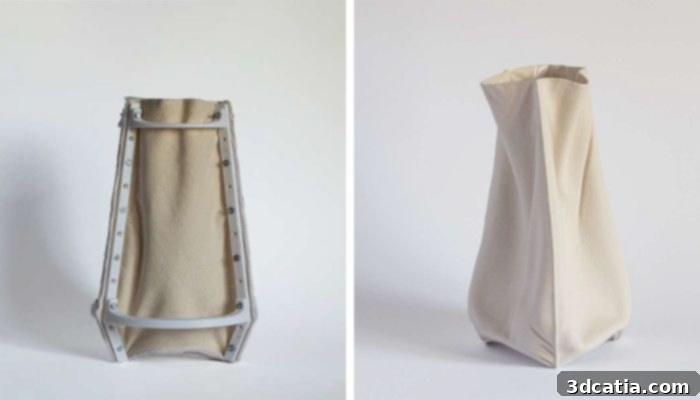
Left, the modular design of the 3D printed mold allows for custom shapes. Right, a finished piece with its unique fabric-like appearance (photo credits: Nir Neria)
Nir Neria: A Visionary in Sustainable Design and 3D Printing
The Forma Fabrica collection stands as a compelling addition to Nir Neria’s impressive and growing portfolio of innovative design collections. Neria, renowned for his forward-thinking approach, consistently integrates cutting-edge technology with a profound understanding of materials and a commitment to sustainability. In recent years, 3D printing and the exploration of sustainable biomaterials have become prominent features in his showcases, underscoring his dedication to pushing the boundaries of what is possible in industrial design while prioritizing environmental consciousness. His work often reflects a thoughtful dialogue between traditional craftsmanship and modern technological advancements, creating objects that are not only aesthetically pleasing but also conceptually rich and environmentally responsible. Forma Fabrica beautifully encapsulates this philosophy, showcasing how ancient techniques can be revitalized and enhanced through contemporary tools and innovative thinking. To delve deeper into Nir Neria’s creative universe and explore his other remarkable collections, you can find more information HERE.
What are your thoughts on Nir Neria’s Forma Fabrica collection and its innovative blend of 3D printing and traditional ceramic techniques? We’d love to hear your perspective! Share your comments below or engage with us on our social media platforms. You can find us on LinkedIn, Facebook, and Twitter. Don’t forget to sign up for our free weekly Newsletter here to get the latest 3D printing news delivered straight to your inbox. For more visual content and in-depth discussions, be sure to check out all our videos on our YouTube channel.
*Cover Photo Credits: Nir Neria