
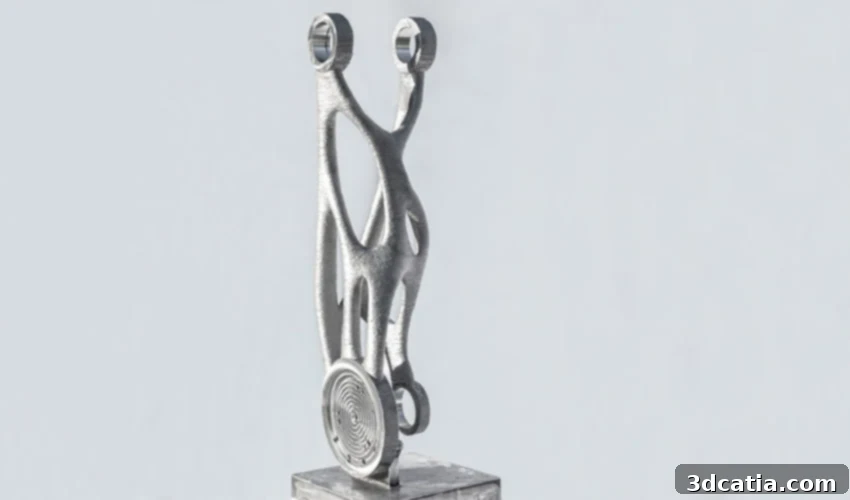
Revolutionizing Industrial Robotics: MX3D and Altair Pioneer 3D Printed, Generative Design Robot Arms
In a groundbreaking collaboration that pushes the boundaries of industrial innovation, MX3D, a specialist in robotic 3D printing, has partnered with Altair, a global leader in computational science and artificial intelligence. Their joint effort has resulted in the successful 3D printing of an optimized industrial robot arm, showcasing the immense potential of large-scale metal 3D printing for Heavy Equipment Parts. MX3D’s core mission is to introduce the transformative advantages of metal additive manufacturing to high-impact industries, focusing on creating robust, user-friendly robotic additive manufacturing technology that empowers users to produce large-scale metal objects with unprecedented efficiency. This project exemplifies how advanced design methodologies and innovative manufacturing can converge to customize and optimize critical industrial components for specific operational requirements and challenging conditions.
The engineering team at Altair spearheaded the design phase, employing cutting-edge generative design methods to achieve optimal performance and structural integrity. This approach is a cornerstone of Design for Additive Manufacturing (DfAM), a philosophy that has emerged as a direct response to the unparalleled design freedom and unique capabilities offered by additive manufacturing (AM) technologies. Unlike traditional manufacturing processes such as CNC machining, where geometric complexities often translate into manufacturing impossibility or prohibitive costs, DfAM allows engineers to explore vast design spaces. Through computational methods, generative design enables the rapid creation of designs that are not only lighter and stronger but also meet stringent performance requirements faster than conventional iterative design cycles. For this particular project, a sophisticated combination of generative design customization and a comprehensive digital twin design approach was meticulously implemented, ensuring the robot arm was optimized from concept to production.
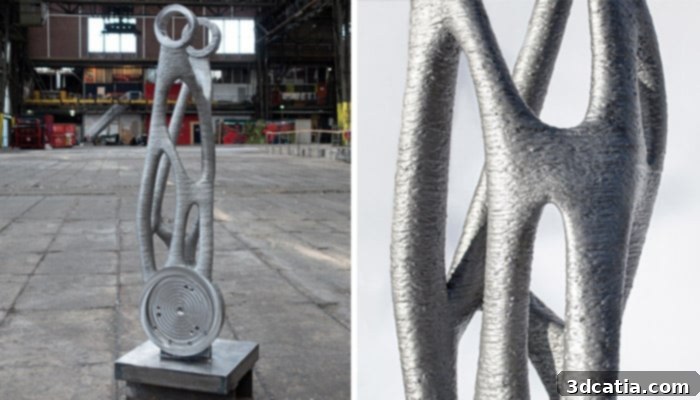
The industrial robot arm, optimized and 3D printed | Credits: MX3D
The Power of Robotic Metal 3D Printing with MX3D’s WAAM Technology
MX3D’s proprietary Wire Arc Additive Manufacturing (WAAM) technology was central to the successful realization of this project. WAAM is a form of robotic 3D printing that utilizes a welding arc to melt metal wire, building up objects layer by layer. This advanced manufacturing process is particularly well-suited for producing large-scale metal parts due to its ability to handle substantial material deposition rates and accommodate a wide array of metals, including stainless steel, which was used for this robot arm. One of the distinguishing features of MX3D’s WAAM technology is its advanced geometry processing capabilities, which facilitate the printing of complex, organic geometries upright without the need for extensive support structures. This capability is a game-changer for industrial applications, allowing for designs that were previously unachievable with conventional manufacturing methods. By leveraging WAAM, MX3D and Altair were able to dramatically increase productivity for tailored robotic applications, demonstrating an astounding 50% weight reduction compared to the original part, all while maintaining or even improving structural integrity and performance.
The shift from traditional manufacturing to WAAM for such critical components carries significant advantages. Firstly, it drastically reduces material waste often associated with subtractive methods like machining, as material is only added where needed. Secondly, it shortens lead times for custom or replacement parts, enabling on-demand production closer to the point of use. This eliminates the extensive tooling requirements and long shipping durations typical of overseas production, which can cause significant downtime and limit customization options. The robust nature of the WAAM process also ensures that the resulting parts are durable and reliable, crucial for the demanding environments of heavy equipment and industrial robotics. This project highlights WAAM as a viable and superior alternative for manufacturing large, complex metal components, opening new avenues for design freedom and operational efficiency in various industries.
Redefining Design: Generative Design and Design for Additive Manufacturing (DfAM)
The core of this optimization success lies in Altair’s expert application of generative design principles within the framework of Design for Additive Manufacturing (DfAM). DfAM represents a paradigm shift in how engineers approach product development. Instead of designing a part and then trying to find a way to manufacture it, DfAM integrates manufacturing considerations from the very first stages of design. Generative design, a powerful subset of DfAM, leverages artificial intelligence and computational algorithms to automatically generate numerous design alternatives that meet predefined performance objectives and constraints, such as weight reduction, stress distribution, and material properties. Engineers input desired performance requirements, materials, and manufacturing processes, and the software autonomously explores thousands or millions of design permutations, often resulting in organic, bionic-like structures that are impossible to conceive or produce with traditional methods. These designs are intrinsically optimized for their intended function, leading to unprecedented levels of efficiency and material utilization.
For the industrial robot arm project, Altair’s engineers utilized generative design to strip away unnecessary material while preserving or enhancing structural integrity. This computational approach enabled them to transform the original 150 kg part into a mere 73 kg component, achieving an impressive 50% weight reduction without compromising strength. Beyond pure weight reduction, generative design also allows for improved dynamic performance, reduced inertia, and enhanced energy efficiency for the robot arm. The implementation of a digital twin design approach further solidified the optimization process. A digital twin is a virtual representation of a physical object or system, updated with real-time data throughout its lifecycle. In this project, the digital twin allowed Altair to simulate the robot arm’s performance under various operational conditions, predict potential failures, and fine-tune the design virtually before any physical printing began. This iterative virtual optimization dramatically reduced prototyping cycles and ensured that the final 3D printed part was perfectly tailored for its intended operational environment, embodying the true spirit of tailored robotics.
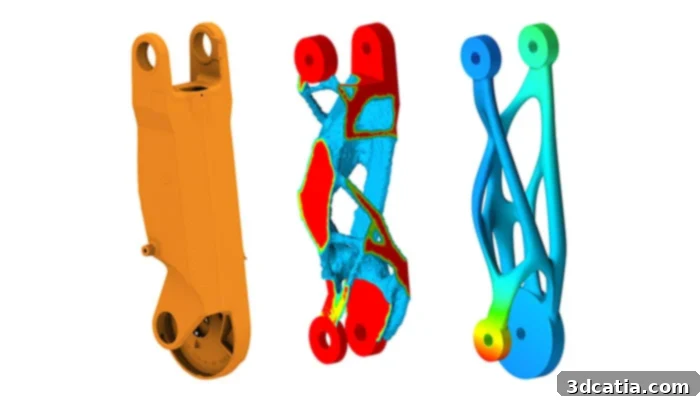
Through generative design techniques, the weight of the part was reduced by 50% while maintaining strength | Credits: MX3D
Project Spotlight: Optimizing the Industrial Robot Arm for Peak Performance
The collaborative project between MX3D and Altair set out with a clear objective: to enable the manufacturing of customized, optimized replacement parts for heavy industrial equipment. The transformation of the original 150 kg robot arm into a 73 kg counterpart, while retaining equivalent strength, serves as a powerful testament to the efficacy of their combined approach. The manufacturing process itself highlights the efficiency of MX3D’s WAAM technology. Operating with 24/7 production, the complete robot arm was 3D printed in just four days. Following the additive process, the part underwent finishing with a standard 3-axis milling machine. This post-processing step was crucial to achieve the precise tolerances required at the connecting points, ensuring seamless integration with existing robotic systems. This hybrid manufacturing approach – combining the design freedom and material efficiency of 3D printing with the precision of traditional machining – represents a highly effective pathway for producing complex, high-performance parts.
The overarching goal of this joint venture was to address critical challenges faced by industries reliant on large-scale industrial machinery. Traditionally, manufacturing customized replacement parts often involves extensive tooling, long lead times from overseas production facilities, and severely limited customization options. Such constraints can lead to prolonged operational downtimes, increased maintenance costs, and an inability to adapt machinery to evolving operational requirements. By contrast, the MX3D-Altair solution offers a rapid, automated, and highly customizable production methodology. This capability not only accelerates the delivery of specialized components but also allows for iterative improvements and rapid prototyping, ensuring that industrial robot arms can be perfectly adapted to specific tasks, thereby enhancing performance, reducing energy consumption, and extending the lifespan of valuable equipment. This innovative project demonstrates a paradigm shift towards more agile, responsive, and efficient manufacturing for heavy industry.
A Vision for Tailored Robotics and Future Manufacturing
James Dagg, CTO of Modeling and Visualization at Altair Engineering, articulated the excitement surrounding this collaboration: “We are thrilled to collaborate with MX3D and are proud to contribute to its vision of developing tailored robotics. The challenge in this showcase was particularly exciting as our Altair team supported the robot customization redesign from the earliest stages, helping to identify requirements for optimal operational conditions with a digital twin representing the entire system. We are looking forward to seeing the project progress as our efforts help to increase MX3D’s productivity.” Dagg’s comments underscore Altair’s deep involvement from conception, leveraging their expertise in simulation and digital twin technology to ensure the robot arm was optimized for real-world operational scenarios. This level of early-stage integration between design and manufacturing is key to unlocking the full potential of additive manufacturing.
The successful optimization and 3D printing of this industrial robot arm heralds a new era for heavy equipment manufacturing and industrial automation. It showcases how advanced computational design tools combined with innovative additive manufacturing technologies can deliver tangible benefits: significant weight reduction, enhanced performance, and the ability to produce highly customized, on-demand parts. This approach has profound implications for supply chain resilience, reducing reliance on distant manufacturers, and fostering localized production capabilities. Industries spanning aerospace, automotive, marine, and general heavy machinery stand to gain immensely from these advancements, enabling them to create more efficient, sustainable, and adaptable systems. The collaboration between MX3D and Altair is not just about a single robot arm; it’s about pioneering the future of manufacturing where design freedom meets industrial strength, paving the way for more intelligent and responsive robotic solutions.
For more detailed information on MX3D and their groundbreaking work, you can visit their official website HERE.
What are your thoughts on this innovative industrial robot arm project and the synergy between generative design and robotic 3D printing? We’d love to hear your insights! Share your comments below or connect with us on our Facebook and Twitter pages. Don’t miss out on the latest advancements in additive manufacturing – sign up for our free weekly Newsletter to receive all the crucial updates about 3D printing directly in your inbox!