
MIT’s Breakthrough: 3D Printed Robotic Hearts Revolutionize Personalized Cardiac Treatment
Human ingenuity and technological advancements have soared to unprecedented heights over the past few centuries. Among the many sectors transformed by this progress, the medical field stands out as a beacon of innovation, continuously pushing boundaries to address humanity’s most pressing health challenges. It’s no secret that the prospect of serious health issues can be daunting, driving an unrelenting quest for better diagnostics, treatments, and preventative measures. This constant pursuit of improvement makes the medical sector a fertile ground for adopting cutting-edge technologies, including the revolutionary potential of additive manufacturing, more commonly known as 3D printing.
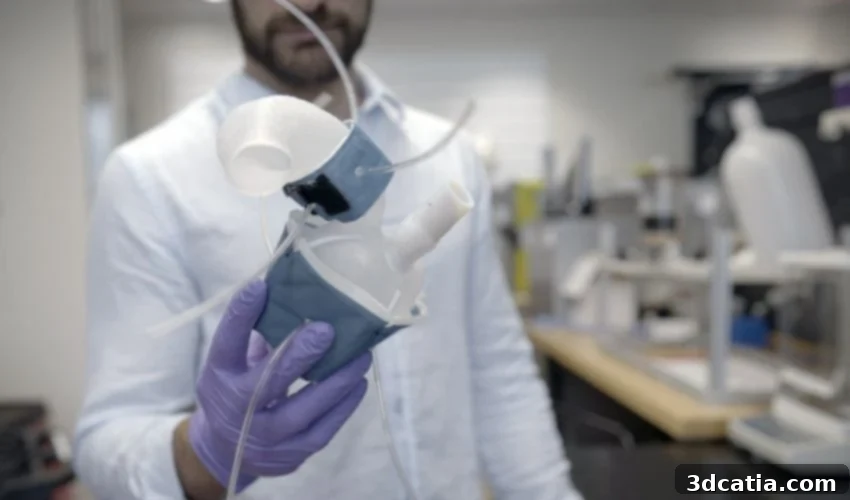
In a groundbreaking development that promises to reshape cardiology, engineers at MIT have successfully developed a 3D printed robotic heart capable of perfectly replicating a patient’s own organ. This remarkable replica not only mirrors the exact look and anatomical structure but also accurately reproduces the patient-specific pumping dynamics. This innovation represents a significant leap forward in understanding and treating heart diseases, offering a new avenue for highly personalized and effective therapeutic strategies.
The Global Burden of Heart Disease: A Critical Challenge
Heart problems remain one of the leading causes of mortality worldwide, representing a monumental public health challenge. The statistics paint a sobering picture: approximately 647,000 Americans succumb to heart disease each year, as reported by Healthline, making it responsible for one in every four deaths in the country. The Centers for Disease Control and Prevention (CDC) further underscore its severity, identifying it as the number one cause of death in the USA. Disturbingly, recent data indicate that these numbers are not only persistent but, in some cases, increasing. A notable study revealed a sharp rise in heart attack death rates across all age groups during the recent global pandemic, highlighting the escalating urgency for advanced interventions.
The complexities of heart disease are vast, encompassing a spectrum of conditions from coronary artery disease and heart failure to valvular disorders and congenital defects. Each patient presents a unique physiological landscape, making a one-size-fits-all approach to treatment often inadequate. The intricate interplay of genetics, lifestyle, and individual anatomy necessitates highly tailored medical solutions. It is within this critical context that finding innovative ways to treat heart diseases becomes a paramount priority for medical researchers and clinicians alike. Here, 3D printing is emerging as a pivotal technology, offering an unparalleled capability to customize treatments precisely to each patient’s specific needs and anatomy.
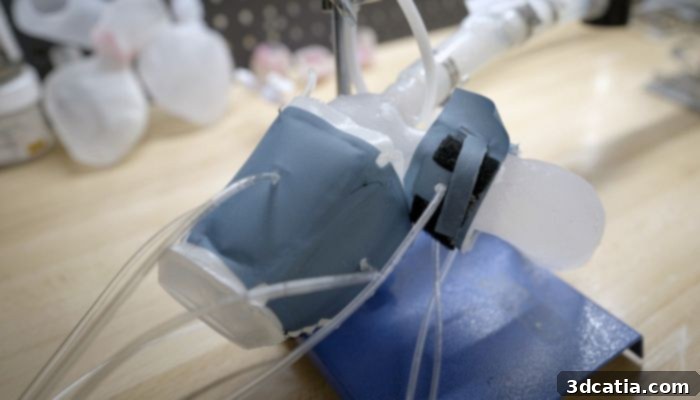
The 3D printed heart replica, designed for personalized medical insights.
MIT’s Vision: Crafting Realistic 3D Printed Cardiac Replicas
This ambitious project was spearheaded by a collaborative team of brilliant minds from MIT, including researchers Luca Rosalia, Caglar Ozturk, Debkalpa Goswami, Jean Bonnemain, Sophie Wang, and Ellen Roche. Their efforts were bolstered by crucial partnerships with Benjamin Bonner of Massachusetts General Hospital, James Weaver of Harvard University, and Christopher Nguyen, Rishi Puri, and Samir Kapadia from the Cleveland Clinic in Ohio. The collective goal was clear: to engineer a soft, flexible robotic heart replica directly from patient data. This advanced replica would serve as an invaluable tool for understanding and treating various heart conditions, from identifying the most suitable implants to perfecting the design and fit of synthetic valves within the aorta.
Unlike traditional anatomical models, the aspiration was to create a dynamic, functional replica that could not only mimic the heart’s shape but also its intricate mechanical behavior. This focus on bio-mechanical accuracy is what sets MIT’s innovation apart, promising to usher in an era of truly personalized cardiac medicine. By simulating the precise conditions within a patient’s heart, clinicians can gain unprecedented insights into disease progression and optimal treatment strategies before ever touching a patient.
The Science Behind the Breakthrough: How the Robotic Heart Works
To achieve this remarkable feat, the team leveraged the power of 3D printing, specifically employing a specialized polymer-based ink. This innovative material, once cured, possesses the unique ability to squeeze and stretch, closely mimicking the elastic and contractile properties of real heart muscle tissue. The entire process begins with high-resolution medical scans – such as CT or MRI – taken directly from individual patients. These scans provide an incredibly detailed map of the patient’s heart, capturing its unique anatomy, including the ventricles and major vessels.
These detailed medical images are then converted into a precise 3D digital model. This model serves as the blueprint for the 3D printer, which then meticulously constructs a soft, anatomically accurate shell of the patient’s heart. But merely replicating the shape was not enough; the true challenge lay in reproducing the heart’s dynamic pumping action. To achieve this, the MIT team engineered custom-fit sleeves designed to wrap snugly around the 3D printed cardiac model. These sleeves are then connected to a sophisticated air pumping system. By precisely controlling the air pressure within these sleeves, researchers can induce contractions and constrictions in the 3D printed heart, effectively replicating the patient’s unique heart-pumping pressures and blood flow dynamics.
As Ellen Roche, one of the lead researchers, eloquently stated, “Being able to match the patients’ flows and pressures was very encouraging. We’re not only printing the heart’s anatomy, but also replicating its mechanics and physiology. That’s the part that we get excited about.” This statement perfectly encapsulates the profound significance of this project: it moves beyond static representation to dynamic, functional mimicry, opening up entirely new possibilities for medical research and personalized treatment.
Transforming Patient Care: Applications and Future Impact
The success of this endeavor has been unequivocally demonstrated. The researchers were not only able to perfectly replicate the external shape and internal architecture of individual patient hearts but also accurately reproduce the previously measured heart-pumping pressures and blood flow patterns. This functional fidelity is crucial for the replica’s primary purpose: to help determine the most suitable and effective treatment for patients, particularly those facing complex cardiac conditions.
One immediate and impactful application is in the realm of pre-surgical planning. For instance, the 3D printed heart can be used to compare different implant sizes, such as stents or heart valves, allowing surgeons to precisely determine which option will result in the best fit and optimal blood flow for a specific patient. This level of personalized foresight can significantly reduce surgical risks, improve procedural outcomes, and minimize the need for subsequent interventions. The researchers specifically highlight its potential benefit for individuals who present with unique or challenging cardiac geometries, where standard approaches might fall short.
Beyond surgical planning, these sophisticated cardiac replicas hold promise for numerous other applications:
- Drug Discovery and Testing: The models can be used to test the effects of new medications or existing drugs on specific cardiac conditions, observing how they impact heart function in a patient-specific context, without exposing the actual patient to potential risks.
- Medical Education and Training: These realistic, beating heart models offer an unparalleled training tool for aspiring cardiologists and cardiac surgeons. They can practice complex procedures, hone their skills, and develop a deeper understanding of diverse cardiac anatomies in a risk-free environment.
- Disease Modeling: Researchers can simulate the progression of heart diseases on these patient-specific models, gaining insights into how various interventions might alter the disease trajectory.
- Improving Device Design: Manufacturers of cardiac devices can utilize these replicas to refine their product designs, ensuring optimal performance and compatibility with a wider range of patient anatomies.
This groundbreaking work by MIT and its collaborators represents a pivotal step towards a future where medical treatments are meticulously tailored to the individual, minimizing trial-and-error and maximizing efficacy. You can delve deeper into the specifics of this project and its implications by visiting the official MIT news article HERE.
Conclusion: The Future of Personalized Cardiology is Here
The development of these 3D printed robotic hearts by MIT engineers marks a profound advancement in the field of cardiovascular medicine. By merging advanced additive manufacturing techniques with sophisticated medical imaging and biomechanical engineering, they have created a tool that goes beyond mere anatomical representation, offering a dynamic, functional replica of a patient’s living heart. This innovation holds immense potential to transform how heart diseases are diagnosed, understood, and treated, paving the way for truly personalized medicine.
As we look to the future, the implications of this technology are vast. From refining surgical procedures and optimizing implant selection to accelerating drug discovery and enhancing medical training, these patient-specific cardiac replicas are poised to save lives and significantly improve the quality of life for countless individuals grappling with heart conditions. The continued integration of 3D printing into medical research and clinical practice promises a future where complex health challenges are met with increasingly precise, effective, and individualized solutions.
What are your thoughts on these revolutionary 3D printed heart replicas? Do you believe they will significantly impact the treatment of heart disease? Share your insights in a comment below or join the conversation on ourLinkedIn,Facebook, andTwitter pages! Don’t forget to sign up for our free weeklyNewsletter here, to get the latest 3D printing news delivered straight to your inbox! You can also find all our captivating videos on ourYouTube channel.
*All Photo Credits: Melanie Gonick, MIT