
Revolutionizing Glass Manufacturing: MIT’s G3DP2 System Unlocks the Future of 3D Printed Glass
The concept of 3D printing glass, a material often perceived as delicate and challenging to manipulate with precision, once seemed beyond the realm of practical possibility. Yet, this formidable challenge has been precisely the focus of groundbreaking research by a dedicated team at the Massachusetts Institute of Technology (MIT). In a pivotal paper published in 3D Printing and Additive Manufacturing in December 2018, researchers Chikara Inamura, Michael Stern, Daniel Lizardo, Peter Houk, and Neri Oxman meticulously detailed their innovative system for 3D printing glass. This pioneering work introduced a revolutionary approach that provides unprecedented control over the molten material and, consequently, the final integrity and aesthetic of the printed glass objects.
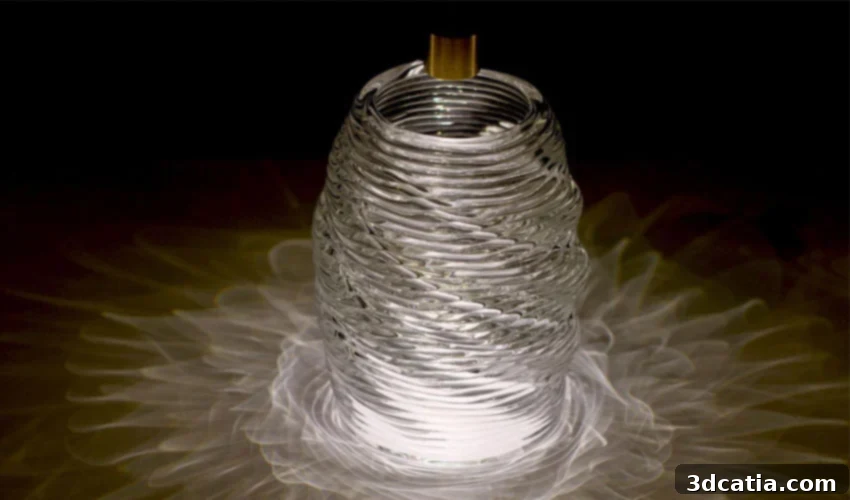
This advanced system, known as G3DP2 (Glass 3D Printing 2.0), represents a significant leap forward in additive manufacturing. It is engineered to facilitate the 3D printing of intricate geometric shapes and highly personalized glass objects, opening up a myriad of possibilities across various industries. The journey to G3DP2 began much earlier; in 2015, the same MIT research team unveiled the initial findings from their ambitious G3DP project. This earlier iteration focused on achieving optically clear glass through 3D printing, a monumental task given the inherent challenges posed by the layered nature of extrusion-based additive manufacturing. Despite these obstacles, the G3DP project successfully produced a captivating collection of artful lamps, each demonstrating the unique ability to refract and sculpt light, showcasing the artistic potential of this nascent technology.
The Evolution from G3DP to G3DP2: Overcoming Challenges and Expanding Horizons
The initial G3DP system, while groundbreaking, served as a crucial learning platform. Researchers quickly identified areas for improvement, particularly concerning scale, reliability, and the ability to reproduce precise results consistently. These insights fueled the development of G3DP2, a platform designed to transcend the limitations of its predecessor and enable 3D printing of glass on an architectural scale. The upgrades implemented to transform G3DP into G3DP2 were comprehensive, significantly enhancing the printer’s capabilities. These improvements allowed for larger prints, increased operational stability, and improved consistency in the final products, crucial factors for real-world applications beyond artistic prototypes.
One of the most compelling demonstrations of G3DP2’s expanded capabilities took place at the Milan Design Week 2017. Here, the technology was utilized to print impressive three-meter-tall glass columns. These architectural marvels were not monolithic but rather composed of 15 unique, intricately 3D-printed glass components. The assembly of these components was a feat of engineering itself, employing silicone film joinery and robust steel post-tensioning systems to ensure their vertical stability and structural integrity. This project not only showcased the aesthetic potential of 3D printed glass but also its viability for large-scale construction and design applications, challenging conventional notions of glass fabrication.
The Transformative Potential of Additive Manufacturing for Glass
The MIT researchers envision a future where this innovative additive manufacturing technology, combined with the inherently unique properties of glass, will usher in a new era of design and construction. As they articulated, “In the future, combining the advantages of this AM technology with the multitude of unique material properties of glass such as transparency, strength, and chemical stability, we may start to see new archetypes of multifunctional building blocks.” This statement underscores the profound implications of G3DP2, suggesting that it could lead to the development of building materials that are not only aesthetically pleasing but also possess advanced functionalities, integrating structural integrity with optical performance and chemical resistance.
The ability to custom-design and print glass components on demand could revolutionize various sectors. In architecture, it means bespoke facades, innovative interior elements, and structural components that seamlessly blend form and function. For product designers, the freedom to create complex, individualized glass objects without the constraints of traditional molds opens up unparalleled creative avenues. Beyond aesthetics, the precise control offered by 3D printing could also be vital for scientific applications, such as microfluidics, optical components, and laboratory equipment, where exact geometries and material purity are paramount. The durability and chemical stability of glass, coupled with the geometric freedom of additive manufacturing, promise robust and long-lasting solutions for these specialized fields.
Inside G3DP2: A Symphony of Precision Temperature Control
At the heart of the G3DP2 printer’s success lies its sophisticated temperature control system, which is numerically integrated across the various stages of glass formation. This precision is critical because glass, unlike many other materials, undergoes dramatic changes in viscosity and structure with even slight temperature variations. The G3DP2 system is composed of three distinct chambers, each meticulously controlled for optimal thermal conditions. The first chamber, acting as a furnace, maintains the glass in a fully molten, fluid state at an extremely high temperature of 1090°C. This ensures a consistent flow of material for printing.
Once the molten glass is ready for deposition, it passes into a second chamber, which operates at a slightly lower temperature of 800°C. This intermediate stage is crucial for preparing the glass for printing, allowing it to cool slightly while still maintaining sufficient fluidity for extrusion. Finally, the actual printing chamber is carefully sustained at 480°C. This controlled environment is essential for the layer-by-layer deposition process, ensuring that each new layer properly adheres to the previous one without premature cooling that could lead to cracking or structural defects.
The Critical Role of Cooling and Crystallization
The researchers at MIT are paying particular attention not just to the heating, but equally, if not more, to the cooling of the glass and its crystallization. The cooling rate of glass is a paramount factor in determining its final properties, including its transparency, strength, and internal stress. Rapid, uncontrolled cooling can lead to internal stresses and cracking, while slow, controlled cooling, known as annealing, is vital for producing strong, clear, and stable glass. Furthermore, uncontrolled crystallization (devitrification) can turn transparent glass opaque and compromise its structural integrity. The G3DP2’s multi-chamber approach and precise thermal regulation are designed to prevent these issues, ensuring that the printed glass maintains its desired optical and mechanical properties.
This meticulous control over the entire thermal cycle, from initial melting to final annealing, represents a significant engineering achievement. It allows for the production of glass objects with predictable characteristics, a necessity for both artistic and functional applications. The ability to precisely manage these variables distinguishes G3DP2 from earlier attempts at 3D printing glass and positions it as a truly transformative technology. Furthermore, the G3DP2 system boasts an impressive output capacity, capable of printing up to 5 kg of glass per hour. This speed is excellent news for industry professionals, signaling the potential for efficient production of specialized glass components on a scale that was previously unimaginable with traditional additive manufacturing techniques for glass.
Looking Ahead: The Future Impact of G3DP2 and 3D Printed Glass
The innovations embedded within the G3DP2 system mark a pivotal moment for additive manufacturing and material science. By making the seemingly impossible—3D printing complex glass structures—a tangible reality, MIT researchers have not only expanded the toolkit for designers and engineers but have also laid the groundwork for entirely new industries and applications. The implications extend far beyond architectural columns and art pieces; imagine custom-designed optical lenses produced on-demand, highly specialized scientific instruments with integrated glass components, or even consumer products with unique translucent features previously constrained by manufacturing limitations.
This technology has the potential to democratize access to advanced glass fabrication, allowing for rapid prototyping and iteration of designs that would be prohibitively expensive or time-consuming with traditional methods. Moreover, the environmental benefits of additive manufacturing, such as reduced material waste through optimized design and on-demand production, could also be significant. As the technology continues to evolve, we can anticipate even greater levels of detail, larger print volumes, and potentially the ability to incorporate varied material properties within a single print, creating truly multifunctional glass objects. The G3DP2 project stands as a testament to human ingenuity, pushing the boundaries of what is conceivable in material additive manufacturing and illuminating a brilliant future for 3D printed glass.
What are your thoughts on this incredible breakthrough in 3D printing glass? Share your opinions in a comment below or join the conversation on our Facebook and Twitter pages! Don’t miss out on the latest advancements in additive manufacturing—sign up for our free weekly Newsletter to receive all the top 3D printing news directly in your inbox!