
Microlight3D’s Long-Range Z Feature: Pioneering Micro 3D Printing with Unprecedented Height and Precision
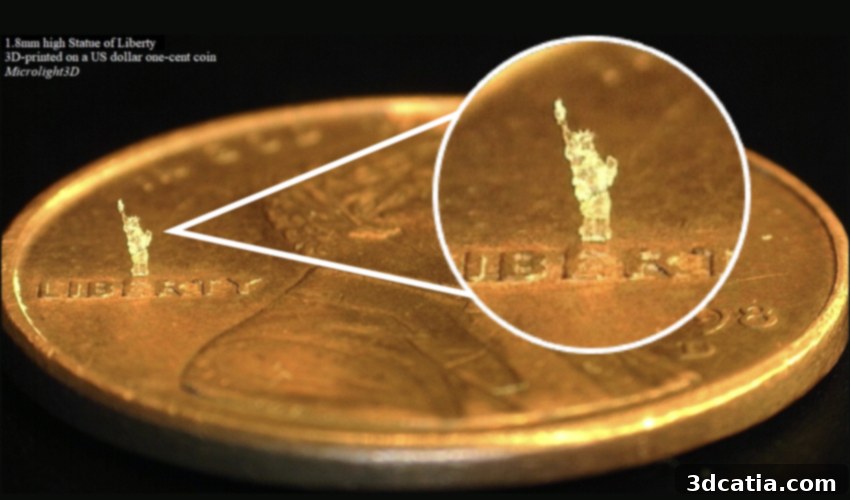
Microlight3D, a leading French innovator in high-resolution microscale 2D and 3D printing systems, has once again pushed the boundaries of additive manufacturing. To commemorate Inauguration Day in the USA and simultaneously unveil their groundbreaking Long-Range Z feature, the company meticulously 3D printed the world’s smallest replica of the iconic Statue of Liberty. This remarkable achievement underscores Microlight3D’s commitment to both scientific advancement and industrial applications, demonstrating their unique capability to produce intricate micron-sized structures with previously unattainable heights.
Earlier this year, Microlight3D garnered significant attention by showcasing a similarly impressive project: the world’s smallest champagne pyramid. This miniature marvel, standing just 2 millimeters tall and composed of 35 perfectly formed micro glasses, was also created using their advanced microfabrication 3D printing technology. The ability to create such delicate and complex structures at this scale is a testament to their expertise. Now, with the introduction of their Long-Range Z feature, Microlight3D has significantly overcome previous height limitations in micro-printing, all while steadfastly maintaining unparalleled micrometric resolution. This innovation marks a pivotal moment, enabling researchers and industries to explore new dimensions in microscopic engineering.
The newly unveiled Statue of Liberty replica, a stunning demonstration of the Long-Range Z feature, measures an astonishing 1.8mm in height and 0.6mm in width. This diminutive yet perfectly detailed structure showcases the feature’s capability to create tiny objects up to 10 mm tall. This represents a monumental leap, extending the previous height limit of 0.3 mm by an impressive 9.7 mm. To further illustrate the versatility and broad compatibility of their technology with various printing substrates, Microlight3D chose to print the miniature statue directly onto the surface of a one-cent coin. This choice not only highlights the precision but also the practical potential of integrating micro-printed components onto existing objects or wafers. The statue itself was fabricated using OrmoGreen, one of Microlight3D’s proprietary materials. OrmoGreen is a specialized polymer intricately doped with silica nanoparticles. These nanoparticles, a primary component of glass, imbue OrmoGreen with several critical glass-like properties, including exceptional rigidity, as well as high chemical and thermal resistance – attributes crucial for the demanding environments of advanced micro-applications.
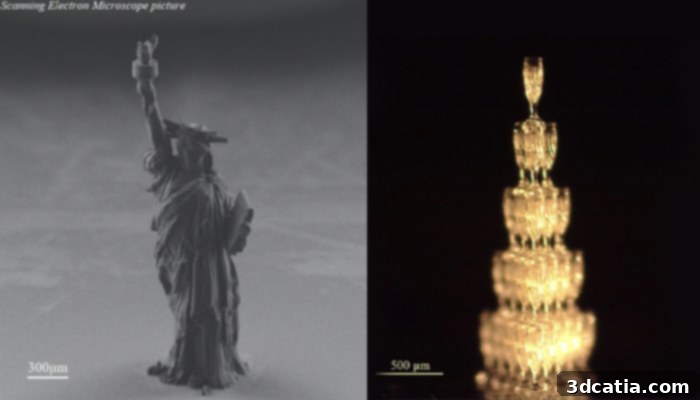
Microlight3D utilized their advanced technology to print the world’s smallest replica of the Statue of Liberty (right) and the world’s smallest champagne pyramid (left), demonstrating exceptional microfabrication capabilities. (Credit: Microlight 3D)
Philippe Paliard, co-founder of Microlight3D, emphasized the profound impact he anticipates this technological advancement will have across diverse sectors. He articulated, “Users will now possess the capability to perform precise alignments on pre-existing patterns, enabling them to print exactly where required.” This ability is particularly vital for integrating micro-components seamlessly onto complex systems like microchips or optical fibers, ensuring optimal functionality and performance. Paliard further elaborated on the expanding horizons for scientific and industrial endeavors: “Researchers and industrial developers are increasingly looking to work on metallic or silicon wafers – substrates that present unique challenges for traditional micro-printing. Our enhanced 3D microprinting system, boasting compatibility with an extensive array of materials and substrates, will empower them to micro-fabricate structures they simply couldn’t achieve before. They will undoubtedly marvel at the unparalleled ability of our µFAB3D-Advanced 3D-microprinter to meticulously align the laser and print directly onto the tip of optical fibers, opening up revolutionary possibilities for micro-optics applications.” This vision highlights a future where the limitations of traditional manufacturing are overcome by the precision and versatility of Microlight3D’s innovative approach.
While the creation of the world’s smallest Statue of Liberty may appear to be a light-hearted, whimsical achievement, its underlying significance, as Paliard points out, is profound and far-reaching. This innovation holds immense promise, particularly for fields relying heavily on microfabrication, such as the development of mechanical micro-parts, novel meta-materials, cutting-edge medical devices, and other highly specialized applications. In these critical areas, researchers and industrial developers frequently require the ability to create objects that demand both exceptionally high micrometric resolution and a vertical dimension of several millimeters. Microlight3D’s groundbreaking Long-Range Z feature directly addresses this crucial need, enabling them to achieve previously impossible designs and functionalities. By extending the printing height capability without compromising resolution, Microlight3D has unlocked a new realm of possibilities for fabricating a wide range of complex micro-components.
The applications for Microlight3D’s enhanced micro 3D printing technology are vast and transformative. In the realm of medical devices, the Long-Range Z feature facilitates the creation of advanced solutions like intricate stents for cardiovascular treatments, offering improved biocompatibility and patient-specific designs. It also enables the production of highly precise micro-needles for transdermal injection, promising less painful and more efficient drug delivery systems, or even continuous monitoring devices for conditions like diabetes. These micro-needles can be engineered with specific geometries and material properties to optimize their interaction with biological tissues, revolutionizing how medicines are administered and patient data is collected. Beyond medicine, the technology is pivotal for developing next-generation micro-optics, serving as critical components like ultra-compact lenses seamlessly integrated onto optical fibers, advanced connectors, and innovative micro-endoscopes designed for minimally invasive diagnostics and surgical procedures. These advancements will have a profound impact on telecommunications, sensing, and diagnostic imaging, making devices smaller, more powerful, and more efficient.
Furthermore, the ability to fabricate mechanical micro-parts with such precision and height is crucial for the burgeoning fields of micro-robotics and micro-electromechanical systems (MEMS). Designers can now create intricate gears, actuators, and sensor components that are not only tiny but also possess the necessary structural integrity and functional complexity. This paves the way for the development of even smaller, more sophisticated autonomous micro-devices for applications ranging from environmental monitoring to targeted drug delivery within the human body. For meta-materials, which are engineered to possess properties not found in nature, Microlight3D’s technology is a game-changer. These materials often rely on precise, sub-wavelength microstructures to achieve their unique optical, acoustic, or electromagnetic characteristics. The Long-Range Z feature allows for the creation of multi-layered or vertically complex meta-material designs that were previously too challenging to realize, opening up new avenues for innovation in areas like stealth technology, advanced waveguides, and super-lenses capable of overcoming diffraction limits. The implications for fundamental research and the acceleration of new product development are immense, establishing Microlight3D as a key enabler for the next generation of micro-engineered solutions.

A precise replication of 500µm-high micro-needles, expertly fabricated using Microlight3D’s advanced micro-printing technology. (Credit: Microlight 3D)
This revolutionary Long-Range Z feature positions Microlight3D at the forefront of micro-additive manufacturing, offering unprecedented capabilities for diverse scientific and industrial applications. By overcoming the long-standing challenge of achieving significant vertical dimensions alongside micron-level resolution, the company is empowering innovators to design and create complex micro-structures that were once confined to theoretical models. From advanced medical implants and sophisticated optical components to new classes of functional materials, the potential impact of this technology is immense. Discover more about Microlight3D’s pioneering projects and their latest innovations on their official website. The era of truly three-dimensional micro-engineering has arrived, and Microlight3D is leading the charge.