
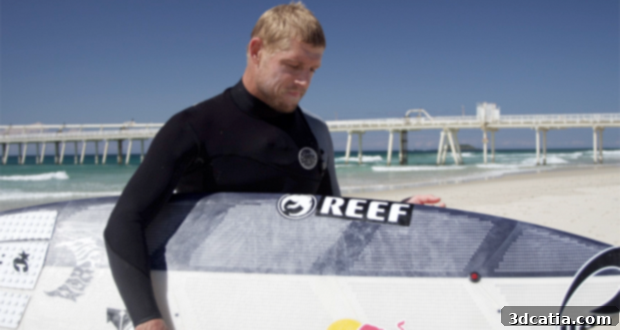
Revolutionizing Surfing: Mick Fanning’s 3D Printed Surfboard Pioneers Sports Innovation
For decades, industries like automotive and aerospace have spearheaded the adoption and advancement of 3D printing technology, leveraging its capabilities for rapid prototyping, complex geometries, and custom component manufacturing. However, the landscape of additive manufacturing is rapidly evolving, with new sectors increasingly recognizing its transformative potential. Among these emerging fields, the sporting industry is making significant waves, quite literally, by embracing 3D printing to redefine equipment design and performance. This paradigm shift is perhaps best exemplified by a groundbreaking project that has delivered a new 3D printed surfboard, offering an iconic sport a fresh, technologically advanced perspective.
At the forefront of this revolution is Mick Fanning, the legendary Australian professional surfer known globally as “White Lightning.” Fanning, a multi-time world champion celebrated for his powerful style and competitive spirit, has fearlessly dived into this cutting-edge technology. His experience riding a revolutionary 3D printed surfboard is not merely a novelty; it represents a pivotal moment, opening an entirely new door for innovation within the surfing world and beyond. This bespoke board, developed under the ambitious Red Bull High initiative and brought to life by Performance Engineer Brandon Larson, signifies a monumental breakthrough for 3D printing applications in high-performance sports equipment.
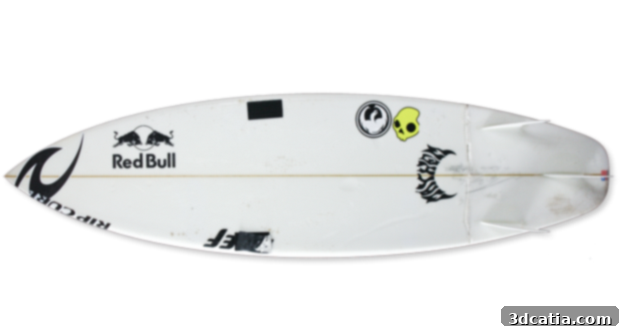
Fanning’s original surfboard, showcasing traditional craftsmanship.
The core philosophy behind this project was to push the boundaries of what’s possible with additive manufacturing. Brandon Larson eloquently articulated this vision, stating, “The whole point was to explore what was possible and see if you could create a 3D printed performance surfboard, and the answer is: absolutely you can.” This bold statement underscores the confidence in 3D printing’s capacity to not only replicate existing designs but to surpass them, offering performance enhancements previously unattainable. The project wasn’t just about printing a board; it was about leveraging the unique advantages of 3D printing to engineer a superior piece of equipment.
Unleashing Unprecedented Precision and Customization
One of the most compelling advantages of 3D printing in surfboard manufacturing lies in its ability to achieve unparalleled precision and customization. According to Fanning himself, the intricate shapes, subtle curves, and critical angles of his 3D printed board were crafted to perfection from nose to tail. Traditional surfboard shaping, while an art form, relies heavily on human skill and intuition, making it incredibly difficult to replicate complex geometries with absolute consistency and precision. Additive manufacturing eradicates these limitations, allowing for digital designs to be translated into physical objects with exacting accuracy, ensuring every detail is exactly as intended by the designer.
Furthermore, 3D printing facilitated the incorporation of minute, often complex details that are typically too challenging or labor-intensive to create by hand on a regular production basis. These intricate features, which can significantly influence hydrodynamics, speed, and maneuverability, were seamlessly integrated into Fanning’s board. By enabling such fine-tuned design elements, 3D printing elevates the board’s performance to an unprecedented level, contributing to what Fanning describes as “surfing perfection.” This level of detail offers a competitive edge, allowing designers to experiment with micro-features that optimize water flow, reduce drag, and enhance lift, areas where conventional manufacturing processes struggle to compete.
Aerospace Ingenuity Meets Ocean Dynamics
The project’s innovative approach wasn’t limited to the printing process itself; it also drew inspiration from highly advanced engineering principles, particularly those found in the aerospace industry. Larson explained, “We introduced techniques used in the aerospace industry when making plane wings and fuselage. It’s giving performance surfboards that F1 treatment.” This comparison is particularly insightful. Just as aerospace engineers optimize wing profiles and fuselage structures for maximum aerodynamic efficiency, strength-to-weight ratio, and stability at high speeds, the designers of Fanning’s board applied similar principles to hydrodynamics.
The application of aerospace techniques involved meticulous analysis of fluid dynamics – in this case, water – to optimize the board’s interaction with the ocean. This could involve using computational fluid dynamics (CFD) simulations to predict water flow over the board’s surface, identifying areas of drag and lift, and then iteratively refining the design using 3D printing. By mimicking the structural integrity and lightweight design methodologies of aircraft components, the team could create internal lattice structures or hollow sections that provide exceptional strength without adding unnecessary bulk. This “F1 treatment” implies a no-compromise approach to performance engineering, where every gram and every curve is precisely calculated to deliver superior results.

Mick Fanning proudly displays his cutting-edge 3D printed surfboard.
The Multi-Part Manufacturing Process: From Digital to Physical
The creation of Fanning’s bespoke 3D printed surfboard was a complex, multi-stage process that highlights the capabilities and current limitations of large-format additive manufacturing. To accommodate the board’s size and intricate internal design, it was initially printed in 10 separate pieces. This modular approach is common in 3D printing for larger objects, allowing for greater detail and the use of smaller, more manageable print beds. The entire printing phase for these 10 components required approximately 100 hours of continuous operation, showcasing the time investment required for such specialized projects.
Once the individual parts were successfully printed, the next critical step involved meticulously piecing them together. Using advanced adhesives and precise alignment techniques, the sections were securely glued to form the full deck and core structure of the surfboard. This assembly process requires expert craftsmanship to ensure a seamless and robust bond. Following the structural assembly, the board underwent a crucial “glassing” stage, where it was sealed and reinforced with fiberglass and epoxy resin. This step is vital for waterproofing, protecting the printed material from the harsh marine environment, and providing the necessary rigidity and strength to withstand the forces encountered during high-performance surfing. The choice of materials for printing likely involved advanced polymers or composites designed for durability and specific mechanical properties, further enhanced by the traditional fiberglass finish.
Addressing the Weight Challenge: The Dissolvable Core Breakthrough
While the initial prototype of the 3D printed board demonstrated remarkable design capabilities, it presented a significant challenge: weight. Fanning openly admitted that the first iteration was considerably heavier than a regular surfboard, tipping the scales at a substantial 12 lbs. For a professional surfer, especially in competitive settings, excess weight can severely hinder maneuverability, speed, and overall performance. However, Proto3000, the innovative 3D printing company responsible for manufacturing the board, viewed this not as a setback, but as an engineering puzzle to be solved.
Proto3000’s engineers are confident in their ability to significantly reduce the board’s weight, making it a viable and even advantageous option for competitive surfing. The key to this breakthrough lies in a revolutionary concept: the “dissolvable core.” Chris McAloney, an engineer at Proto3000, elaborated on this ingenious solution: “One of the things we’ve been working on is a dissolvable core.” This method promises to unlock unprecedented lightweight design while maintaining structural integrity. The process involves 3D printing a solid core using a water-soluble or otherwise dissolvable material. Around this printed core, a high-performance fibrous material, such as carbon fiber or advanced fiberglass composites, is meticulously wrapped and then sealed with resin. Once the outer structural shell is cured and solidified, the dissolvable core is flushed out using a specific solvent, leaving behind a precisely engineered, hollow, and incredibly lightweight structure.

This ‘dissolvable core’ technology is a game-changer. It allows for the creation of intricate internal lattice structures or optimized hollow cavities that are impossible to achieve with traditional foam blanks or even with direct 3D printing of solid, heavy materials. By strategically removing internal material, designers can control the board’s flex patterns, buoyancy, and weight distribution with extreme precision. This innovative approach ensures that the board can be tailored not only for a surfer’s body and style but also for specific wave conditions, offering a level of personalization and performance optimization that could fundamentally transform how surfboards are designed and used in the future.
The Future of 3D Printing in Sports: Beyond the Surfboard
While Mick Fanning’s 3D printed surfboard is a prominent and exciting example, it is by no means the first application of additive manufacturing in sports. However, this particular initiative promises considerable and far-reaching benefits for the future of 3D printing throughout the entire sports industry. The ability to rapidly prototype, iterate designs, and produce highly customized, performance-optimized equipment is invaluable. Imagine running shoes with perfectly tuned midsoles, cycling components that maximize aerodynamics for individual riders, or protective gear tailored precisely to an athlete’s anatomy for enhanced safety and comfort. 3D printing facilitates a design freedom that allows for intricate lattice structures, organic shapes, and multi-material components, all of which contribute to superior performance across various athletic disciplines.
This technology also holds immense promise for sustainability. As material science advances, the potential to use recycled or bio-based filaments, coupled with reduced material waste during manufacturing compared to subtractive methods, could make sports equipment production more environmentally friendly. Furthermore, rapid localized production could reduce supply chain complexities and shipping emissions. The “White Lightning” surfboard project serves as a beacon, illustrating how elite athletes, cutting-edge engineers, and innovative manufacturing processes can converge to push the boundaries of human performance and technological achievement.
To delve deeper into this fascinating project and witness the innovation firsthand, explore the dedicated Red Bull page here, or watch the captivating video presentation detailing its development and Mick Fanning’s experience. This pioneering effort represents more than just a new surfboard; it’s a testament to the boundless possibilities when traditional sports meet the power of additive manufacturing, heralding an era of unprecedented customization, performance, and innovation in athletic equipment.
What are your thoughts on this revolutionary 3D printed surfboard and its implications for the future of sports? We invite you to share your insights in a comment below or join the conversation on our Facebook and Twitter pages. For the latest updates, breaking news, and in-depth analyses from the world of additive manufacturing, don’t forget to sign up for our free weekly newsletter, delivered straight to your inbox!