
RAPID + TCT 2024: Unveiling Groundbreaking Innovations in Additive Manufacturing and 3D Printing Technologies
The world of additive manufacturing (AM), often referred to as 3D printing, is evolving at an unprecedented pace. Keeping track of the latest breakthroughs, revolutionary technologies, and transformative applications can be a significant challenge, even for industry veterans. This is precisely why premier events like RAPID + TCT are indispensable. As a leading global authority in additive manufacturing, RAPID + TCT consistently serves as a critical barometer for the industry, showcasing the most intriguing and impactful innovations each year. In a concerted effort to bring these cutting-edge developments directly to our audience, 3Dnatives, in collaboration with SME, proudly presents an in-depth look at some of the most captivating technologies and applications unveiled at RAPID + TCT 2024.
Our Content Specialist, Madeleine Prior, embarked on an exciting journey through the exhibition halls in Los Angeles, immersing herself in the myriad of advancements shaping the future of industrial 3D printing. Her mission was to identify the truly groundbreaking machines and applications that promise to redefine manufacturing processes across various sectors. From the high-octane world of Formula 1 racing, where additive manufacturing delivers unparalleled performance advantages, to the emergence of innovative binderless and laser-less powder technologies that challenge conventional wisdom, this report delves into what we considered the most compelling highlights of RAPID + TCT 2024. These innovations are not just incremental improvements; they represent significant leaps forward, offering new possibilities in material science, design freedom, production efficiency, and sustainability. Discover our top choices and witness these incredible advancements firsthand by watching the exclusive video below:
Deep Dive into RAPID + TCT 2024: Pioneering the Future of Additive Manufacturing
The energy at RAPID + TCT 2024 was palpable, reflecting an industry surging with innovation and growing adoption. Attendees witnessed a convergence of groundbreaking hardware, advanced materials, sophisticated software, and real-world applications that are pushing the boundaries of what’s possible with 3D printing technology. This annual event is not merely an exhibition; it’s a vibrant forum where ideas are exchanged, partnerships are forged, and the future trajectory of additive manufacturing is shaped. Our exploration focused on innovations that demonstrated significant potential for scalability, efficiency, and disruptive impact across key industries.
The Revolutionary Landscape of Binderless, Laser-less Powder Technologies
Among the most intriguing developments highlighted at RAPID + TCT 2024 were the advancements in binderless and laser-less powder technologies. These emerging additive manufacturing processes represent a paradigm shift from traditional powder bed fusion methods that typically rely on high-energy lasers or binders to fuse material. The implications are profound, offering solutions that could dramatically lower energy consumption, reduce manufacturing costs, and expand the range of compatible materials. Imagine producing complex metal or ceramic parts without the intense heat associated with lasers, or without the subsequent debinding and sintering steps required by many binder jetting processes.
These innovative approaches often leverage cold processes or novel chemical reactions to consolidate powder particles. For instance, cold spray additive manufacturing, a robust technique gaining traction, deposits materials at supersonic speeds, forming dense parts without melting the material. Other concepts explored at the show hinted at new forms of solid-state additive manufacturing that circumvent the need for binders or lasers entirely, opening doors to previously unprintable materials, including high-temperature alloys or composite structures that degrade under conventional thermal processing. The benefits extend beyond material versatility; these technologies promise enhanced material properties due to minimized thermal stresses, improved surface finishes, and the potential for larger build volumes at a lower operational expenditure. This advancement signifies a major step towards making additive manufacturing more sustainable, accessible, and versatile for a broader range of industrial applications.
Formula 1: Driving Performance Through Advanced 3D Printing
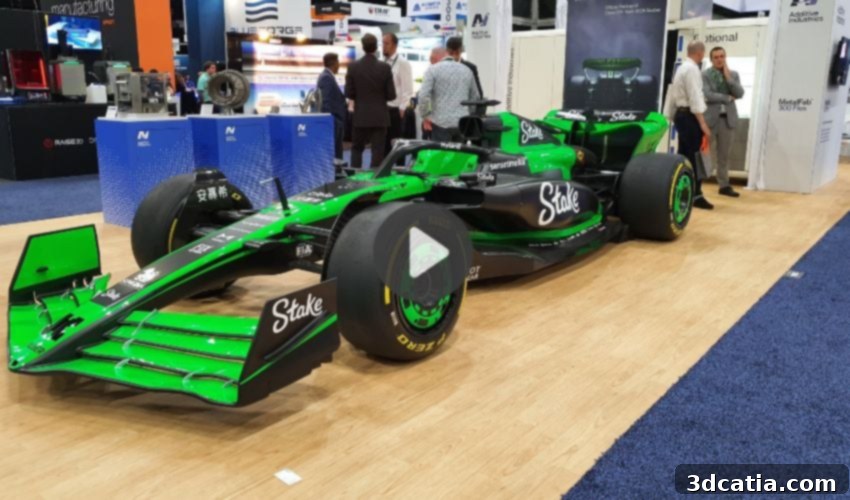
The world of Formula 1 racing stands as a testament to the power of additive manufacturing in achieving unparalleled performance. At RAPID + TCT 2024, the presence of F1 applications underscored how 3D printing is not just an advantage, but a critical necessity for competitive teams. F1 cars are marvels of engineering, where every gram saved and every aerodynamic efficiency gained can mean the difference between victory and defeat. Additive manufacturing empowers engineers to rapidly prototype, iterate, and produce highly complex, lightweight components that would be impossible or prohibitively expensive to create with traditional manufacturing methods.
Exhibits at the event showcased how AM is utilized across various critical areas of an F1 vehicle. From intricate aerodynamic elements like bespoke wing components and cooling ducts with optimized internal geometries, to lightweight chassis structures and complex gearbox parts, 3D printing enables engineers to push design boundaries. High-performance polymers such as PEEK, reinforced carbon fiber composites, and specialized metal alloys are common materials, offering exceptional strength-to-weight ratios and thermal resistance. Furthermore, AM plays a crucial role in creating custom tooling, jigs, and fixtures for assembly, streamlining the manufacturing process and ensuring precision. The ability to quickly produce multiple design iterations allows teams to respond rapidly to performance data and track conditions, giving them a vital competitive edge in a sport defined by relentless innovation and speed.
Expanding Horizons: Broader Industry Impact and Machine Advancements
While Formula 1 provides a thrilling showcase, the innovations seen at RAPID + TCT 2024 have far-reaching implications across numerous sectors. The medical field, for instance, continues to benefit immensely from patient-specific implants, prosthetic devices, and surgical guides that offer unprecedented levels of customization and efficacy. Aerospace manufacturers are leveraging AM for lighter, more fuel-efficient components with optimized internal structures, reducing both weight and material waste. The automotive industry is increasingly employing 3D printing for tooling, spare parts, and bespoke customization options, moving towards more agile and sustainable production lines.
Beyond specific applications, the event also highlighted significant advancements in the additive manufacturing hardware itself. We observed new machines boasting larger build volumes, enabling the production of bigger parts or higher throughput of smaller components. Increased printing speeds, enhanced accuracy, and improved multi-material capabilities were common themes, indicating a maturing industry focused on industrial-scale production. User interfaces are becoming more intuitive, making advanced AM accessible to a broader range of engineers and technicians. Coupled with these hardware advancements, software solutions for design optimization, simulation, process monitoring, and quality control are becoming increasingly sophisticated, creating a more seamless and integrated digital workflow from concept to final part. These integrated solutions are critical for widespread industrial adoption, ensuring reliability and repeatability in complex manufacturing environments.
Sustainability and Digitalization: Cornerstones of Future Additive Manufacturing
RAPID + TCT 2024 also placed a strong emphasis on the industry’s commitment to sustainability and digitalization. The discussions around greener additive manufacturing processes included the development of more recyclable and biodegradable materials, energy-efficient machines, and strategies to minimize waste throughout the production lifecycle. The inherent ability of AM to produce near-net-shape parts and consolidate assemblies already contributes to material efficiency, but the industry is pushing further, exploring closed-loop recycling systems for powders and filaments. This focus aligns with global efforts to create more environmentally responsible manufacturing practices.
Furthermore, the integration of additive manufacturing into the broader Industry 4.0 framework was a prominent topic. Smart factories are increasingly leveraging the Internet of Things (IoT), artificial intelligence (AI), and machine learning to optimize 3D printing processes. Real-time data analytics can monitor print parameters, predict potential failures, and automate adjustments, leading to higher success rates, reduced material waste, and improved part quality. This digitalization not only enhances efficiency but also provides unprecedented traceability and control over the entire additive manufacturing workflow, paving the way for fully automated, lights-out production facilities. These developments underscore a future where additive manufacturing is not just a technology for creating parts, but a fully integrated, intelligent, and sustainable manufacturing ecosystem.
What were your favorite innovations from RAPID + TCT 2024? Which particular technology or application captivated your interest the most? We encourage you to share your thoughts and insights in the comments section below, or engage with us on our LinkedIn, Facebook, and Twitter pages! Don’t miss out on the latest advancements and industry news; sign up for our free weekly newsletter here to get the freshest 3D printing updates delivered straight to your inbox! You can also find all our comprehensive video content and interviews on our official YouTube channel.