
Mastering 3D Printing Supports: An Essential Guide to Optimizing Additive Manufacturing
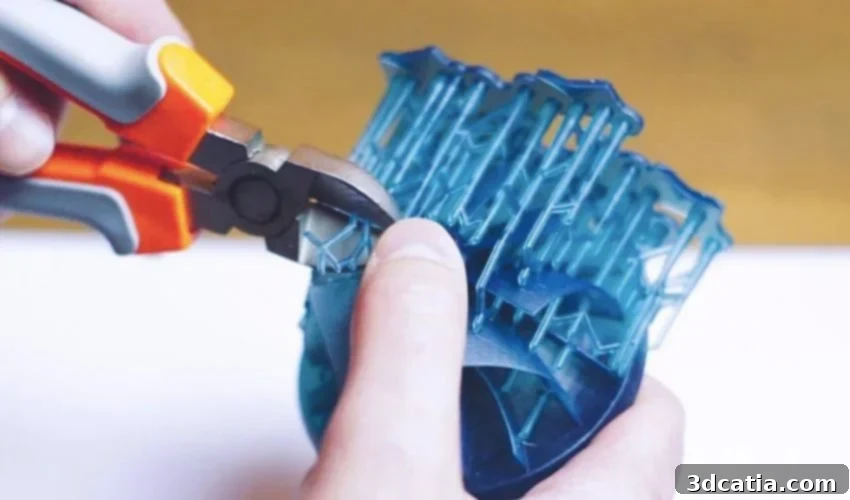
Additive manufacturing, commonly known as 3D printing, empowers creators with unparalleled design freedom, enabling the production of highly complex and intricate parts that would be impossible with traditional manufacturing methods. However, bringing these sophisticated designs to life often necessitates an intermediate but crucial step: the strategic use of support structures. In essence, 3D printing supports are temporary structures designed to brace unsupported areas of a part during the printing process. While the concept might seem straightforward, effectively configuring and utilizing these supports can be quite challenging for both novice and experienced users. Common questions frequently arise, such as when supports are truly indispensable, how they can be removed without damaging the final product, and what potential drawbacks their implementation might entail. To demystify these aspects and guide you toward successful prints, we’ve undertaken an in-depth exploration into the effective and optimized use of supports within the realm of additive manufacturing.
The Influence of Technology on 3D Printing Support Structures
When considering the integration of support structures into your 3D printing workflow, it’s paramount to understand that their type, design, and necessity are heavily dependent on the specific 3D printing technology being employed and the complexity of your model. Each additive manufacturing process has unique operational principles that dictate how and when supports are required.
For instance, in Fused Deposition Modeling (FDM) 3D printing, two fundamental rules often guide the need for support structures: the 45-degree rule and the 5-millimeter rule. The 45-degree rule refers to the maximum angle an overhang can have relative to the vertical axis before requiring support. If a part’s overhang angle is less than 45 degrees from the vertical, the FDM printer can typically build this section without external supports, as each successive layer has enough previous material to adhere to. This works because each new layer slightly overlaps the one below it, effectively building out gradually. However, if the angle exceeds 45 degrees, the machine will struggle to stack layers properly, leading to drooping, warping, or print failure, thus necessitating support structures. The 5-millimeter rule, on the other hand, pertains to horizontal bridges – unsupported spans between two points on a part. It states that supports are generally not required if a bridge is shorter than 5 mm. For distances greater than this, printing problems such as significant sagging can occur. To successfully connect two parallel points without supports, the printer utilizes a technique called “bridging,” where the hot material is stretched across the short distance, cooling rapidly in the air to minimize sag and create a stable connection. Mastering these rules can significantly reduce material waste and post-processing time in FDM.
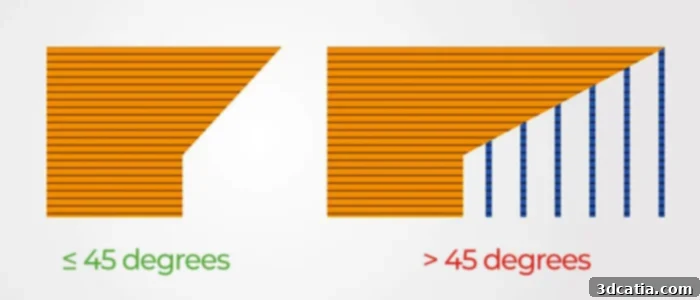
The 45-degree rule is a crucial guideline for FDM 3D extrusion printing.
In contrast to FDM, resin 3D printing technologies like Stereolithography (SLA) or Digital Light Processing (DLP) operate by photopolymerizing liquid resin with a light source, curing it layer by layer to produce the final part. These technologies are renowned for their exceptional precision, capable of producing incredibly small and highly detailed objects with smooth surface finishes. A key characteristic of many resin printers is their inverted printing process: the build platform moves upwards, pulling the cured part out of the resin vat. For this reason, and to ensure optimal adhesion to the build platform while minimizing peeling forces, resin prints almost always require supports. These structures typically appear as thin columns with minimal, strategically placed contact points on the model, designed to save both material and manufacturing time. Advanced slicing software plays a critical role here, automatically calculating the optimal number of supports, their precise positions, and where they will contact the part. These calculations are heavily influenced by the part’s geometry and complexity. With careful post-processing, especially when removing supports, resin 3D printing with well-configured support structures should not compromise the exceptional quality of the finished part, leaving behind a virtually flawless surface.
Within additive manufacturing, another significant category of technologies relies on a powder bed for part production. This group includes processes such as Selective Laser Sintering (SLS) for polymers, Direct Metal Laser Sintering (DMLS), Electron Beam Melting (EBM), and Binder Jetting. For polymer-based laser processes like SLS or Multi Jet Fusion, a distinct advantage is that support structures are generally not required. This is because the unsintered powder surrounding the printed part acts as a natural, self-supporting bed for each new layer, negating the need for dedicated support material. This inherent self-supporting characteristic offers immense design freedom, allowing for highly intricate geometries and nesting multiple parts within the build volume, which can optimize batch production. While this eliminates the need for support removal, it often increases the cost and time associated with the post-processing steps like powder removal and surface finishing.
However, the situation changes dramatically when working with metal additive manufacturing technologies (DMLS, EBM). While the powder still surrounds the part, the term “supports” takes on a different, more critical meaning. Robert Chiari, sales manager at DMG MORI, explains, “Because of the stresses inherent in metals, especially high-strength materials like titanium, the material can warp, deform, or even break away from the structure below. So, the support is actually a robust anchoring plate or lattice that serves to firmly secure the part to the build platform during the entire construction process.” These metal supports are vital for several reasons: they anchor the part to the build plate to prevent warping caused by extreme thermal gradients (rapid heating and cooling of molten metal), and they facilitate the dissipation of heat away from the part, which is crucial for maintaining material integrity, preventing internal stresses, and achieving desired mechanical properties. Without these robust anchoring structures, the intense thermal expansion and contraction during metal printing would lead to severe part distortion or detachment from the build plate, making successful printing almost impossible.
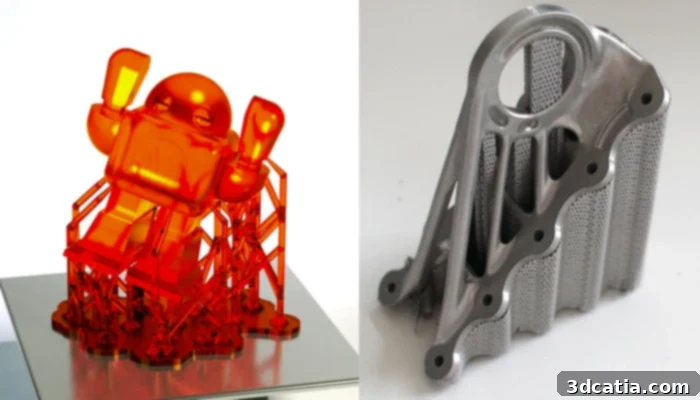
Left: a 3D part printed with resin. On the right, a “cockpit support” of the Airbus A350 XWB.
In Material Jetting 3D printing, liquid photopolymers are jetted onto the build plate, layer by layer, and then instantly cured by an ultraviolet light source. This technology, similar to FDM and resin printing in some aspects, consistently requires support structures whenever any part of the product protrudes or forms an overhang, regardless of the angle or slope of the preceding layer. The supports in material jetting are typically made from a different material, often a wax-like substance, designed for easy removal. These supports can be efficiently removed through various post-processing steps, such as ultrasonic baths, water blasting, or even manual peeling. A significant advantage of material jetting supports is that their removal typically does not affect the surface finish of the printed parts. It is remarkably difficult to discern where supports were used after proper post-processing, resulting in a significantly smoother and cleaner part surface compared to technologies where support removal can leave noticeable marks or require extensive sanding.
Exploring Diverse Types of 3D Printing Support Structures
While the fundamental function of support structures – to brace and stabilize a part during additive manufacturing – remains consistent across technologies, their specific design and composition can vary significantly. Understanding these different types can help users select the most appropriate support strategy for their particular design and printing process.
Among the most popular support designs are the so-called **Lattice Girders** (also known as grid or line supports). These structures are characterized by their simple, often crisscrossing patterns, forming columns or walls that provide stable support for overhanging features and steep angles. Lattice girders are widely used due to their relative ease and speed of fabrication within the slicing software, as well as their broad compatibility with most extrusion-based printing processes. They offer good structural integrity. However, a primary drawback is that they can sometimes be challenging to remove, especially from intricate geometries or internal cavities. This difficulty in removal can potentially leave noticeable marks or blemishes on the part’s surface, necessitating additional post-processing like sanding or filing.
Another innovative type is **Tree Supports**, which are characterized by their organic, branching structure. These supports start with a broad “trunk” at the build plate and then develop into finer, delicate branches that extend upwards, contacting the printed model only at selected, strategic points. Tree supports are incredibly useful for supporting specific cantilevered sections of a part that require localized bracing but are not overly vertical or complex in geometry. Their main advantage lies in minimizing contact with the model, which significantly reduces the potential for surface damage and makes post-processing easier. They are particularly effective for models with complex curves or areas where minimal scarring is paramount.
Users also frequently employ **Linear Supports**, which are somewhat similar to lattice supports but often consist of more dense, vertical columns or walls that are in continuous contact with the entire length of the cantilevered member or bridge. While linear supports provide extremely robust and reliable support, ensuring a correct and stable impression of the part, they are often more difficult and time-consuming to remove. The extensive contact area means they are more likely to leave noticeable marks or surface imperfections, potentially damaging the aesthetic quality of the model if not handled carefully during post-processing.
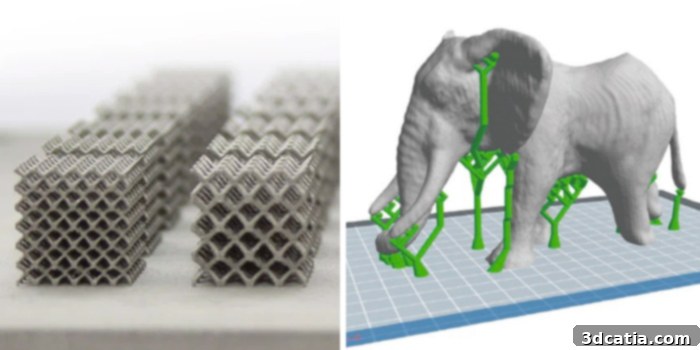
Left: a lattice structure. Right: tree supports.
Finally, regarding material composition, **Soluble Support Materials** represent a significant advancement in 3D printing. These innovative structures are typically produced using dual extrusion 3D printers, where one nozzle prints the model material and the other prints the soluble support material. The key benefit of soluble supports is their effortless removal: they can be dissolved by simply immersing the printed part in water or a specialized solvent. This method completely eliminates the need for manual scraping, cutting, or sanding, thereby preventing any potential damage to the delicate surfaces of the final product. Well-known soluble materials include PVA (Polyvinyl Alcohol), which dissolves in water, and HIPS (High Impact Polystyrene), which dissolves in limonene. More advanced soluble materials, such as AquaSys 180 (developed by Infinite Material Solutions), are also emerging, offering compatibility with high-performance model materials and better heat resistance during printing.
Strategies for Optimizing the Use of 3D Printing Supports
While 3D printing supports are indispensable for achieving complex geometries and ensuring the structural integrity of challenging parts, their effective implementation requires careful consideration. Understanding the function of supports and the advantages they offer is crucial, but it’s equally important to acknowledge and mitigate their associated disadvantages. Beyond enabling design freedom and ensuring the final quality of intricate models, the use of these structures also introduces a number of trade-offs that need to be managed for optimal results.
The primary disadvantage concerns the post-processing required for support removal. Without proper and careful post-treatment, the aesthetics and even the functional performance of the final product can be significantly compromised. Rough removal can leave unsightly marks, roughened surfaces, or even damage delicate features. An exception to this rule is often seen in processes like material jetting or with soluble supports, where removal is cleaner and less destructive. However, for most FDM or resin prints, manual removal demands skill and patience. Furthermore, the more supports configured within the slicing software, the more material is consumed, the longer the print time, and the greater the effort and time invested in post-processing. This is closely related to the obvious amount of material required to manufacture the supports themselves, which adds to the overall cost and environmental footprint.
To truly optimize the use of support structures in additive manufacturing, several key aspects should be carefully considered during the design and preparation phases. First, **part orientation** on the build plate is paramount. By carefully orienting the model, designers can significantly reduce the need for supports, minimize overhangs, and place necessary supports in less visible or critical areas. Second, **minimizing contact points** and adjusting **support density and pattern** in the slicer software can reduce material consumption and ease removal without compromising structural integrity. Using sparse support infills or specific patterns like zigzag or lines can be more efficient than solid structures. Third, considering the **post-processing workflow** during the design phase can influence support placement and type. For instance, designing parts with break-away features or opting for soluble supports if dual extrusion is available can streamline the entire process. By meticulously adjusting these parameters – including layer height, print speed, support interface settings, and infill percentages – we can achieve not only a substantial reduction in printing time and material usage but also a decrease in overall manufacturing cost and lead times, leading to more efficient and aesthetically pleasing final parts.
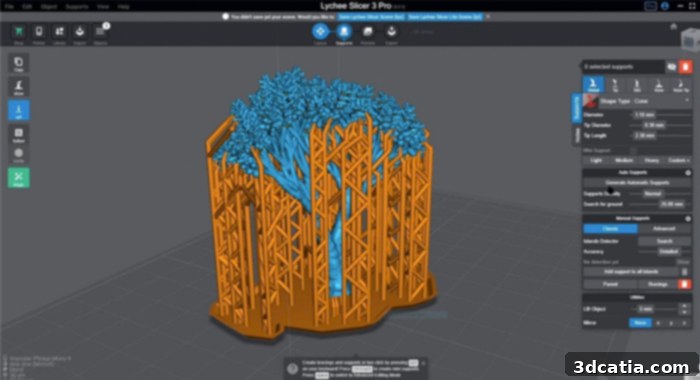
Photo Credits: Lychee Slicer
In summary, the strategic use of supports in additive manufacturing is often an unavoidable necessity when dealing with complex parts, models featuring significant overhangs, or designs that demand high precision and structural integrity. However, it is fundamentally important for users to possess a comprehensive understanding of the specifics of each 3D printing technology, the various types of support structures available, and the best practices for their configuration and removal. By gaining this knowledge, designers and engineers can make informed decisions, configure support structures optimally, and ultimately leverage these temporary aids to achieve the highest quality final parts while minimizing waste and post-processing challenges. Mastering supports transforms them from a necessary evil into a powerful tool for unlocking the full potential of 3D printing.
What are your thoughts on this comprehensive guide to support structures for 3D printing? We invite you to share your experiences and insights in a comment below or join the discussion on our Facebook, Twitter and LinkedIn pages! Don’t miss out on the latest advancements and news in the world of additive manufacturing; sign up for our free weekly Newsletter here, delivered straight to your inbox!
*Cover Photo Credits: Hubs