
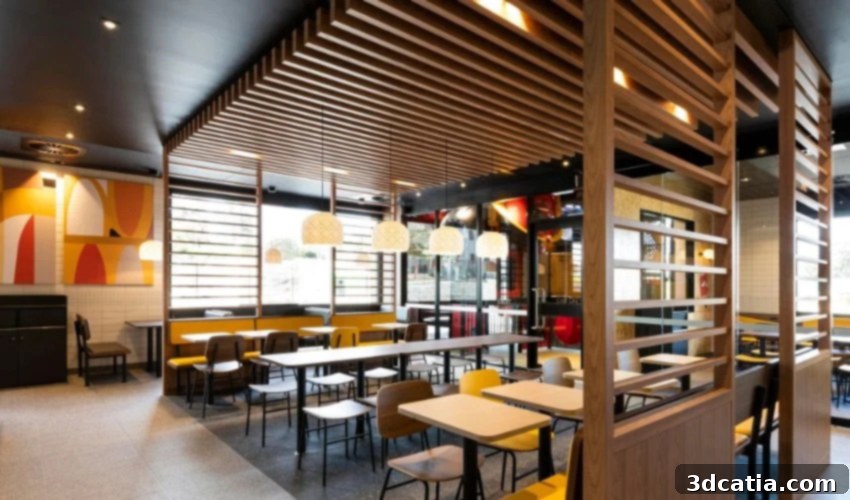
How McDonald’s Leveraged 3D Printing for Sustainable and Iconic Restaurant Lighting
In an innovative move that redefines restaurant aesthetics and sustainability, fast-food giant McDonald’s recently turned to cutting-edge 3D printing technology. This wasn’t for designing new menu items, but rather for an equally crucial, yet often overlooked, element of their global brand experience: the lighting fixtures in their restaurants. To achieve a very specific and challenging design vision, the multinational corporation partnered with lighting leader Philips and embraced additive manufacturing. This strategic decision came after numerous attempts to replicate their desired luminaire design through traditional production methods proved unsuccessful, highlighting the unique capabilities of 3D printing.
McDonald’s had a clear aesthetic in mind: they envisioned a translucent, circular luminaire (or lighting fixture) featuring an intricate embossed relief. The goal was for this design to create a visually captivating, shimmering velvet effect, adding a touch of sophisticated warmth to their restaurant interiors. By integrating 3D printing into their design and manufacturing process, McDonald’s not only achieved an almost perfect realization of their original creative concept but also made significant strides towards their ambitious sustainability targets by opting for durable and recyclable materials. This project underscores a growing trend where bespoke design meets environmental responsibility through advanced manufacturing.
The Drive for Sustainable Innovation at McDonald’s
McDonald’s is globally recognized not just for its food but also for its ambitious and forward-thinking sustainability goals. The company has publicly committed to reducing its carbon footprint by a remarkable 60% by the year 2030. Achieving such a significant reduction requires a holistic approach, scrutinizing every aspect of their global operations, from ingredient sourcing to restaurant construction and interior design. This commitment extends deeply into how their 38,000 restaurants worldwide are built, remodeled, and decorated, ensuring that sustainability is embedded in their infrastructure.
Marc Pochert, Senior Director of Global Design Integration at McDonald’s Corp, articulates the rigorous demands placed on their design and procurement teams: “We design for new store modelings and openings across the globe, for all of our 38,000 restaurants. We have a couple of requirements which are not discussable. So there are no off the shelf solutions. We want to own the IP rights and we need a scalable solution within a short lead time. It also needs high durability and we want it all at competitive cost.” This statement perfectly encapsulates the complex challenge McDonald’s faced: finding a manufacturing partner who could deliver a unique, proprietary design, ensure rapid, global scalability, guarantee long-term durability, all while maintaining cost-effectiveness and contributing to their overarching sustainability objectives.
The Quest for a Unique Lighting Design
The specific design McDonald’s sought for its luminaires was far from standard. They desired a unique translucent circular form, accented with an embossed relief that would create a distinct shimmering, velvet-like effect when illuminated. This particular aesthetic was crucial for creating the desired ambiance within their restaurants globally. Traditional manufacturing methods, however, proved inadequate for several reasons. Achieving such a complex, nuanced texture with consistent quality and scalability across thousands of units often presents significant hurdles with conventional injection molding or thermoforming processes. These methods often require expensive tooling and molds that are difficult to adapt for intricate designs, and they can struggle to replicate the precise surface finish required for the “shimmering velvet” effect.
The limitations of conventional manufacturing meant that McDonald’s was either forced to compromise on their design vision or incur prohibitive costs and extended timelines for custom tooling. This challenge underscored the need for an alternative approach, one that offered greater design freedom, material flexibility, and economic viability on a global scale. It was this impasse that led McDonald’s to explore the transformative potential of advanced manufacturing technologies.
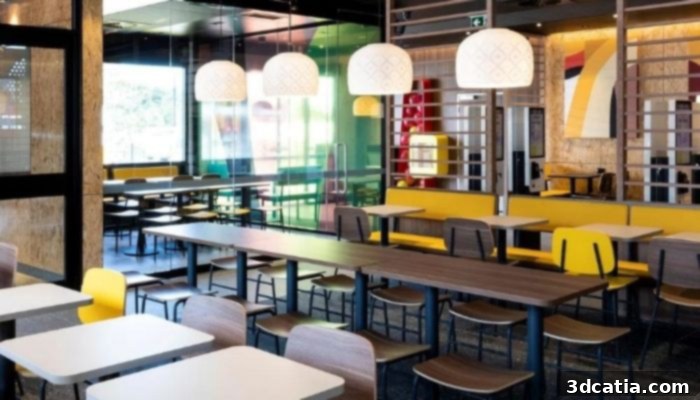
3D-printed luminaires were to have a shimmering effect
The Strategic Partnership with Philips MyCreation
Faced with these stringent requirements and manufacturing constraints, McDonald’s embarked on a search for a solution that was fast, sustainable, cost-effective, and highly flexible. This quest led them to Philips, a global leader in lighting, which offers a specialized co-creation service, prominently featuring 3D printing capabilities through its MyCreation platform. This collaboration proved to be a pivotal moment, as Philips MyCreation’s expertise in additive manufacturing aligned perfectly with McDonald’s complex needs.
The co-creation process allowed McDonald’s and Philips to work hand-in-hand, iteratively designing and refining the luminaire. Leveraging 3D technology, they were able to rapidly prototype various iterations of the spherical model. This iterative design freedom, a hallmark of additive manufacturing, was crucial for perfecting the intricate embossments and distinct patterns required to achieve the desired shimmering, velvet-like appearance. The ability to directly translate digital designs into physical objects without the need for traditional tooling significantly accelerated the development cycle and ensured the final product met McDonald’s exact specifications.
Additive Manufacturing: The Key to Unlocking Design Freedom and Efficiency
3D printing, or additive manufacturing, proved to be the ideal solution for McDonald’s for several compelling reasons, addressing each of Marc Pochert’s non-negotiable requirements:
-
Unparalleled Design Complexity: Additive manufacturing excels at producing highly complex geometries and intricate surface textures that are often impossible or prohibitively expensive with traditional methods. This capability was essential for creating the luminaire’s unique embossed patterns, with different designs at the top and bottom, which collectively produced the coveted shimmering, velvet-like effect. The precision of 3D printing ensured every detail was faithfully reproduced, maintaining consistency across all units.
-
Material Innovation and Sustainability: While the specific 3D printing process used was not explicitly detailed (possibly selective laser sintering or another polymer-based method given the translucent and durable nature), McDonald’s confirmed that the materials chosen were more durable and environmentally friendly. 3D printing enables the use of advanced, often recyclable, polymers that can withstand the demands of a commercial environment, contributing directly to McDonald’s sustainability goals by reducing waste and extending product lifecycle. Furthermore, additive processes are inherently material-efficient, typically using only the necessary material and generating less waste compared to subtractive manufacturing.
-
Speed and Agility: The rapid prototyping capabilities of 3D printing significantly compressed the design and validation timeline. It took just three months from the initial concept to the validation of the final design and the commencement of production. This swift turnaround is virtually unheard of in traditional manufacturing for a custom product of this scale and complexity, demonstrating the agility that 3D printing brings to product development.
-
Localized Production and Supply Chain Optimization: One of the most significant advantages of this collaboration is Philips’ ability to produce the luminaires locally, as close as possible to McDonald’s restaurants across the globe. Considering McDonald’s presence in over 100 countries, localized manufacturing dramatically reduces shipping distances, associated costs, and the carbon footprint related to logistics. This strategy not only enhances supply chain resilience but also aligns perfectly with McDonald’s carbon reduction targets by minimizing transportation emissions. It represents a fundamental shift from centralized mass production to distributed, on-demand manufacturing.
-
IP Ownership and Scalability: By developing a unique design through co-creation with Philips, McDonald’s retained full intellectual property rights, safeguarding their distinct brand identity. The scalability of 3D printing, especially through an established partner like Philips MyCreation with a global production network, ensures that these custom luminaires can be replicated efficiently and consistently across thousands of restaurants worldwide, meeting the demand for new openings and remodels without sacrificing quality or design integrity.
Crafting the Shimmering Velvet Effect: A Closer Look at the Luminaires
The meticulous design and production process ultimately yielded a spherical luminaire that truly embodies the artistic vision. Its surface is characterized by carefully crafted embossments, featuring distinct patterns on both the top and bottom sections. This intentional design creates a dynamic interplay of light and shadow, which, when illuminated, produces the highly sought-after shimmering, velvet-like appearance. This effect adds depth and texture to the light, transforming a functional object into a captivating design feature that enhances the overall atmosphere of the restaurant.
The ability of 3D printing to achieve such precise and consistent surface finishes was critical here. Whether it involved a method like Selective Laser Sintering (SLS), which uses a laser to fuse powdered material, or another polymer additive manufacturing technique, the technology allowed for the creation of micro-textures and intricate geometries that are challenging, if not impossible, to achieve with traditional molding processes. This level of detail is what gives the luminaires their unique aesthetic appeal and ensures they stand out as bespoke design elements within McDonald’s restaurants worldwide. Furthermore, the selection of materials through this process emphasized durability, crucial for high-traffic commercial environments, ensuring a long lifespan and reduced need for replacements, another win for sustainability.
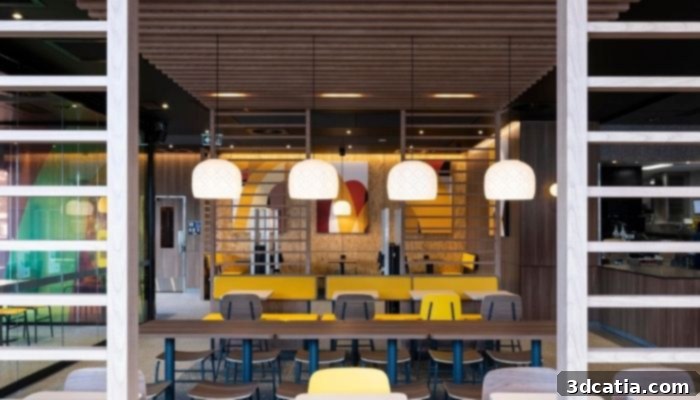
McDonald’s opts for sustainability through 3D printing
A Vision Realized: Marc Pochert’s Endorsement
The success of this collaborative project is perhaps best summarized by Marc Pochert himself. Reflecting on the outcome and the partnership, he enthusiastically states, “It really shimmers like velvet. The pattern is just stunning. The way we cooperated with Philips MyCreation was a great learning for us. Their capabilities. The innovation piece. We were happy to discover them as a perfect partner that can deliver on a global scale. Whenever it comes to new designs, Philips MyCreation will be our first contact to create and develop unique luminaires.”
Pochert’s comments highlight several key takeaways: the aesthetic triumph of the design, which perfectly captured the initial vision; the invaluable learning experience gained by McDonald’s through engaging with advanced manufacturing; and the profound satisfaction with Philips MyCreation as a strategic partner. This partnership not only solved an immediate design and production challenge but also established a template for future innovation. It signifies McDonald’s commitment to exploring cutting-edge technologies to enhance customer experience, uphold brand identity, and achieve critical sustainability milestones. The trust forged in this project positions Philips MyCreation as a preferred partner for McDonald’s future design endeavors requiring bespoke, globally scalable, and sustainable solutions.
For those interested in delving deeper into the specifics of this groundbreaking collaboration, more details can be found by clicking HERE.
Beyond Lighting: The Broader Impact of 3D Printing in Retail and Hospitality
The McDonald’s and Philips MyCreation partnership for restaurant luminaires serves as a powerful case study, illustrating the broader implications of additive manufacturing in the retail and hospitality sectors. This project goes beyond simply creating a visually appealing light fixture; it represents a significant shift in how large, global enterprises can approach custom design, supply chain management, and sustainability.
For industries characterized by extensive global footprints and a constant need for brand consistency, 3D printing offers unprecedented advantages. It enables businesses to move away from generic, off-the-shelf solutions towards highly customized, branded elements that reinforce their unique identity. This level of customization, once considered cost-prohibitive for mass deployment, becomes economically viable through the efficiencies of additive manufacturing, which eliminates the need for expensive molds and tooling, particularly beneficial for complex or low-volume parts.
Furthermore, the localized production capabilities demonstrated in this project are a game-changer for supply chain resilience. In an era where global supply chains face increasing disruptions, the ability to manufacture components closer to the point of use significantly reduces lead times, minimizes transportation costs, and mitigates risks. This decentralized manufacturing model also directly contributes to environmental sustainability by cutting down on freight emissions, aligning with corporate goals to reduce carbon footprints. McDonald’s pioneering adoption of this technology for a core element of its restaurant experience sets a new benchmark for how other retail and hospitality chains might leverage 3D printing to achieve their own design, operational, and sustainability objectives.
What do you think of McDonald’s decision to use 3D printing for its restaurant lighting? Let us know your thoughts in a comment below or connect with us on our LinkedIn, Facebook, and Twitter pages! Don’t forget to sign up for our free weekly newsletter here for the latest 3D printing news straight to your inbox! You can also find all our videos on our YouTube channel.
*All Photo Credits: Philips/McDonald’s