
Transforming Vision: How 3D Printing and Materialise Deliver Personalized, Sustainable Eyewear Solutions
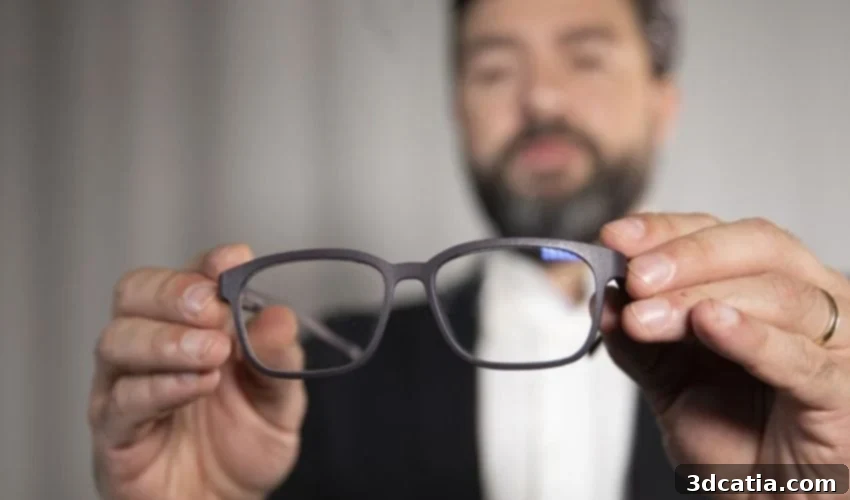
The advent of 3D printing has ushered in a new era for product manufacturing, allowing companies to transition from traditional mass production models to sophisticated mass customization. This revolutionary shift enables businesses to offer an extensive array of colors, styles, and designs, meticulously tailored to the individual preferences and tastes of each consumer. Going beyond mere aesthetic choices, advanced 3D technologies, such as precise facial scanning, empower companies to create truly personalized products that conform perfectly to the unique anatomical features and characteristics of every individual. For instance, in the eyewear industry, 3D printing facilitates the production of high-quality glasses frames using advanced materials like Polyamide 12 (PA-12), commonly known as Nylon. This particular 3D printing material is highly valued for its exceptional durability, flexibility, and abrasion resistance, making it an ideal choice for wearable products that demand both comfort and longevity. This brings us to Materialise, a pioneering Belgian company that has firmly established itself as an innovator within the dynamic eyewear market. Materialise leverages the power of 3D printing to craft high-end glasses, providing unparalleled design freedom for brands to fully realize their creative visions, while simultaneously offering customers a truly personalized and comfortable fit. To gain a deeper insight into the transformative role of 3D printing within the eyewear sector, we had the distinct pleasure of speaking with Alireza Parandian, the Head of Global Business Strategy for Wearables at Materialise.
3DN: You’ve been working with Materialise for over 7 years now, but when did you first get your start in additive manufacturing?
My journey into additive manufacturing began during my involvement in a significant EU-funded project, where I managed the networking component. This project was groundbreaking, representing one of the first major European initiatives focused on digital production. Through this extensive network, I first became acquainted with Materialise. Our work revolved around technology and application mapping, aiming to guide how emerging technologies could be effectively leveraged to create novel applications in various market sectors. As a crucial part of this project, I authored a paper exploring methodologies for identifying new applications, which ultimately illuminated the immense possibilities presented by additive manufacturing. At that time, additive manufacturing, or AM, was a nascent technology with a core value proposition centered on enabling unprecedented freedom of design – a capability that was simply unattainable with conventional manufacturing technologies. Indeed, for more than a century, manufacturing had seen incremental improvements in efficiency rather than truly disruptive innovations. The timing of my joining Materialise was particularly fortuitous, coinciding with the introduction of new materials and significantly faster 3D printing technologies. This convergence made additive manufacturing more economically viable and relevant for moving beyond prototyping into serial production, fundamentally altering its potential impact across industries.

Alireza Parandian, Head of Global Business Strategy, Wearables at Materialise. (Photo Credit: Materialise)
3DN: What are some of the specific issues consumers have with traditional glasses, and how does 3D printing solve these issues?
The most significant and pervasive challenge for consumers today is finding a pair of traditional glasses frames that fit them perfectly and comfortably. The reality is that every individual’s facial features are distinct – the shape and width of the nose bridge, the precise length of the temples, and the overall contour of the face are entirely unique to each person. This anatomical variability profoundly impacts not only the wearability and comfort of glasses but also the visual experience delivered by corrective lenses. To illustrate the scale of this problem, statistics show that a staggering 1 in 4 consumers regularly struggle to find glasses that fit properly, leading to discomfort, slippage, and suboptimal vision. Current mass manufacturing technologies for eyewear inherently limit the ability of brands to offer a truly diverse range of choices and sizes. It becomes incredibly difficult for them to adequately address the critical issue of personalized fit within their existing production paradigms. This is precisely where additive manufacturing (AM), or 3D printing, offers an elegant and powerful solution to achieve custom fit. With AM, manufacturers gain unparalleled flexibility in production, enabling them to create eyewear completely on-demand. Brands can utilize digital facial scans to produce a single, perfectly custom-fit frame, or they can offer an extensive range of sizing opportunities for individual components like temples and fronts, ensuring a much broader spectrum of personalized options.
A prime example of achieving complete customization is our innovative project, Yuniku. We are incredibly proud to have pioneered the creation of the first end-to-end digital supply chain that facilitates full customization of both frames and lenses, developed in a strategic partnership with Hoya. This groundbreaking platform allows consumers to be actively involved in the design process, fostering a strong, personal connection to their eyewear. When co-creating Yuniku with our partner Hoya, we developed a sophisticated digital platform specifically designed to enhance the interaction between eyewear professionals and their customers, thereby significantly improving the overall experience within optical retail environments. Another excellent example of a brand leveraging this technology to offer consumers access to a fit that is precisely tailored to their unique features is weareannu. This forward-thinking brand empowers consumers to design their frames from a curated selection of shapes, sizes, colors, and specialized nose-fit components, resulting in a truly tailor-made and comfortable eyewear solution.
1 in 4 consumers have trouble finding glasses that fit properly. (Photo Credit: Materialise)
3DN: What do you believe are some misconceptions consumers may have regarding 3D printing for eyewear?
A significant misconception consumers may hold about 3D printing for eyewear often stems from the initial hype surrounding home 3D printers in the 2010s. This early exposure led many to associate 3D printing with hobbyist-level machines producing relatively rudimentary objects. Consequently, people can still find it challenging to reconcile this image with the idea that premium, high-quality products, such as sophisticated eyewear, can be produced through industrial-grade 3D printing. However, what we’ve observed recently is a positive shift in consumer awareness regarding the true capabilities of advanced additive manufacturing technology. With this growing awareness, consumers are becoming more attuned to various aspects of their purchasing experience, including the quality and customization potential. They are also increasingly recognizing the substantial sustainability benefits offered by 3D printing and are beginning to view it not merely as a technology, but as a genuine solution for their specific needs, aligning with their values for both quality and environmental responsibility.
3DN: Can you tell us more about Materialise’s eyewear production product, Luxura?
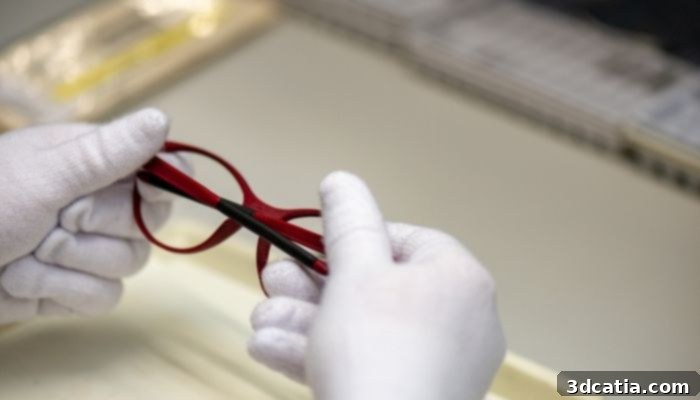
Luxura is the distinguished name for our premium, consumer-grade finish specifically developed for eyewear. This advanced finish masterfully combines cutting-edge automated techniques with the meticulous attention to detail found in atelier-style hand finishing. The result is a product that achieves the precise look and tactile feel that designers envision for their high-end collections. However, our comprehensive offering for eyewear extends far beyond just the finish itself. Materialise has developed a dedicated, end-to-end production process tailored uniquely for the eyewear industry. This process encompasses every stage, from the initial ideation and conceptual design, through rapid prototyping, and finally to scaled manufacturing for commercial production. We have meticulously engineered this production line to meet the unique, intricate, and often demanding needs of the eyewear sector in terms of product quality, aesthetic perfection, and rigorous performance requirements. Our approach goes significantly beyond merely printing the part; it delivers on every single aspect crucial to the creation of an entire eyewear collection. This includes collaborative work with brands to optimize their 3D designs, the creation of custom colors or selection from our extensive palette, and the crucial step of finding the perfect, exquisite finish that elevates the product to a premium standard.

(Photo Credit: Materialise)
3DN: What are some of the measurable business goals in Materialise’s eyewear division that align with sustainability initiatives?
At Materialise, our overarching goal in the eyewear division is to empower sustainable choices, enabling brands and businesses to construct models that align with their environmental objectives. We achieve this by offering a spectrum of options across production methods, material selections, and optimized supply chains. A key part of our sustainability drive involves continuously expanding our range of eco-friendly materials. A notable recent achievement in this area is the launch of PA11, a high-performance, bio-based material sourced from sustainable castor beans. This particular material offers a significantly reduced environmental footprint compared to traditional plastics, without compromising on the desired mechanical properties and aesthetic qualities required for premium eyewear. By integrating such innovative, bio-based materials and advocating for efficient, on-demand production processes inherent to 3D printing, we aim to minimize waste, reduce carbon emissions, and promote a more circular economy within the eyewear industry, making measurable progress towards a greener future.
3DN: Anything else you’d like to share with our readers?
For those particularly interested in delving deeper into the critical subject of sustainability in 3D printing for eyewear production, I highly recommend reading a recently released paper. This comprehensive study empirically explores the comparative sustainability impact of two prominent mass customization-oriented production methods – additive manufacturing (AM) and subtractive manufacturing – within the context of two complete eyewear production lines. The paper, titled “A Holistic View on Sustainability in Additive and Subtractive Manufacturing: A Comparative Empirical Study of Eyewear Production Systems,” offers valuable insights and can be accessed HERE. It provides a data-driven perspective on how different manufacturing approaches weigh against each other in terms of environmental impact, which is essential for informed decision-making in the industry.
Have you ever experienced the personalized fit or innovative design of products from Materialise, especially their eyewear? We would love to hear your thoughts and experiences in a comment below! You can also join the conversation and connect with us on our Linkedin, Facebook, and Twitter pages. Don’t miss out on the latest advancements and news in the exciting world of 3D printing – make sure to sign up for our free weekly Newsletter here, delivering the most important updates straight to your inbox! Additionally, you can explore all our insightful videos and compelling content on our dedicated YouTube channel for more in-depth coverage.