

Cold Spray Additive Manufacturing: Revolutionizing Metal Part Production and Repair
The world of additive manufacturing (AM) is vast and continuously evolving, presenting an array of innovative technologies that can initially seem boundless. While many of these techniques often fall into one of about seven primary categories, some stand out as unique deviations. Among these distinct methods is cold spray additive manufacturing – a fascinating process that leverages kinetic energy rather than thermal energy to build or repair metal parts. Unlike traditional AM processes that rely on melting and solidification, cold spray operates at significantly lower temperatures, opening up a realm of possibilities for materials that are sensitive to heat.
At its core, cold spray is a solid-state deposition technique. It involves accelerating finely atomized metallic powder particles to extremely high velocities – often reaching supersonic speeds, up to four times the speed of sound – using a high-pressure, heated gas jet. These particles are then directed onto a substrate, typically a metal, from a distance of approximately 25mm. Upon impact, the kinetic energy is so immense that the particles plastically deform and bond metallurgically with the substrate and previously deposited particles, forming a dense, cohesive layer. This unique bonding mechanism allows for either the creation of a protective coating over an existing component or, in the context of additive manufacturing, the fabrication of an entire, free-standing part. The original cold spray process was conceptualized and developed in the 1980s by a team of visionary researchers at the Institute of Theoretical and Applied Mechanics (ITAM) of the Siberian Branch of the Russian Academy of Science. Their initial discovery focused on the feasibility of coating solid particles using a gas flow at near-room stagnation temperature, setting the stage for decades of innovation in material deposition.
When applied specifically to additive manufacturing, cold spray technology transforms from a coating method into a powerful tool for constructing or repairing complex metal components. This is achieved through the precise control of a spray nozzle, often integrated with advanced robotic arms. These robotic systems meticulously manipulate either the substrate or the nozzle itself, enabling layer-by-layer material deposition to create intricate geometries. Each approach – moving the substrate or the nozzle – offers distinct benefits and limitations in terms of part size, complexity, and production efficiency. But what truly sets cold spray AM apart, and what specific advantages does it bring to the manufacturing landscape? What are its most impactful applications? Let’s delve deeper into this compelling technology and explore its potential.
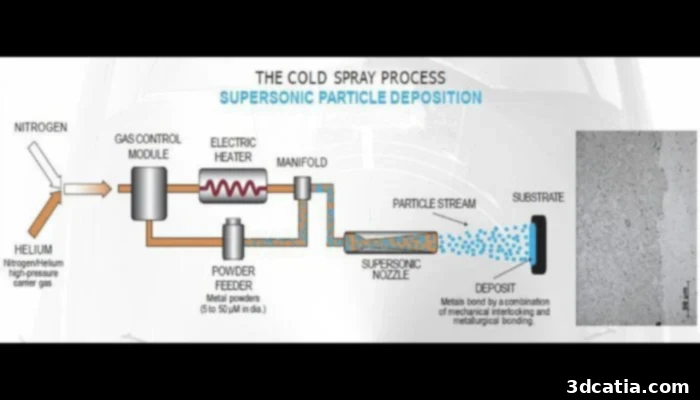
Photo credit: VRC Metal Systems
Understanding the Mechanics of Cold Spray Additive Manufacturing
To appreciate its benefits, it’s essential to understand how cold spray AM operates. The process begins with a stream of fine metallic powder, fed into a high-pressure gas stream. Nitrogen and helium are the most common gases used, with helium often preferred for its lower molecular weight, which allows for higher particle velocities and, consequently, better deposition efficiency for certain materials. This gas is then heated, but only to a moderate temperature (typically below 800°C), primarily to increase its speed and help prevent particle oxidation, not to melt the powder. The heated, high-velocity gas then propels the powder particles through a specially designed de Laval nozzle, which further accelerates them to supersonic speeds. As these particles strike the substrate, their immense kinetic energy causes them to deform plastically, essentially smashing and bonding together in a solid state. This impact creates a metallurgical bond, layer by layer, without ever reaching the melting point of the material. This solid-state bonding is the cornerstone of cold spray, distinguishing it from all fusion-based additive manufacturing methods and preserving the inherent properties of the feedstock material.
Benefits and Limitations of Cold Spray Additive Manufacturing
Cold spray additive manufacturing offers a unique suite of advantages, particularly when compared to conventional thermal spraying or other metal 3D printing techniques. One of its most significant benefits is the low-temperature nature of the process. Because the material temperature generally remains below 800°C, and often much lower, the method is exceptionally well-suited for temperature-sensitive materials. This includes advanced nanostructured materials, which can lose their unique properties when exposed to high heat, as well as oxygen-sensitive metals like titanium and aluminum, which are prone to oxidation and microstructural changes during thermal processing. In cold spray, the particles never melt, thereby avoiding issues such as phase transformations, thermal stresses, grain growth, and the formation of brittle intermetallic compounds that are common in fusion-based processes. This preservation of material integrity leads to deposited parts with superior mechanical properties, often mirroring or even exceeding those of the original bulk material.
Furthermore, cold spray AM boasts impressive production speeds, often significantly shorter than those of powder bed fusion techniques like Selective Laser Melting (SLM) and Electron Beam Melting (EBM), or directed energy deposition methods such as Laser Metal Deposition (LMD). Its high deposition rates mean parts can be built much faster, reducing overall manufacturing time and costs. Another compelling advantage is the relative independence of product size. While other AM methods might be constrained by build chamber dimensions, cold spray, especially with robotic integration, allows for the repair or creation of very large components. The material versatility is also remarkable; cold spraying can be performed with a wide array of different metals and their compounds, including common industrial metals such as aluminum, nickel, copper, steel, and titanium. It also handles precious metals like silver, gold, and platinum, as well as high-performance refractory materials. This broad material compatibility makes it a valuable tool across numerous industries. A particular niche where cold spray additive manufacturing truly excels is in the repair and refurbishment of corroded or damaged parts. This capability is especially critical in high-value sectors such as aerospace, defense, and oil & gas, where replacing entire components can be prohibitively expensive and time-consuming. By selectively depositing material, cold spray can restore worn surfaces, fill cracks, and rebuild geometries, significantly extending the lifespan of critical components.
Despite its numerous advantages, the cold spray technique is not without its limitations. One primary drawback is the relatively restrictive part geometry it can achieve compared to other advanced 3D printing methods. As a line-of-sight process, creating highly intricate internal features or significant overhangs can be challenging without support structures or multi-axis robotic control. While advancements are continuously being made, achieving the same geometric freedom as powder bed fusion technologies remains an area of ongoing research. Additionally, parts produced via cold spray can sometimes exhibit lower density and accuracy compared to highly precise laser or electron beam systems, though this largely depends on material, process parameters, and post-processing. Surface finish also tends to be rough, often necessitating post-milling or grinding operations to achieve the desired surface smoothness and dimensional precision for optimized shapes and critical tolerances. Another challenge can be material embrittlement, particularly with certain alloys, due to the intense plastic deformation and work hardening experienced by the particles upon impact. This can lead to increased residual stresses within the deposited material, which may require post-deposition heat treatments to relieve. Furthermore, compared to the broader landscape of 3D printing, the number of manufacturers offering robust cold spray additive manufacturing solutions is relatively limited, indicating a technology still maturing in the wider market, though adoption is growing rapidly.
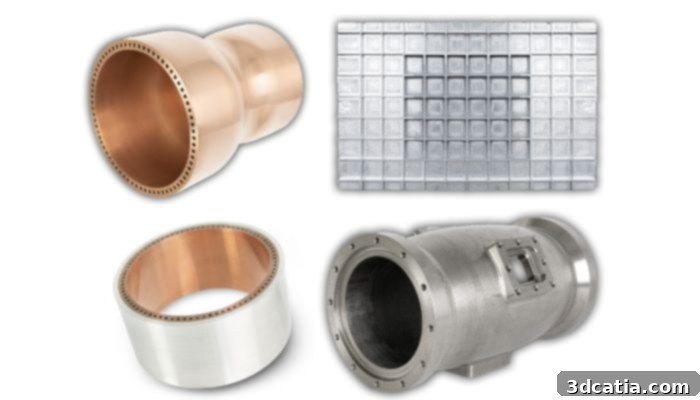
Parts made using cold spray additive manufacturing (Photo credit: Impact Innovations)
Pioneering Companies and Innovative Applications
Several innovative firms are at the forefront of advancing cold spray additive manufacturing, each bringing unique solutions to the market. One such leader is SPEE3D, an Australian company renowned for its patented ‘Supersonic Particle Deposition’ technology. Their systems, like the WarpSPEE3D 3D Metal Printer, boast an incredible speed, claiming to be up to 1000 times faster than traditional metal 3D printing methods such as binder jetting and Direct Metal Laser Sintering (DMLS). This remarkable speed, combined with material efficiency, allows SPEE3D to offer metal parts at a cost comparable to traditional casting processes, making them significantly more economical than many CNC-machined components. This makes rapid prototyping and on-demand production highly feasible for industries where speed and cost are critical.
Another well-established name in the field is Impact Innovations, a German company specializing in comprehensive cold spray solutions. They provide a full range of Cold Spray Systems, including advanced cold spray guns, precise powder feeders, intuitive control panels, efficient water cooling systems, and specialized powder preheaters. Their expertise lies in delivering robust, high-performance equipment designed for industrial applications. Similarly, VRC Metal Systems offers its own diverse selection of cold spray technologies, featuring highly versatile mobile cold spraying systems ideal for on-site repairs and maintenance, as well as several integrated solutions that combine cold spray with CNC machining for hybrid manufacturing capabilities, enabling both deposition and precision finishing in a single workflow. Beyond equipment manufacturers, companies like Höganäs of Sweden play a vital role by focusing on the development and production of specialized metal powders optimized for cold spray technology. The quality and composition of these powders are crucial for achieving desirable material properties in the final deposited part.
While cold spray additive manufacturing might seem like a niche technology given the relatively small number of solution providers compared to other AM methods, its impact on various industries is profound, demonstrating its immense potential through a series of impressive applications. For instance, as early as 2009, General Electric (GE) recognized the potential of cold spray and received a significant grant from the German government to fund their research into enhancing modern jet engines. Their initial efforts focused on utilizing the grant to manufacture large turbofan engine components – a type of jet engine critical for turbo propulsion in aircraft. This application resulted in ‘considerable’ cost savings and performance improvements, highlighting cold spray’s ability to create complex geometries and repair high-value components within stringent aerospace requirements. The technology can also be effectively employed to create robust grid structures that reinforce existing aerospace components, improving their structural integrity and extending their operational life. Furthermore, cold spray is being leveraged for critical rocket propulsion components, including the fabrication and repair of rocket combustion chambers and nozzles. SPEE3D, for example, has famously used its technology for everything from rapid prototyping of rocket components to various demanding military applications, showcasing its versatility and reliability in extreme environments. In the defense sector, cold spray offers invaluable capabilities for repairing damaged equipment in the field, rapidly manufacturing spare parts, and applying protective coatings to extend the life of military assets. Beyond aerospace and defense, potential applications span into automotive for lightweighting and repair of molds, energy for turbine repair and oil & gas infrastructure, and even biomedical fields for applying biocompatible coatings to implants.
Did you already know about the transformative potential of cold spray additive manufacturing? This solid-state technology is continually pushing the boundaries of what’s possible in metal part creation and repair, offering unparalleled advantages in material integrity and operational speed. We’d love to hear your thoughts and insights! Let us know in a comment below or connect with us on ourLinkedIn,Facebook, andTwitter pages! Don’t forget to sign up for our free weeklyNewsletter here, to get the latest 3D printing news delivered straight to your inbox! You can also find all our engaging videos and more content on ourYouTube channel.