

Sydney Pioneers E-Waste Recycling for 3D Printing Filament, Boosting Sustainable Manufacturing
Sydney, Australia, has taken a monumental leap towards a more sustainable future with the unveiling of a groundbreaking facility dedicated to transforming hard plastics from electronic waste into high-quality 3D printing filament. This innovative venture, a collaborative effort between the University of New South Wales (UNSW) and Renew IT, a leading IT asset management firm, marks a pivotal moment in the global pursuit of circular economy principles, especially within the rapidly evolving landscape of sustainable manufacturing.
Nestled in Lane Cove, New South Wales, the state-of-the-art facility is powered by the revolutionary Plastics Filament MICROfactorie™ Technology. Developed by the UNSW Centre for Sustainable Materials Research & Technology (SMaRT), this cutting-edge system possesses the remarkable ability to convert traditionally challenging hard plastic waste—ubiquitous in modern electronic devices—into valuable and reusable 3D printing materials. Professor Veena Sahajwalla, the visionary founder and director of the UNSW SMaRT Centre, articulated the profound significance of this project, stating, “We’re turning the hard plastics found in all modern electronic hardware but not subject to conventional recycling methods into feedstock for a booming sector. This isn’t just about recycling; it’s about upcycling waste into a resource that fuels innovation and sustainability in industries like 3D printing.”
The establishment of this facility is not merely an incremental improvement; it represents a paradigm shift. Historically, 3D printer filament in Australia, and indeed much of the world, has been primarily sourced from imported petrochemicals. This reliance on virgin plastics has significant environmental drawbacks, contributing to carbon emissions through production and global shipping, and depleting non-renewable resources. The new Sydney facility directly addresses these challenges by producing filament locally from recycled plastics. This localized production mitigates the environmental impact associated with long-distance transportation and drastically reduces the industry’s dependence on new plastic resources. Professor Sahajwalla passionately emphasized this transformation: “The tragedy is, until now, 3D printing has relied on virgin plastics. I look forward to a time when 3D printing feedstock is sourced exclusively from recycled plastics. This facility is a tangible step towards realizing that vision, proving that high-quality, sustainable alternatives are not only possible but commercially viable.”
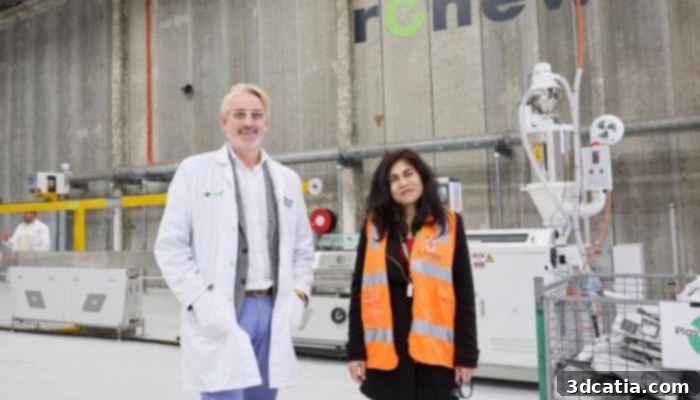
Renew IT Founder and CEO James Lancaster and UNSW SMaRT Centre Founder and Director, Professor Veena Sahajwalla. (Photo Credits: UNSW Sydney)
UNSW Vice-President for Societal Impact, Equity, and Engagement, Professor Verity Firth, underscored the immense potential for transformative change that this partnership embodies. By synergizing UNSW’s world-class research and innovative technological developments with Renew IT’s established commercial expertise in IT asset management, this collaborative venture is poised to tackle some of Australia’s most pressing environmental concerns, particularly the ever-growing challenge of electronic waste.
Addressing the Global E-Waste Crisis and Australia’s Role
In an era defined by rapid technological advancements and accelerated consumption cycles, electronic waste (e-waste) has escalated into a global environmental crisis. Products like televisions, computers, smartphones, and printers, despite their relatively short lifecycles, contribute significantly to hazardous waste streams. The sheer volume of discarded electronics poses a severe threat to ecosystems and human health, largely due to the presence of toxic materials. Traditionally, a substantial portion of this complex waste has been relegated to landfills, where valuable materials are lost, and harmful substances leach into the soil and water. However, this innovative facility in Sydney offers a robust and sustainable alternative, demonstrating how high-quality plastics from e-waste can be ingeniously repurposed, not merely recycled, but upcycled into new, in-demand products. It represents a proactive and practical solution to a problem that many regions are still struggling to contain.
James Lancaster, CEO and founder of Renew IT, candidly expressed his dissatisfaction with conventional disposal methods: “Dispatching hard plastics to landfill is not a solution that sits easily with me. It’s an unsustainable practice that wastes valuable resources and pollutes our environment. To re-purpose that plastic into a new product that’s increasingly in demand and which we can sell at a competitive price is a beautiful solution. It closes the loop, transforming what was once a burden into an asset, thereby creating both environmental and economic value.” This sentiment perfectly encapsulates the ethos behind the circular economy, where waste is minimized, and resources are kept in use for as long as possible.
The statistics surrounding Australia’s plastic waste challenge are sobering. The nation generates approximately 3.4 million tonnes of plastic waste annually, yet a mere 13% of this is currently recycled. Clean Up Australia highlights the significant economic ramifications of this inefficiency, estimating that about $419 million in economic value is lost each year due to unrecovered plastic waste. This represents not just an environmental cost but a substantial economic drain. Technologies like the Plastics Filament MICROfactorie™ offer a powerful antidote to this problem, promising to reclaim this lost value and unlock both substantial financial and environmental benefits. By converting electronic waste into readily usable 3D printing materials, this pioneering facility makes a multi-faceted contribution to national sustainability goals. It plays a critical role in significantly reducing the volume of plastic waste heading to landfills, invigorates local manufacturing sectors by providing a domestic source of raw materials, and empowers organizations to substantially lower their carbon emissions and environmental footprint by choosing recycled feedstock. This local solution offers a blueprint for how nations can tackle their waste problems while simultaneously fostering innovation and creating new economic opportunities within a burgeoning green economy.
The Broader Impact: Towards a Circular Economy for Additive Manufacturing
The significance of Sydney’s new e-waste recycling facility extends far beyond its immediate operational benefits. It represents a tangible step towards establishing a truly circular economy within the additive manufacturing industry. For years, the rapid growth of 3D printing has been accompanied by questions about its environmental footprint, particularly concerning material sourcing and waste. This initiative directly addresses these concerns by providing a viable, scalable model for closing the loop on plastic materials. By transforming discarded electronics into high-value filament, the project demonstrates that waste can be a resource, not just a problem to be managed. This shift has the potential to inspire similar ventures globally, fostering a new era of sustainable production where environmental responsibility is integrated into every stage of the product lifecycle.
Moreover, the partnership between UNSW and Renew IT serves as an exemplary model for university-industry collaboration. It showcases how academic research and technological innovation, when combined with commercial acumen and a commitment to sustainability, can yield practical and impactful solutions to complex societal challenges. The development of the MICROfactorie™ technology is a testament to the power of scientific inquiry to create tangible environmental benefits and economic opportunities. This collaborative spirit is crucial for accelerating the transition to a more sustainable future, encouraging knowledge transfer, and ensuring that groundbreaking research translates into real-world applications that benefit communities and the planet.
Future Outlook and Scalability
The potential for the Plastics Filament MICROfactorie™ Technology is immense. While the initial focus is on hard plastics from e-waste for 3D printing filament, the underlying principles of the MICROfactorie concept—modular, decentralized, and adaptable resource recovery—suggest a broader applicability. This model could potentially be scaled to process other challenging waste streams, converting them into valuable new products for various industries. Imagine similar facilities processing textiles, glass, or other types of plastics, all locally, efficiently, and with minimal environmental impact. The Sydney facility is not just a solution for e-waste; it is a proof-of-concept for a decentralized, sustainable manufacturing paradigm that could revolutionize how we manage resources and waste on a global scale. This vision, championed by Professor Sahajwalla, points towards a future where waste is systematically viewed as a valuable resource, driving innovation and economic growth while simultaneously protecting our planet.
This pioneering E-waste management facility in Sydney is a beacon of innovation and sustainability, offering a practical pathway towards a greener future for manufacturing and waste management. We encourage you to share your thoughts on this exciting development in the comments below or join the conversation on our LinkedIn, Facebook, and Twitter pages! Don’t miss out on the latest advancements in additive manufacturing—sign up for our free weekly newsletter here to receive the freshest 3D printing news directly in your inbox! You can also explore all our insightful videos and interviews on our dedicated YouTube channel.