
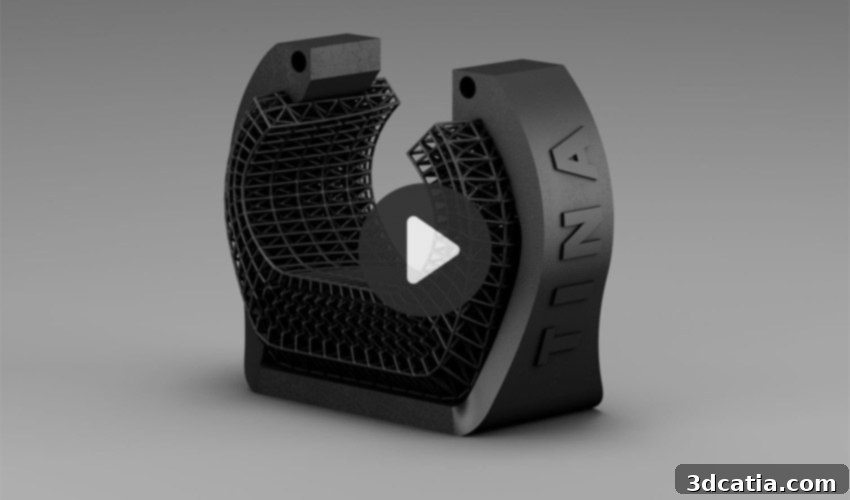
Exploring the Future: Our Top 5 3D Printing Innovations This Week
Welcome to your weekly dose of groundbreaking insights into the world of additive manufacturing! This week, we’ve curated an exciting selection of the top five videos that brilliantly showcase how 3D printing is not just a technology, but a transformative force shaping our society across a myriad of sectors. From the intricate demands of medical applications to the boundless frontiers of space exploration, 3D printing is consistently pushing the boundaries of what’s possible. Join us as we dive into these incredible innovations, featuring a revolutionary new material from Sinterit, a bespoke product line designed specifically for gamers, and much more. If you find these captivating, remember there’s a wealth of additional 3D printing content waiting for you on our YouTube channel. Get ready to be inspired and have a fantastic Sunday!
TOP 1: Elastic and Resistant Material for SLS 3D Printing: A Game Changer
Material innovation is at the heart of additive manufacturing’s continuous evolution, and this week, we highlight a significant breakthrough from Sinterit. Based in Poland, Sinterit has cemented its reputation as a leading manufacturer of accessible and affordable Selective Laser Sintering (SLS) 3D printers, democratizing a technology once reserved for industrial giants. Their commitment extends beyond hardware, as they also develop and produce advanced materials tailored for SLS applications. Their latest release is a prime example: a groundbreaking Thermoplastic Elastomer (TPE) specifically engineered for SLS 3D printing. This new material opens up an entirely new realm of possibilities for creating functional prototypes and end-use parts that demand both elasticity and durability.
The introduction of a high-performance TPE for SLS printing is particularly exciting because it allows for the fabrication of complex, flexible components with excellent mechanical properties. Imagine 3D printing functional prototypes like pumps, intricate bellows, robust gaskets, and various other elastic solutions that can withstand repeated stress and deformation. This material bridges the gap between traditional manufacturing methods for flexible parts and the design freedom offered by additive manufacturing. Engineers and designers can now iterate faster, produce custom parts on demand, and explore designs previously deemed too complex or costly with conventional TPE processing. The video below delves deeper into the unique advantages of this material and showcases the extensive production possibilities it unlocks for various industries, from automotive to consumer goods, where flexible, durable components are critical.
TOP 2: IKEA and UNYQ Unleash 3D Printed Customization for Gamers
The gaming industry continues its exponential growth, with millions of enthusiasts worldwide dedicating countless hours to their passion. Recognizing the need for enhanced ergonomics, personalization, and comfort in this competitive and immersive world, IKEA, the global leader in home furnishings, has partnered with UNYQ, a company renowned for its innovative 3D printed medical prosthetics and custom solutions. This unique collaboration aims to provide gamers with a bespoke and practical line of 3D printed products. The core philosophy behind this venture between IKEA and UNYQ is to explore how individual personalization and thoughtful home furnishing can revolutionize the gaming experience and the lifestyle surrounding it.
This pioneering product line addresses common challenges faced by gamers, focusing on comfort, injury prevention, and optimized performance. The first product introduced is a biometric wrist support, meticulously designed to maintain the optimal height of a gamer’s wrist relative to their keyboard. This crucial ergonomic support significantly reduces strain on tendons and minimizes the risk of repetitive stress injuries, allowing for longer, more comfortable gaming sessions. Next, we have an innovative keyboard accessory: soft, pliable, and vented keycaps. These specially designed keycaps provide a tactile experience that makes the keyboard feel like a natural extension of the gamer’s fingers, enhancing responsiveness and precision. Finally, no gaming setup is complete without a perfected mouse experience. Their 3D printed mouse accessory elegantly clamps the user’s mouse cable securely in place, preventing frustrating tangles and ensuring complete freedom of movement. This collaboration exemplifies how 3D printing can deliver truly personalized and functional solutions, marrying cutting-edge technology with consumer needs to create a superior user experience.
TOP 3: Unlocking the Transformative Benefits of Additive Manufacturing
In our comprehensive article, ‘Why 3D printing?‘, we delve deeply into the myriad advantages offered by additive manufacturing, and the following video perfectly complements this discussion by visually illustrating these benefits. Additive manufacturing, commonly known as 3D printing, is fundamentally reshaping the landscape of product design, engineering, and production across nearly every industry. One of its most compelling advantages is the unprecedented design freedom it offers. Unlike traditional manufacturing methods that are limited by tooling and subtractive processes, 3D printing enables the creation of highly complex and intricate geometries, organic shapes, and internal lattice structures that are impossible to produce otherwise. This capability allows for significant lightweighting of parts without compromising strength, leading to more efficient and sustainable products, especially critical in aerospace and automotive applications.
Beyond design freedom, additive manufacturing boasts superior cost-effectiveness for small batch production and custom parts, eliminating the need for expensive molds and tooling. This translates into quicker manufacturing times and a significantly faster iteration process, accelerating product development cycles from concept to market. Companies can rapidly prototype designs, test them, and make modifications within days, not weeks or months. Furthermore, 3D printing facilitates mass customization, allowing manufacturers to produce unique, personalized items at scale without incurring substantial additional costs per unit. This is evident in medical devices, consumer goods, and even architectural models. The technology also contributes to reduced material waste, as it builds objects layer by layer, only using the material necessary for the part. This efficiency, coupled with the potential for on-demand local production, can streamline supply chains and lower logistical carbon footprints. From revolutionizing patient-specific medical implants to producing critical components for aerospace, 3D printing is truly affecting all sectors, enhancing innovation, efficiency, and sustainability. Discover how these profound benefits are driving the next industrial revolution in the video below.
TOP 4: Participant: Revolutionizing Mobility with 3D Printed Wheelchairs
Access to essential healthcare and mobility solutions remains a significant challenge in many parts of the world, particularly in impoverished countries where conventional medical devices are often prohibitively expensive or simply unavailable. This is where companies like Participant are making a monumental difference, harnessing the power of 3D printing to address critical social needs. Participant is a visionary organization dedicated to manufacturing affordable, custom-fit 3D printed wheelchairs for children in these underserved regions. Their mission is deeply rooted in the belief that every child deserves the opportunity for mobility and independence, regardless of their economic circumstances.
The genius of Participant’s approach lies in its utilization of additive manufacturing technologies to overcome the traditional barriers to producing and distributing mobility aids. By leveraging 3D printing, they can produce wheelchairs that are not only significantly more affordable but also highly customizable. This customization is vital, as a properly fitted wheelchair can drastically improve a child’s quality of life, prevent secondary health complications, and enable greater participation in education and social activities. Traditional wheelchairs often come in standard sizes, which are rarely a perfect fit, leading to discomfort and inefficient mobility. 3D printing allows Participant to tailor each wheelchair to the exact dimensions and specific needs of the individual child, ensuring maximum comfort and functionality. Their ambitious mission is to scale these innovative solutions globally, focusing especially on countries and communities that lack robust healthcare infrastructure. This initiative highlights the immense humanitarian potential of 3D printing, demonstrating how advanced technology can be a powerful tool for social good, making a tangible difference in the lives of vulnerable populations. Learn more about the inspiring philosophy and impactful mission of this company in the video below.
TOP 5: Tailored Care: A 3D Printed Prosthetic for a Rooster
The medical applications of 3D printing have long been a cornerstone of its revolutionary impact, especially in the development of highly personalized medical devices. From intricate surgical guides and patient-specific implants to advanced prosthetics for humans, additive manufacturing excels at responding to individual patient needs with unparalleled precision and customization. This ability to easily tailor products to fit every single individual is one of the technology’s most significant advantages, providing solutions that are often superior to mass-produced alternatives.
However, the utility of 3D printing extends far beyond human medicine. Increasingly, this technology is being harnessed to create bespoke prosthetics and medical aids for animals, dramatically improving their quality of life. The following video beautifully illustrates this compassionate application of 3D printing, featuring a heartwarming case that captured global attention. We meet Jack Frost, a rooster who, through unfortunate circumstances, lost his feet. For a bird, losing its feet means losing its ability to walk, perch, and forage, severely impacting its well-being and survival. Thanks to the ingenuity of 3D printing, Jack Frost received a new pair of custom-designed ‘feet’. These prosthetics were meticulously tailored to his unique anatomy, allowing him to regain his mobility, walk again, and enjoy a significantly improved quality of life. This remarkable story not only showcases the incredible versatility of 3D printing but also underscores its potential to offer innovative, life-changing solutions across all species, demonstrating the profound impact of personalized care in veterinary medicine. It’s a testament to how creative application of technology can bring hope and function back to those in need, whether human or animal.
What are your thoughts on this week’s incredible Top 5 3D Printing Videos? Each story highlights a unique facet of additive manufacturing’s power, from industrial material breakthroughs to deeply personal and humanitarian applications. We’d love to hear your insights! Drop a comment below or join the conversation on our Facebook and Twitter pages. And to ensure you never miss out on the latest advancements and news in the dynamic 3D printing industry, make sure to sign up for our free weekly Newsletter, delivered straight to your inbox!