
4D_Additive 1.4: Revolutionizing 3D Printing with Advanced Data Repair and Simplification
In the rapidly evolving landscape of additive manufacturing, the integrity and optimization of 3D data are paramount for successful and high-quality prints. Leading French-German software developer, CoreTechnologie, continues to push the boundaries of innovation with its specialized CAD software, 4D_Additive. Designed exclusively for the rigorous demands of additive manufacturing workflows, the latest iteration, 4D_Additive 1.4, introduces groundbreaking features that empower users to repair and simplify complex 3D scan data and intricate STL files with unprecedented ease and efficiency. This significant update, highlighted by the revolutionary “Marching Cube” function, is set to transform the way professionals approach file preparation, ensuring error-free production and maximizing print quality in every application.
CoreTechnologie’s commitment to enhancing the user experience in additive manufacturing is evident in its continuous development of its CAD software. The design phase in 3D printing is undeniably a cornerstone of the entire value chain. It’s where theoretical concepts translate into tangible forms, requiring meticulous attention to detail and adherence to specific design rules to achieve optimal part performance, minimize material consumption, and accelerate printing times. However, the journey from design to a flawless physical part is often fraught with challenges, particularly concerning the structural integrity and fidelity of digital models. Imperfections, errors, or excessive complexity in 3D files can lead to failed prints, material waste, and significant delays. Addressing these critical issues, 4D_Additive 1.4 offers a robust suite of tools engineered to automatically correct common data flaws and streamline file preparation, ensuring that every part is printed without the slightest error, consistently meeting the highest quality standards.
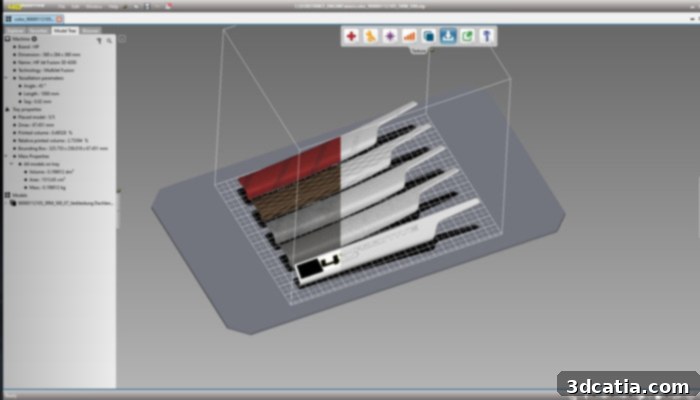
4D_Additive allows you to add textures to 3D files (photo credits: CoreTechnologie)
The Pivotal Role of Design in Additive Manufacturing
Additive manufacturing, by its very nature, demands precision and robust digital models. Unlike traditional manufacturing methods, 3D printing builds parts layer by layer, and any defect in the digital model can manifest as a physical flaw. This makes the design and preparation phase exceptionally critical. Designers and engineers must consider a myriad of factors, including geometric constraints, material properties, support structures, and post-processing requirements, all while striving for optimal part performance and cost-efficiency. Tools that can automatically identify and rectify common modeling issues, such as non-watertight geometries, self-intersections, inverted normals, or unwanted gaps, are invaluable. Such tools not only prevent print failures but also significantly reduce the time and expertise required for manual corrections, thereby democratizing access to complex 3D printing processes.
Introducing CoreTechnologie’s 4D_Additive Platform
CoreTechnologie has established itself as a pioneer in CAD conversion and modeling solutions for a quarter of a century. Their 4D_Additive software suite is a testament to this expertise, specifically tailored to address the unique challenges of additive manufacturing. Beyond basic repair, 4D_Additive offers a comprehensive set of functions for preparing 3D models, including lattice structure generation, texture application, nesting, slicing, and support structure creation. It acts as an essential bridge between standard CAD design environments and the highly specialized requirements of 3D printers. The platform’s ability to handle diverse file formats and provide intuitive tools for complex tasks positions it as a cornerstone for anyone serious about professional additive manufacturing. The 1.4 update further solidifies this position by focusing on the often-overlooked yet critical aspects of data integrity and simplification.
A Closer Look at 4D_Additive 1.4: Revolutionary Enhancements
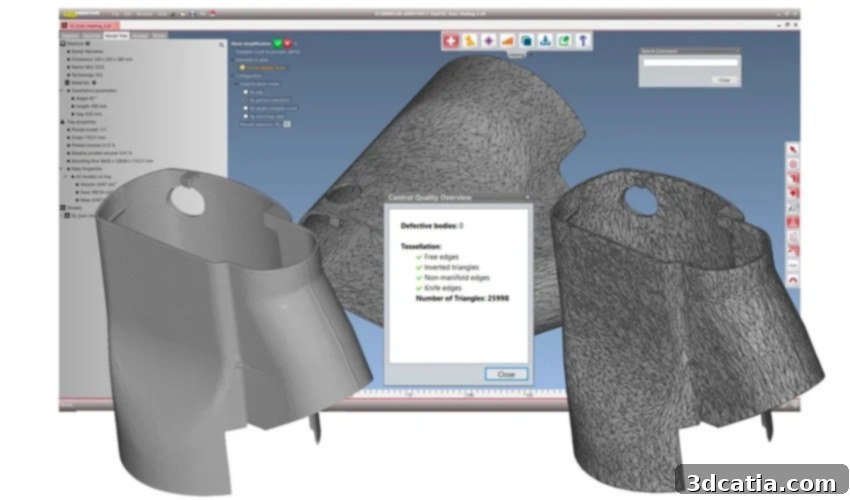
CoreTechnologie’s press release sheds light on the core innovations within 4D_Additive 1.4, stating, “The 4D_Additive 1.4 software has revolutionary functions to close the tessellated models into ‘watertight’ solids and intelligently mesh reduction functions in order to reduce the number of triangles without losing accuracy. These new features called ‘Marching Cube’ and ‘Mesh Simplification’ allow any type of triangulated, mostly STL data, to be automatically corrected and simplified at the touch of a button.” This statement underscores the dual-pronged approach of the update: comprehensive repair and intelligent optimization. By integrating these two powerful features, CoreTechnologie offers a streamlined and automated solution, circumventing the often time-consuming and labor-intensive manual interventions previously required for preparing complex 3D models. This automation not only accelerates the workflow but also significantly reduces the potential for human error, ensuring a higher rate of first-time right prints.
The Power of Marching Cube: Ensuring Watertight Models
The CoreTechnologie team provides a deeper explanation of the “Marching Cube” functionality: “The Marching Cube function combines a ‘voxelisation’ of the parts with their repair, whereby the size of the voxel, i.e. cube, and thus the fineness can be defined by the user. After the adaptive filling of the part volume with voxels, the so-called ‘voxelisation’, a closed 3D mesh is generated. The 4D_Additive software thus repairs models with hundreds and thousands of triangulation defects fully automatically within a few seconds.” This technical detail is crucial. Voxelization is a process where a 3D model is converted into a grid of discrete volume elements (voxels), similar to how a 2D image is composed of pixels. By converting a potentially flawed mesh into a voxel representation, the software can effectively “fill in” gaps, repair overlaps, and address non-manifold edges, creating a solid, watertight volume. The ability for users to define the voxel size is key, allowing a balance between computational intensity and the desired level of detail and accuracy for the repaired model. A watertight model is absolutely essential for additive manufacturing, as most slicers and simulation software rely on this geometric integrity to correctly interpret the internal and external surfaces of a part. Non-watertight models often lead to ambiguous geometries, causing slicers to fail, produce incomplete layers, or generate errors that result in unprintable or structurally unsound parts.
Intelligent Mesh Simplification: Balancing Fidelity and Efficiency
Alongside the powerful repair capabilities, 4D_Additive 1.4 also introduces enhanced “Mesh Simplification” features. The team further clarifies, “In addition, the user has access to various options for the intelligent reduction of triangles. By defining a maximum angle between the triangles, the maximum chord deviation, by percentage reduction or by defining the desired number of triangles the filesize and complexity of triangulated models can be reduced easily.” Mesh simplification is critical for managing the vast datasets often associated with high-resolution 3D scans or complex CAD models. Excessively dense meshes can lead to unwieldy file sizes, slow processing times, increased memory usage, and potential performance bottlenecks during slicing and printing. CoreTechnologie’s intelligent approach allows users to reduce the number of triangles (polygons) in a mesh while preserving critical geometric features and accuracy. Options such as defining a maximum angle between triangles ensure that sharp edges and fine details are maintained, while broad, flat surfaces can be simplified more aggressively. Similarly, specifying a maximum chord deviation allows the software to reduce polygons in curved areas only where the deviation from the original curve remains within acceptable limits. This intelligent simplification is vital for maintaining design intent and aesthetic quality while drastically improving file manageability and processing speed. This means designers can expect a simpler, more reliable modeling process, significantly quicker preparation of 3D files, and ultimately, faster turnaround times for their additive manufacturing projects.
Real-World Benefits for 3D Printing Professionals
The combined power of Marching Cube and Mesh Simplification in 4D_Additive 1.4 offers tangible benefits across the additive manufacturing spectrum. For service bureaus, this means handling a wider variety of customer files, regardless of their initial quality, with less manual effort and higher success rates. Designers can experiment more freely, knowing that the software can automatically clean up complex geometries derived from generative design tools or organic modeling. Engineers benefit from more reliable simulations and structural analysis, as the underlying geometry is guaranteed to be watertight and accurate. Furthermore, the reduction in file size and complexity translates directly into faster slicing, reduced build times, and lower computing resource demands, ultimately leading to significant cost savings through optimized material use and reduced machine downtime. This update positions 4D_Additive 1.4 as an indispensable tool for any professional aiming to streamline their additive manufacturing workflow and consistently achieve superior print results.
Addressing the Challenges of Scan-to-Print Workflows
The advancements in 4D_Additive 1.4 are particularly impactful for scan-to-print workflows, which are increasingly common in industries like reverse engineering, healthcare, and cultural heritage preservation. Raw 3D scan data, often captured as dense point clouds or messy triangulated meshes, is notoriously difficult to directly prepare for 3D printing. These scans frequently contain holes, noise, overlapping triangles, and a lack of watertightness – all issues that render them unprintable without extensive manual repair. The “Marching Cube” function offers an automatic and robust solution to transform such imperfect scan data into print-ready, watertight solid models. This capability significantly lowers the barrier to entry for utilizing scan data in additive manufacturing, enabling faster prototyping, custom medical devices, and rapid reproduction of existing objects with unprecedented ease and accuracy. CoreTechnologie’s foresight in addressing these specific challenges underscores its commitment to delivering practical, industry-leading solutions.
Looking Ahead: The Future of AM Software
The continuous evolution of software like 4D_Additive is fundamental to the broader adoption and advancement of additive manufacturing. As 3D printing moves from niche applications to mainstream industrial production, the demand for intelligent, automated, and user-friendly tools that can handle complex data with ease will only grow. CoreTechnologie’s 4D_Additive 1.4 represents a significant stride in this direction, providing crucial functionalities that simplify challenging aspects of the 3D printing workflow. By focusing on fundamental issues like data repair and optimization, CoreTechnologie not only enhances its product but also contributes to the overall maturity and reliability of additive manufacturing processes worldwide. It paves the way for greater innovation, enabling designers and engineers to focus on creativity and problem-solving rather than grappling with tedious file preparation.
What are your thoughts on the groundbreaking new features in 4D_Additive 1.4? We invite you to share your insights and experiences in a comment below, or engage with us on our Linkedin, Facebook, and Twitter pages! Don’t miss out on the latest advancements and news in the additive manufacturing industry—be sure to sign up for our free weekly Newsletter here to get all the essential 3D printing updates delivered straight to your inbox! You can also explore all our informative videos and demonstrations on our dedicated YouTube channel for more in-depth content and tutorials.