
Sustainable Space Construction: Leveraging Cyanobacteria for 3D Printed Habitats on Mars and Beyond
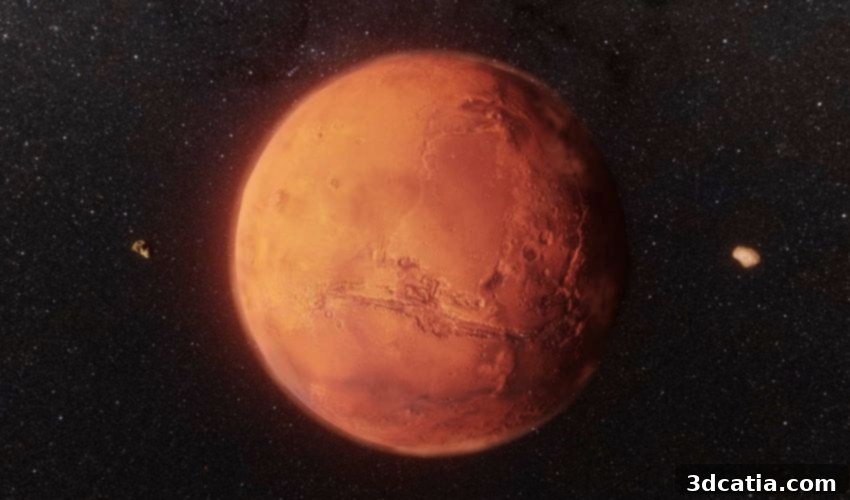
Humanity’s gaze has long been fixed on the stars, and among the celestial bodies, Mars holds a special place in our collective imagination. As NASA aptly states, “no other planet has captured our collective imagination quite like Mars.” In recent years, the ambitious focus of space exploration has decisively shifted from lunar missions to the challenging, yet inspiring, pursuit of the Red Planet. The ultimate goal for many space enthusiasts and scientists is the colonization of Mars, a feat that demands robust, self-sustaining infrastructure. To realize this vision, we desperately need innovative methods for constructing habitable environments in an incredibly hostile alien world. Addressing this critical need, researchers at the University of California, Irvine (UCI), have delved into the biochemical processes of cyanobacteria, studying how these microorganisms absorb essential nutrients from rocks found in Chile’s extreme Atacama Desert. Their groundbreaking findings suggest that these remarkable bacteria possess the ability to alter the properties of natural materials, a discovery they believe could be revolutionary for 3D printed construction in environments as challenging as Mars.
The Martian landscape presents formidable obstacles to traditional construction. The planet’s thin atmosphere, intense radiation, extreme temperature fluctuations, and the logistical nightmare of transporting vast quantities of building materials from Earth render conventional methods virtually impossible. This makes the concept of In-Situ Resource Utilization (ISRU) – using local materials – not just advantageous, but absolutely essential for any long-term human presence. Three-dimensional printing technologies have emerged as a leading contender for ISRU, offering the ability to fabricate structures layer by layer using Martian regolith (soil). However, untreated regolith may lack the structural integrity or specific properties required for safe and durable habitats. This is where UCI’s research offers a unique and bio-inspired solution.
The UCI researchers conducted a series of sophisticated experiments, employing high-resolution electron microscopy and advanced spectroscopic imaging techniques. These cutting-edge tools allowed them to observe, at a microscopic level, precisely how these resilient microorganisms interact with and modify both natural minerals and synthetic nanoceramics. Their detailed observations revealed that cyanobacteria secrete complex biofilms. These biofilms act as powerful natural agents, fundamentally changing the properties of naturally occurring materials around them. Specifically, the researchers discovered that the cyanobacteria can dissolve magnetic iron oxide particles embedded within gypsum rocks. This dissolution process isn’t random; it actively transforms magnetite into oxidized hematite. The underlying biological reason for this complex mineral alteration is survival: the bacteria undertake these processes to produce the vital minerals they require for photosynthesis, their primary means of energy production. This remarkable adaptation, perfected over millions of years in Earth’s harshest environments, sparked a pivotal question for the researchers: could these natural, highly efficient processes be manipulated and harnessed to aid human survival and construction efforts in equally inhospitable environments, such as the distant Red Planet?
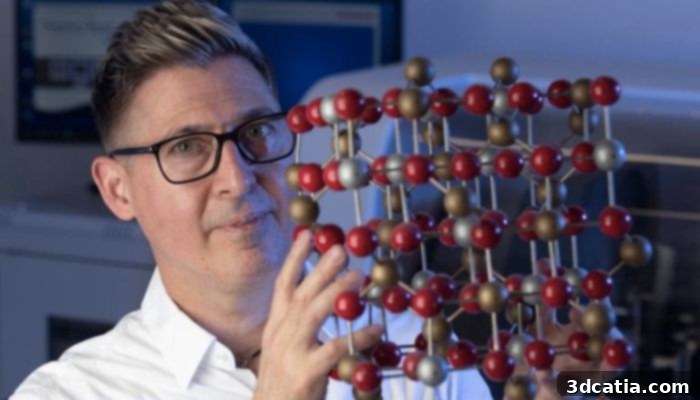
David Kisailus, UCI professor of materials science and engineering. (Photo credit: Steve Zylius / UCI)
Revolutionizing Extraterrestrial Construction: The “Lunar Forming” Concept
The implications of these findings are profound and far-reaching. Given that the experiment demonstrated cyanobacteria’s ability to modify the properties of both natural and artificial materials, the researchers are incredibly optimistic that the natural, biologically driven processes of these microorganisms could be strategically harnessed for the production of large-scale additive manufacturing. This offers an unprecedented pathway for construction in extreme, hostile environments like those found on Mars or even the Moon. David Kisailus, a distinguished UCI professor of materials science and engineering and a leading figure in this research, articulated the immense importance of their work with a compelling vision. He explained, “I call it ‘lunar forming’ instead of terraforming.” Kisailus emphasized the practical advantages: “If you want to build something on the moon, instead of going through the expense of having people do it, we could have robotic systems 3D-print media and then have the microbes reconfigure it into something of value. This could be done without endangering human lives.” This concept dramatically reduces the inherent risks, complexities, and prohibitive costs associated with human-led construction in space.
Professor Kisailus further expanded on the philosophical foundation of his Biomimetics and Nanostructured Materials Lab, stating, “This is the main theme of my Biomimetics and Nanostructured Materials Lab. Why try to reinvent the wheel when nature’s perfected it over hundreds of millions of years? We just have to extract the secrets and blueprints for what nature does and apply or adapt them to what we need.” This biomimicry approach, learning from and imitating nature’s optimized designs and processes, underscores the elegance and efficiency of their proposed solution. Instead of synthesizing entirely new materials from scratch or importing everything from Earth, humanity could leverage existing biological mechanisms to enhance and transform local planetary resources into high-performance building materials. This vision for “lunar forming” or “Martian forming” offers a sustainable, autonomous, and potentially self-repairing construction paradigm for future space settlements.
The Broader Landscape of Extraterrestrial 3D Printing
This pioneering research from UCI is not an isolated endeavor but fits into a broader, accelerating trend of utilizing 3D printing for construction beyond Earth. Just this year, for instance, ICON has been awarded a substantial $57.2 million in funding by NASA. This significant investment is earmarked for researching and developing the possibility of constructing habitable structures on the Moon that can provide adequate thermal regulation, radiation shielding, and protection against micrometeorite impacts. While ICON focuses on the larger-scale architectural and structural integrity of lunar bases, the UCI research provides a crucial complementary piece: a biological method to enhance the very materials used in such additive manufacturing processes. Imagine ICON’s advanced 3D printers utilizing Martian regolith that has been pre-processed or even actively modified by specially engineered cyanobacteria, resulting in a stronger, more resilient, and perhaps even self-healing building material.
As global space agencies and private enterprises increasingly shift their research and development efforts towards enabling a long-term human presence on the Moon and facilitating extended deep-space travel to Mars, it is unequivocally clear that 3D printing will continue to play an indispensable role in these ambitious projects. The ability to manufacture complex components and entire structures using local resources will drastically reduce mission costs, increase self-sufficiency, and enhance the safety of future astronauts. The integration of biotechnologies, such as those demonstrated by the cyanobacteria research, takes this concept a step further, opening doors to truly sustainable and adaptive construction methods that could pave the way for humanity’s permanent foothold among the stars. This blending of robotics, materials science, and microbiology represents the frontier of space exploration, where innovation ensures survival and progress. To delve deeper into the scientific intricacies of this specific experiment, you can access the full scientific paper by clicking HERE.
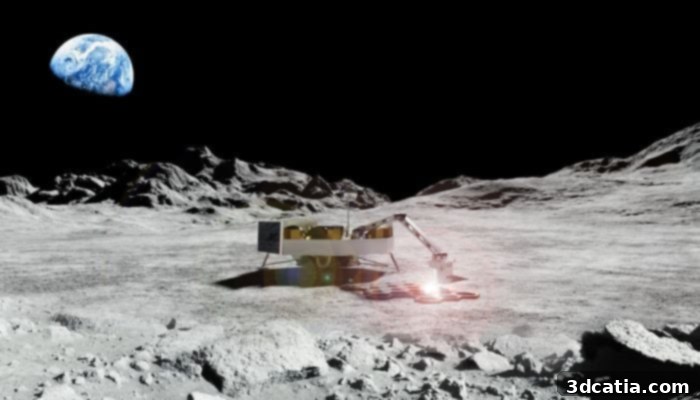
In another example of extraterrestrial habitations, ICON has been offered funding by NASA to produce 3D printed lunar constructions (Photo credit: ICON)
What are your thoughts on this groundbreaking project, which has the potential to fundamentally transform 3D printing and construction on Mars? We invite you to share your insights in a comment below or engage with us on our LinkedIn, Facebook, and Twitter pages! Don’t miss out on the latest advancements in additive manufacturing—be sure to sign up for our free weekly Newsletter here, delivering the freshest 3D printing news directly to your inbox! You can also explore all our fascinating videos on our dedicated YouTube channel.
•Cover photo credits: Vito Technology, Inc