
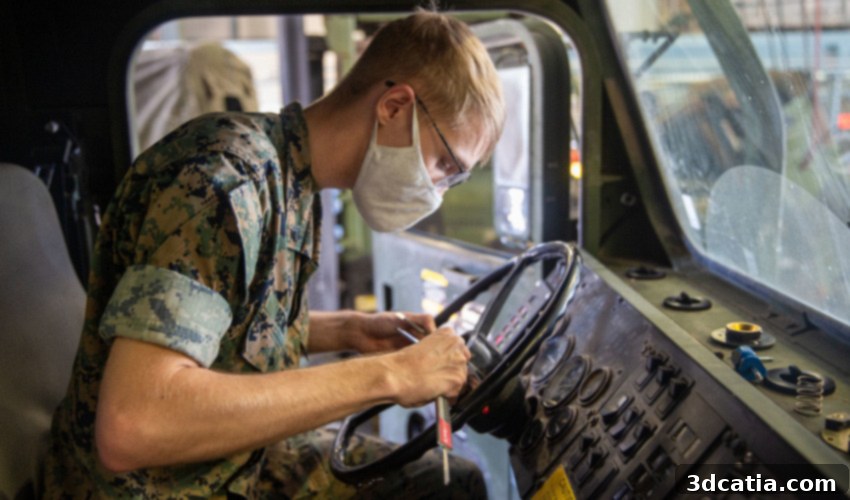
Empowering Marines: How 3D Printing a Steering Wheel Removal Tool Revolutionizes Vehicle Maintenance
In a continuous pursuit of operational excellence and enhanced field readiness, the American military is increasingly leveraging the transformative power of additive manufacturing (AM), commonly known as 3D printing. This cutting-edge technology is proving to be invaluable for innovative applications that directly support personnel in demanding environments. A prime example of this ingenuity comes from the Marine Corps System Command’s (MCSC) Advanced Manufacturing Operations Cell (AMOC), which, in a collaborative effort with the 1st Supply Battalion and dedicated industry partners, has successfully developed a revolutionary 3D printed metal steering wheel removal device. This pioneering tool is specifically designed to enable Marines to safely and efficiently remove steering wheels during routine vehicle maintenance, critically preventing damage to the components and ensuring that essential vehicles remain operational without unnecessary downtime. This innovative solution underscores the immense potential of 3D printing to address specific, critical challenges within military logistics and maintenance.
While the need for a specialized steering wheel removal tool might appear to be a niche issue at first glance, it addresses a significant and recurring problem for the Marine Corps. Marines frequently undertake the task of removing steering wheel columns, particularly in Medium Tactical Vehicle Replacement (MTVR) and Logistics Vehicle System Replacement (LVSR) vehicles, as part of their essential vehicle maintenance routines. However, the standard-issue tool for this procedure, a 10-way slide hammer, has historically presented considerable challenges. Its design necessitates applying a substantial amount of force directly to the steering wheel column, which, more often than not, results in costly damage or complete breakage of the component. The repercussions of such damage are severe: a replacement steering wheel must be ordered, leading to a protracted waiting period of approximately 25 days. During this extended period, the vehicle is rendered inoperable, creating significant logistical hurdles and compromising fleet readiness. This frequent frustration among maintenance personnel spurred one determined soldier to seek a better way, eventually harnessing the capabilities of additive manufacturing to conceptualize and design a more effective tool, one that could preempt these expensive delays and enhance overall operational efficiency for every Marine in the field.
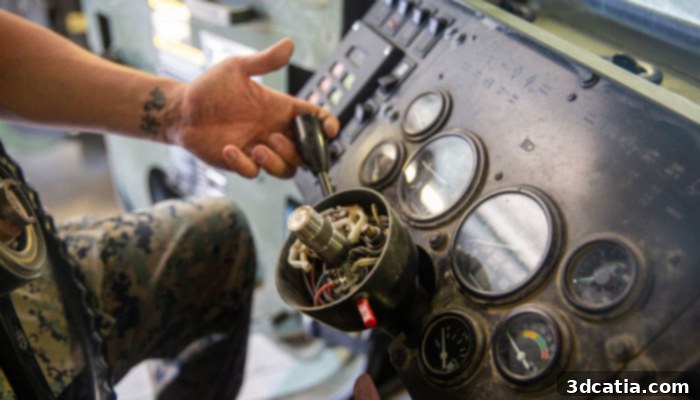
Inside the steering wheel (photo credits: Gunnery Sgt. Michele Hunt/USMC)
When the requirement is for an innovative tool that addresses complex engineering challenges with precision and adaptability, additive manufacturing emerges as the definitive solution. The genesis of this specific steering wheel removal tool traces back to the ingenuity of Staff Sgt. Kyle Owens, a motor transportation chief with the 1st Marine Logistics Group. His initial prototype, born out of necessity and crafted from scrap metal and washers in 2012, demonstrated the core concept. However, the true breakthrough occurred more recently when Staff Sgt. Owens was able to collaborate with his unit’s innovation officer, transforming his rudimentary design into a sophisticated prototype utilizing advanced AM techniques. The early iterations of this new tool were predominantly fabricated using polymers, a choice dictated by the widespread availability of polymer 3D printers within Marine Corps units. This allowed for rapid prototyping, quick design modifications, and thorough functional testing. Once the polymer-based tool successfully passed rigorous form, fit, and function checks, proving its efficacy in controlled environments, the project advanced to the next crucial stage: transitioning to metal AM. This strategic shift to metal printing was vital for producing a final prototype that possessed the superior strength, durability, and resilience required to withstand the demanding conditions of military vehicle maintenance, ensuring its longevity and reliability in the field.
The culmination of this meticulous design and prototyping process led to a finalized, ready-to-print design that received formal approval from the AMOC. This approval marked a significant milestone, leading to the steering wheel removal device’s inclusion in MCSC’s comprehensive additive manufacturing digital repository. This repository serves as a centralized database for validated 3D printable designs, making critical tools and replacement parts readily accessible across the entire Marine Corps. While additive manufacturing is still a relatively nascent technology within the broader context of the U.S. Marine Corps, the dedicated efforts of the AMOC have been instrumental in accelerating its adoption and integrating it more deeply into daily operations. Currently, this invaluable database houses an impressive collection of approximately 500 replacement parts, all ingeniously designed by Marines themselves, showcasing a robust culture of innovation from the ground up. The steering wheel removal device stands out as a particularly impactful addition, designated as an enterprise-wide Marine Corps solution. This means that any authorized unit or individual Marine equipped with a compatible 3D printer can now independently produce this essential tool on demand, wherever they are stationed. This decentralized manufacturing capability not only streamlines the supply chain but also drastically reduces lead times for critical maintenance items, profoundly enhancing the readiness and self-sufficiency of Marine units globally.
The strategic decision to utilize additive manufacturing for producing the final versions of the steering wheel removal tool is rooted in its inherent advantages, which align perfectly with the dynamic operational needs of the military. Additive manufacturing offers unparalleled flexibility and speed in production, factors that are rapidly making the technology increasingly popular within the USMC. Beyond just the efficiency of production, the creation of a standardized, 3D printable design empowers individual Marines and units to fabricate the part autonomously. This capability extends far beyond simply reducing traditional production and procurement costs; it fundamentally transforms the logistics paradigm. Soldiers deployed in remote locations or on the move, provided they have access to the necessary 3D printing equipment and materials, can now produce critical components directly at the point of need. This on-demand manufacturing capability minimizes reliance on conventional supply chains, which can be slow, costly, and vulnerable to disruption. Furthermore, it fosters a spirit of self-reliance and rapid problem-solving, allowing maintenance crews to address unexpected issues quickly and keep essential vehicles in service, thus directly contributing to mission success and overall force readiness. The ability to print a custom, durable tool that prevents damage and ensures continuous vehicle operation is a testament to AM’s role in modern military logistics and maintenance.
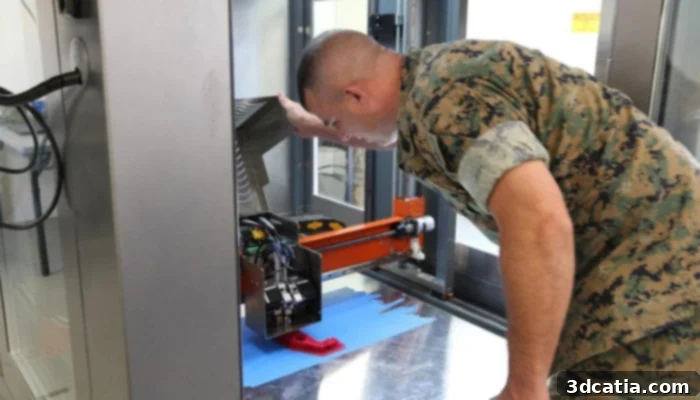
This is not the first time the Marines have used AM. Increasingly they have turned to the technology thanks to its flexibility and cost-effectiveness. (Photo Credits: Photo by Kaitlin Kelly/U.S. Marine Corps)
Captain Matthew Audette, a distinguished project officer at MCSC, eloquently captured the essence of this innovative approach: “We’re always talking about how Marines move toward the sound of gunfire. If we open up that aperture a little bit, we can say Marines move toward the sound of problems, and they solve those problems. Additive manufacturing lowers the barrier to entry for physically making that solution.” This philosophy encapsulates the very spirit of Marine Corps adaptability and ingenuity. It highlights how AM is not merely a technological advancement but a strategic enabler, empowering service members at every level to identify challenges and, crucially, to craft immediate, tangible solutions. This direct, bottom-up innovation approach significantly enhances operational readiness by reducing reliance on external supply chains and long lead times for parts. The ability to quickly design, prototype, and produce custom tools or replacement parts in the field or at remote bases provides an unparalleled advantage in maintaining critical equipment and ensuring continuous mission capability. The steering wheel removal tool is a powerful illustration of this principle in action, showcasing how localized additive manufacturing capabilities can solve widespread problems, reduce costs, and ultimately save time and resources, directly contributing to the effectiveness of the U.S. Marine Corps. For a more comprehensive understanding of the steering wheel tool and the broader integration of AM within the USMC, the official press release can be found HERE.
The development of the 3D printed steering wheel removal device stands as a testament to the U.S. Marine Corps’ commitment to leveraging cutting-edge technology for practical, field-level solutions. This innovation not only solves a persistent maintenance problem but also exemplifies the broader strategic advantages that additive manufacturing offers to military operations: enhanced readiness, significant cost savings, and empowered personnel. By enabling Marines to solve their own problems efficiently and effectively, AM is proving to be a cornerstone of modern military logistics and a catalyst for future advancements. We are eager to hear your thoughts on the Marine Corps’ groundbreaking 3D printed vehicle maintenance tool. Please share your insights in a comment below or join the conversation on our Facebook, Twitter, and LinkedIn pages! For the latest updates and breaking news in the world of 3D printing, remember to sign up for our free weekly Newsletter here, delivered straight to your inbox!
*Thumbnail Photo Credits: Gunnery Sgt. Michele Hunt/USMC