
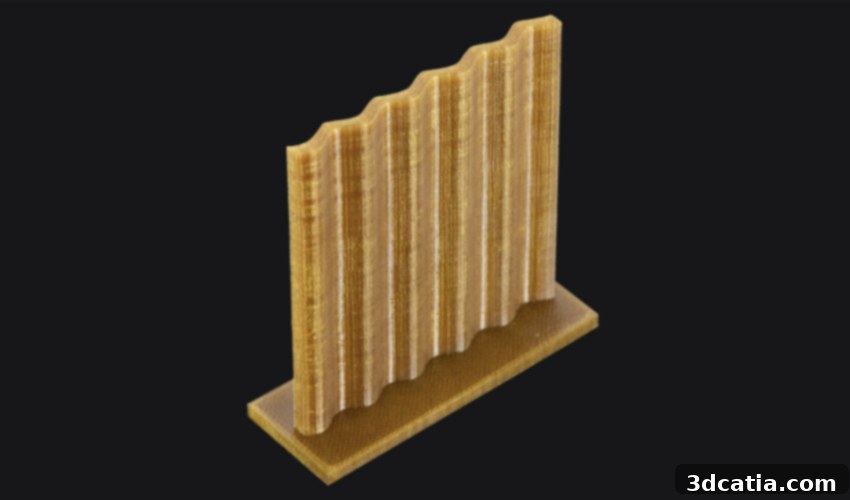
EXTEM™ AMHH811F: Roboze and SABIC Unveil a Game-Changing High-Temperature 3D Printing Material
The landscape of additive manufacturing is continuously evolving, driven by the persistent demand for materials that can withstand increasingly harsh industrial environments. In a significant stride forward, Italian manufacturer Roboze, a leader in high-performance FFF (Fused Filament Fabrication) 3D printing solutions, has joined forces with chemical giant SABIC to introduce a groundbreaking new high-temperature 3D printing material: the EXTEM™ AMHH811F filament. This innovative amorphous thermoplastic polyimide (TPI) is designed to push the boundaries of what’s achievable with industrial 3D printing, offering an unprecedented level of temperature resistance within its class in the additive manufacturing market. Specifically engineered for Roboze’s robust ARGO 500 3D printers, which are built for production-scale applications, EXTEM™ AMHH811F can withstand continuous operating temperatures of up to an impressive 230°C, opening up a realm of new possibilities for demanding industrial sectors.
The additive manufacturing market has experienced a remarkable transformation in recent years, moving well beyond its prototyping origins. What once started with basic plastics like PLA or ABS has now matured into a sophisticated ecosystem utilizing advanced, technical polymers for a myriad of industrial applications. Among these sophisticated polymers, the broad family of high-performance thermoplastics such as PEEK, PEKK, or ULTEM has gained immense traction. These materials are highly valued for their superior mechanical strength, excellent chemical resistance, exceptional dimensional stability, and remarkable temperature resistance. While some of these advanced polymers can achieve heat resistance up to 260°C for specific applications, the new amorphous thermoplastic polyimide from SABIC and Roboze – EXTEM™ AMHH811F – sets a new benchmark, offering unparalleled continuous operating temperature resistance in this highly competitive polymer family, especially when considering its overall balanced properties and processability on an FFF system.
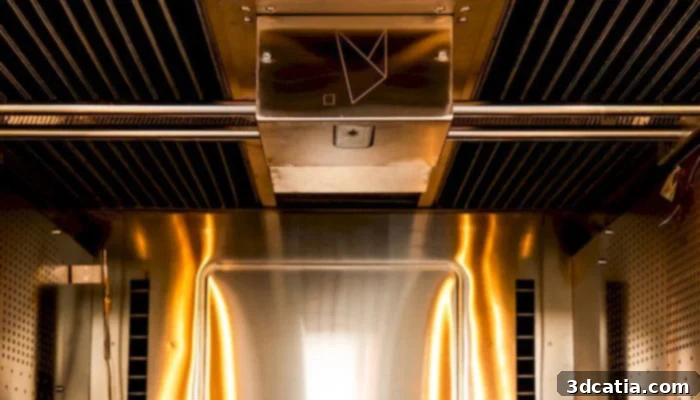
The high temperature chamber of the Roboze ARGO 500 3D printer | Credits: Roboze
Building on SABIC’s extensive expertise in advanced materials, the EXTEM™ AMHH811F filament is derived from SABIC’s high-performance EXTEM resin. Roboze highlights its exceptional heat deflection performance, capable of withstanding temperatures up to 230°C, alongside its outstanding dimensional stability. This combination ensures that parts printed with EXTEM™ AMHH811F maintain their precise geometries and structural integrity even under prolonged exposure to high heat, a critical factor for precision engineering. Furthermore, its glass transition temperature (Tg) is reported to reach 247°C. The glass transition temperature is a key indicator of a material’s rigidity and load-bearing capacity at elevated temperatures; a high Tg signifies that this TPI retains its structural integrity and mechanical properties even when subjected to significant thermal stress. This characteristic is vital for applications where parts must perform reliably in hot environments without deforming or losing strength.
The collaboration between SABIC and Roboze extends beyond just material development; it encompasses rigorous testing and optimization to ensure real-world performance and compliance. Keith Cox, Head of SABIC Operations, emphasized this commitment: “To enable customers to print high quality parts for a range of demanding high temperature applications, SABIC and Roboze have worked closely together to optimize printing parameters and secure UL recognition of EXTEM™ parts printed on the ROBOZE solution.” This meticulous process culminated in significant certifications, notably the UL Blue Card program for plastics in additive manufacturing. This certification is a testament to the material’s suitability for industrial 3D printing, verifying its performance, safety, and consistent quality when processed on the Roboze ARGO system. It provides end-users with confidence in the reliability and safety of components produced with EXTEM™ AMHH811F.
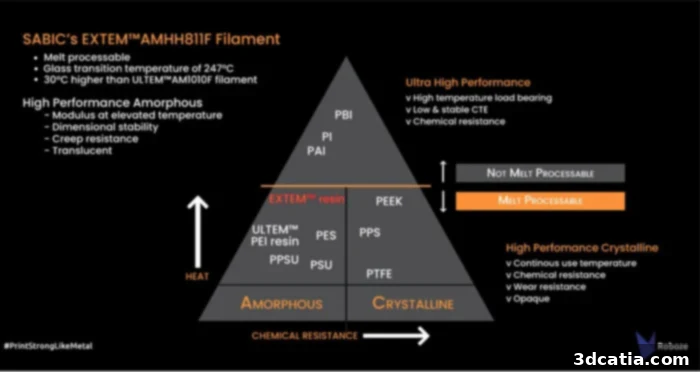
Where does EXTEM™ AMHH811F stand in the polymer hierarchy? | Credits: Roboze
The robust development and testing process ensures that EXTEM™ AMHH811F meets stringent industrial standards. The two partners proudly confirm that the filament has obtained UL Blue Card recognition with V0-075 certification on samples precisely printed by ARGO systems with a thickness of 0.75 mm. This V0 rating is particularly significant, indicating that the material stops burning within 10 seconds on a vertical part with no flaming drips, highlighting its superior flame retardant properties. Beyond this, EXTEM™ AMHH811F also complies with the RoHS directive, which meticulously limits the use of hazardous substances in electrical and electronic equipment, making it a safer and more environmentally conscious choice. Crucially, it does not contain halogens, further contributing to its environmental profile and reducing potential health risks during processing or in end-use applications. This halogen-free composition is increasingly sought after in sensitive industries. Finally, the semi-transparent nature of the material is an aesthetic characteristic, but its superior flame retardant properties, even for intricate, thin-walled 3D printed parts, are a critical performance attribute, adding another layer of safety and reliability for mission-critical components.
The unique combination of mechanical resilience, chemical resistance, and extreme temperature performance positions EXTEM™ AMHH811F as an indispensable material for a wide array of demanding industrial sectors. Industries such as aeronautics and defense, motorsport, electronics, and automotive frequently encounter applications that necessitate materials capable of performing under high temperatures, aggressive chemical exposure, or both. The EXTEM™ AMHH811F filament is perfectly poised to meet these stringent requirements, offering solutions where traditional materials fall short. Roboze provides compelling examples of concrete applications, including the 3D printing of advanced thermal and acoustic screens for the aerospace industry, intricate sensors designed for harsh environments, as well as components requiring minimal outgassing for vacuum applications or those needing subsequent metallization processes. These examples underscore the material’s versatility and its capacity to address complex engineering challenges.
The introduction of EXTEM™ AMHH811F also signifies a major leap towards the long-standing goal of metal replacement in manufacturing. Alessio Lorusso, CEO of Roboze, eloquently summarizes this vision: “The EXTEM™ AMHH811F filament offers the opportunity to explore new horizons on a FFF system. We are proud of this achievement and this collaboration with SABIC. With the Roboze ARGO Production 3D printers and the new EXTEM™ AMHH811F filament, we can increase opportunities to replace metal. I am absolutely certain that all this will guarantee great advantages in terms of speed and productivity for users.” The ability to replace metal parts with advanced polymers like EXTEM™ AMHH811F brings a multitude of benefits, including significant weight reduction, which is paramount in aerospace and automotive for improving fuel efficiency and performance. It also unlocks unprecedented design freedom, allowing engineers to create complex geometries and integrated functionalities that would be impossible or prohibitively expensive to achieve with traditional metal manufacturing methods. Furthermore, for low-volume production and prototyping, 3D printed high-performance polymers offer a more cost-effective and faster alternative to machining metals, accelerating innovation and reducing lead times for critical components. The synergy between this cutting-edge material and Roboze’s industrial-grade ARGO 3D printers truly empowers users to achieve new levels of engineering excellence.
This collaborative breakthrough from Roboze and SABIC not only enhances the capabilities of FFF 3D printing but also reinforces its position as a transformative manufacturing technology. By providing a material with such extreme performance characteristics and robust certifications, they are enabling industries to innovate faster, build lighter, and operate more efficiently in the most demanding environments. The EXTEM™ AMHH811F filament is not just a new material; it’s a catalyst for the next generation of industrial applications, paving the way for advanced manufacturing solutions that were once considered out of reach. With its superior thermal, mechanical, and chemical properties, this advanced thermoplastic polyimide is set to redefine expectations and unlock significant advantages in terms of speed, design flexibility, and productivity for engineers and manufacturers worldwide.
Find more information on Roboze’s innovative solutions HERE.
What are your thoughts on this revolutionary high-temperature 3D printing filament? Share your insights and expectations in a comment below or join the conversation on our Facebook and Twitter pages!