
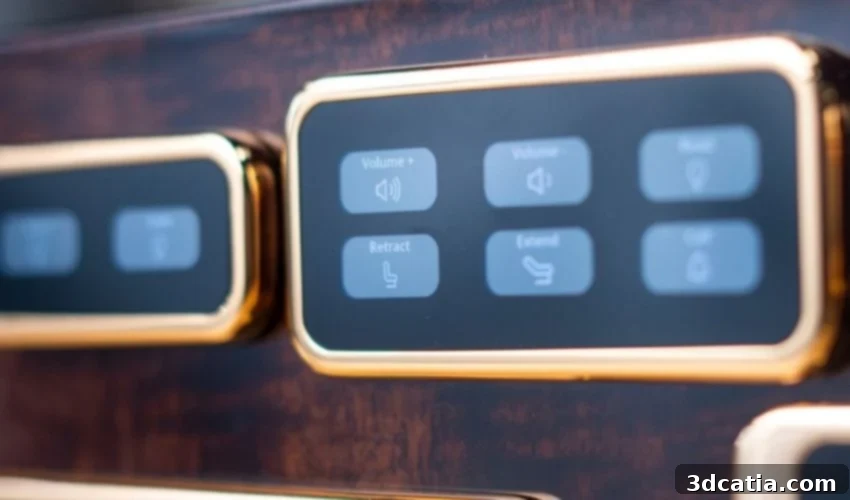
Revolutionizing Aerospace Manufacturing: Cabin Management Solutions Leverages Markforged 3D Printing for FAA-Compliant Aircraft Parts
In the demanding world of aerospace, where precision, reliability, and stringent certifications are paramount, innovation in manufacturing plays a critical role. Texas-based aviation company, Cabin Management Solutions (CMS), stands at the forefront of this evolution, having strategically partnered with The Digital Forge – an advanced industrial platform from Markforged. This powerful platform, comprising cutting-edge 3D printers, intuitive software, and high-performance materials, empowers manufacturers like CMS to produce complex parts precisely at the point-of-need, dramatically accelerating production cycles and enhancing design flexibility.
Established in 2019, CMS has carved a niche for itself by collaborating with aircraft maintenance, repair, and overhaul (MRO) companies, as well as discerning individual aircraft owners. Their core expertise lies in designing and implementing sophisticated cabin control and entertainment systems tailored for the exclusive needs of luxury, private, and business aircraft. This commitment to bespoke, high-end solutions necessitates manufacturing capabilities that can match the unparalleled quality and aesthetic demands of premium aviation. Recognizing the transformative potential of additive manufacturing, CMS is dedicated to further integrating Markforged’s solutions, with a particular focus on Markforged’s Onyx™ FR-A and Carbon Fiber FR-A. These aerospace-ready materials are specialized versions of Markforged’s robust Onyx FR and Carbon Fiber FR, engineered to meet the rigorous performance and safety standards of the aviation industry.
Transforming Production Timelines: Hours Instead of Weeks
One of the most profound impacts of this collaboration has been the dramatic reduction in manufacturing lead times. Thanks to Markforged’s state-of-the-art X7 carbon fiber 3D printers, CMS is now capable of producing industrial-grade parts in a matter of hours, a stark contrast to the weeks traditionally required through conventional manufacturing methods. This incredible speed not only streamlines their operational workflow but also allows for rapid prototyping and iteration, ensuring that designs are perfected efficiently before final production. This agility is a game-changer in an industry where time-to-market and responsiveness to client needs are crucial competitive advantages.
Jeff Pike, VP of Engineering at CMS, underscores the significance of this technological leap: “In the aerospace industry, quality and on-the-fly adaptability are crucial to success. We often have to produce low-volume, high-value parts from scratch, which can be inherently time- and labor-intensive. Markforged’s X7 allows us to do this quickly and more efficiently while ensuring paramount functionality and retaining the upscale aesthetics expected in luxury aircraft interiors.” This statement highlights the dual benefits—operational efficiency coupled with uncompromising quality and visual appeal—that Markforged’s additive manufacturing solutions bring to CMS’s operations.
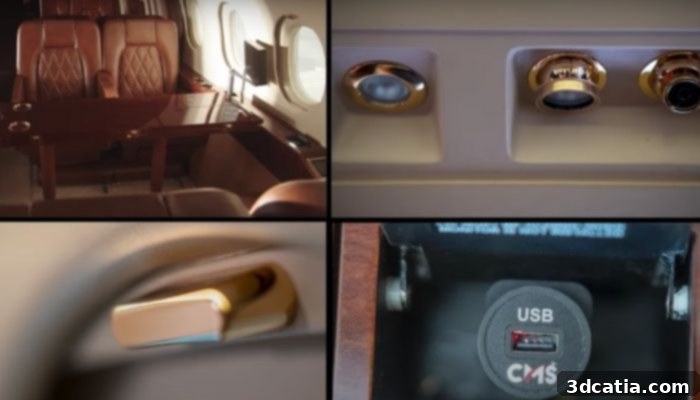
Cabin Management Solutions 3D printed light switch panels, latches, and electronic accessories, showcasing intricate design and functional integration.
Continuous Carbon Fiber-Reinforced Aircraft Parts: Unmatched Strength and Lightweight Design
The Engineering Marvel of Continuous Carbon Fiber
The X7 3D printer’s capability to print with continuous carbon fiber reinforcement is a cornerstone of its appeal in aerospace. This advanced technique allows CMS to produce parts that can rival the strength of traditionally machined aluminum, yet at a fraction of the weight. While standard carbon fiber filaments already offer impressive strength, the integration of continuous fibers takes structural integrity to an entirely new level. Unlike chopped or discontinuous fibers, continuous fibers run uninterrupted throughout the part, distributing loads more effectively and drastically improving mechanical properties such as tensile strength, stiffness, and impact resistance.
This superior mechanical performance makes continuous carbon fiber 3D printing an excellent alternative to conventional metal components, particularly where weight reduction is critical. Imagine aircraft components that are just as robust as their metal counterparts but weigh significantly less—this translates directly into improved fuel efficiency, increased payload capacity, and enhanced overall aircraft performance. In fact, continuous carbon fiber reinforced parts can be up to half the weight of equivalent aluminum parts, without compromising on strength or durability. Furthermore, this method allows for intelligent design optimization, where structural integrity can be maximized while simultaneously reducing the amount of material required, leading to less waste and more sustainable manufacturing processes.
Meeting Aerospace Demands: Flame Retardancy and FAA Compliance
For aerospace applications, material selection is not merely about strength and weight; it’s also about critical safety parameters, particularly flame retardancy. CMS leverages Markforged’s Onyx™ FR (Flame Retardant) material, which, when combined with the precision of the X7 3D printer, enables the production of high-strength, low-weight, and critically, FAA-compliant custom aircraft parts. The FAA (Federal Aviation Administration) sets incredibly high standards for materials used in aircraft interiors, focusing on preventing the spread of fire. Markforged’s FR-A materials are specifically designed to meet these rigorous requirements, providing confidence and security for aviation applications.
By integrating Markforged’s X7 printers, CMS has not only significantly ramped up its capacity for higher volume jobs but has also seen a marked improvement in the quality and reliability of its parts. This technological upgrade has enabled CMS to streamline its delivery times and successfully navigate the arduous testing and certification processes demanded by the aviation industry. The ability to quickly iterate and produce parts that consistently pass stringent FAA compliance tests is a testament to the reliability and precision of Markforged’s additive manufacturing ecosystem.
Customization and Luxury: Parts that Redefine Cabin Interiors
The versatility of the X7 printer has empowered the CMS team to produce an extensive array of components for a single aircraft, often exceeding 100 different parts. This impressive catalog includes highly customized items such as nearly 20 unique light switch panels, a sophisticated cabin climate controller, intricately designed latches, ergonomic release buttons, modern USB-C and convenient drop-in USB-A chargers, and precisely adjustable touch screen brackets. Crucially, all these components are manufactured with the luxurious end-use aesthetics expected in the cabins of high-end private and business jets. The ability to achieve intricate geometries, custom branding, and premium finishes directly from the printer ensures that every part contributes to the overall exquisite design and functionality of the aircraft interior.
The traditional manufacturing of such custom, low-volume parts would involve expensive tooling, long lead times, and limitations on design complexity. With Markforged’s technology, CMS can produce highly personalized components without these constraints, offering unparalleled design freedom to meet the unique preferences of each aircraft owner or operator. This level of customization not only enhances the passenger experience but also allows for optimal integration of electronic systems and cabin controls, improving both ergonomics and functionality. The precise control over material placement and the capability to embed continuous fibers allow for parts that are not only aesthetically pleasing but also structurally optimized for their specific application within the aircraft.
The Future of Aerospace Additive Manufacturing
The collaboration between Cabin Management Solutions and Markforged serves as a powerful case study for the broader aerospace industry. It demonstrates how advanced additive manufacturing, particularly with continuous carbon fiber reinforcement, can address some of the most pressing challenges in aircraft design and production. From reducing manufacturing lead times from weeks to hours to producing FAA-compliant, high-strength, and ultra-lightweight components, the benefits are clear and far-reaching. This approach not only enables greater design freedom and customization but also drives significant improvements in operational efficiency and cost-effectiveness.
As the aerospace sector continues its drive towards more sustainable, efficient, and technologically advanced solutions, the role of 3D printing is set to expand exponentially. Markforged’s Digital Forge platform, with its robust printers and specialized aerospace materials like Onyx FR-A and Carbon Fiber FR-A, is well-positioned to meet these evolving demands. Companies like CMS are leading the charge, proving that high-quality, end-use parts can be rapidly manufactured on-demand, without compromising the stringent safety and performance standards inherent to aviation. This partnership is not just about making parts; it’s about pioneering the future of flight, one meticulously printed component at a time. The ability to create parts that are not only lighter and stronger but also perfectly tailored to specific aircraft interiors opens up new possibilities for cabin design, passenger comfort, and overall operational excellence.
The success story of CMS leveraging Markforged’s technologies is a testament to the transformative power of additive manufacturing in specialized fields. It highlights how targeted innovation can lead to significant breakthroughs, offering solutions that were once deemed impractical or impossible with traditional methods. Learn more about Cabin Management Solutions’ innovative use of Markforged’s technologies and their impact on aerospace part production HERE.
What do you think of CMS’ 3D printed aircraft parts and the potential of continuous carbon fiber reinforcement in aerospace? We invite you to share your thoughts in a comment below or join the conversation on our Facebook and Twitter pages. Don’t forget to sign up for our free weekly newsletter, with all the latest news and innovations in 3D printing delivered straight to your inbox!