

Relativity Space Propels Space Exploration: 3D Printed Rockets & NASA’s Tipping Point Mission
The landscape of aerospace manufacturing is undergoing a significant transformation, led by innovative companies pushing the boundaries of what’s possible. Among these pioneers is the American startup Relativity Space, which specializes in the groundbreaking design and manufacturing of 3D printed rockets. Established in 2015, Relativity has rapidly positioned itself as the world’s first autonomous rocket factory, aiming to revolutionize how rockets are built, tested, and launched into orbit. Their flagship product, the Terran 1, stands as a testament to this audacious vision – it is proudly recognized as the world’s first entirely 3D printed rocket, with an astonishing 95% of its components being additively manufactured. This radical approach promises unprecedented speed, flexibility, and cost-efficiency, making space more accessible for a wider range of missions and organizations.
Relativity Space’s innovative manufacturing strategy has garnered significant attention from the investment community. Last year alone, the company successfully raised an impressive $140 million in funding, building upon the $45 million already secured since its inception. This substantial capital injection underscores strong investor confidence in Relativity’s disruptive technology and its potential to reshape the future of space travel. The consistent influx of funding has enabled Relativity to aggressively scale its operations, further refine its proprietary additive manufacturing technologies, and attract top-tier talent, solidifying its position as a burgeoning leader in the commercial space sector.
A pivotal moment for Relativity Space arrived recently with the announcement of its first major government contract. The Los Angeles-based startup has entered into a significant partnership with Lockheed Martin, one of the largest and most respected weapons and aerospace manufacturers globally. This landmark agreement involves Relativity’s participation in a critical space exploration mission spearheaded by NASA. This collaboration not only validates Relativity’s innovative manufacturing approach on a grand scale but also integrates its cutting-edge 3D printing technology into high-stakes national space initiatives, signaling a new era for aerospace production.
The context for this exciting partnership is NASA’s esteemed Tipping Point program. This initiative is strategically designed to accelerate the development and maturation of transformative space technologies by awarding contracts to companies that demonstrate promising advancements. Tipping Point projects encompass a diverse array of innovations crucial for future space endeavors, ranging from in-space testing of advanced cryogenic systems—essential for long-duration missions and deep-space travel—to pioneering foundational infrastructure like a 4G LTE network for the Moon. These forward-looking projects are integral to NASA’s ambitious plans, including establishing a sustained human presence on the Moon through the Artemis program and eventually enabling crewed missions to Mars.
Within the intricate framework of this ambitious program, Lockheed Martin and NASA are collaboratively designing and building the sophisticated cryogenic systems and the overall payload for the space exploration mission. Relativity Space, however, has been strategically selected to fulfill the crucial role of the launch provider. The meticulous plan involves launching Lockheed Martin’s Cryogenic Demonstration Mission (CDM) payload aboard Relativity’s groundbreaking Terran 1 rocket. This significant launch event is currently scheduled for October 2023, representing a major milestone for all parties involved and a definitive step forward in leveraging the power of additive manufacturing for critical, high-profile space operations.
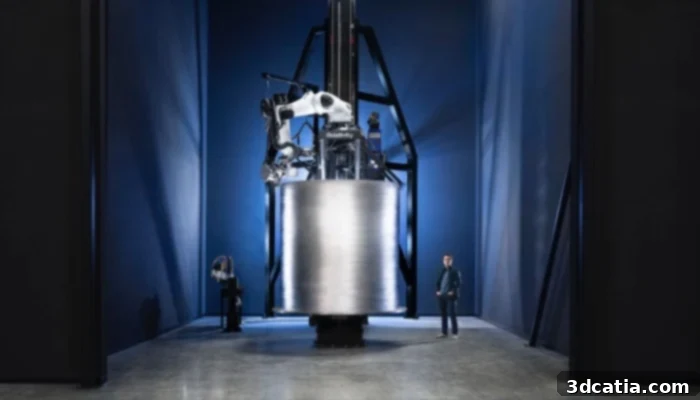
Relativity Space’s third generation 3D printer, crucial for building the Terran 1 rocket (All image credits: Relativity Space)
Tim Ellis, the visionary Founder and CEO of Relativity Space, expresses profound confidence that the company’s unique approach of 3D printing nearly the entire rocket is an ideal solution for this challenging mission. He highlights the stark contrast between Relativity’s cutting-edge methods and traditional aerospace manufacturing, which, he argues, has seen little fundamental change in over six decades. “If you look at the manufacturing tools being used today,” Ellis notes, “they’re not much different from the last 60 years. It’s fixed tooling, giant machines that look impressive but only make one shape or one object that’s been designed by hand. And it’ll take 12-24 months to make it.” This traditional reliance on specialized, fixed tooling and extensive manual labor results in protracted production timelines and often prohibitive costs, making rapid iteration and adaptation extremely difficult.
Relativity Space’s additive manufacturing prowess fundamentally alters this established paradigm, offering unparalleled speed and adaptability. “With our 3D printed approach we can print the entire fairing in under 30 days,” Ellis explains. This dramatic reduction in production time — from potentially two years to just weeks — is a transformative game-changer for the aerospace industry, enabling faster mission deployment and quicker responses to evolving requirements. Furthermore, the inherent flexibility of 3D printing, being “software defined,” allows for unprecedented adaptability. “We can just change the file to change the dimensions and shape,” Ellis states. This capability is particularly crucial for missions that require custom features or are likely to experience inevitable last-minute design modifications as launch dates approach.
Ellis further elaborates on the practical benefits for the NASA mission: “For this particular object we have some custom features that we’re able to do more quickly and adapt. Even though the mission is three years out, there will always be last-minute changes as you get closer to launch, and we can accommodate that. Otherwise, you’d have to lock in the design now.” This unparalleled flexibility mitigates the significant risks associated with rigid production schedules and ensures that missions can incorporate the latest technological advancements or respond effectively to unforeseen challenges without incurring substantial delays or prohibitive cost overruns. It means the final product is truly optimized for the mission right up until launch, a luxury rarely afforded by conventional manufacturing.
At the technological heart of Relativity Space’s revolutionary manufacturing capabilities lies “Stargate,” the world’s largest metal 3D printer, developed entirely in-house. This colossal additive manufacturing solution is a marvel of modern engineering, seamlessly integrating advanced robotics, sophisticated software, and cutting-edge automatic learning algorithms with robust metal 3D printing technology. Stargate is not merely a printer; it is an intelligent, autonomous manufacturing system meticulously designed to construct complex rocket components with unprecedented speed and precision. Its impressive capabilities include the ability to build entire rockets ready for launch, capable of carrying payloads of up to 1,250 kg, in less than 60 days. This incredibly rapid production cycle dramatically reduces the time required from initial design to launch, offering a significant competitive advantage in the increasingly dynamic and demanding space launch market. The ability to iterate designs quickly and print large, complex structures as single, monolithic pieces also drastically reduces part count, simplifies assembly processes, minimizes potential failure points, and ultimately improves the overall structural integrity and reliability of the rocket.
The partnership with Lockheed Martin and NASA’s Tipping Point program represents a monumental leap forward for Relativity Space, solidifying its position at the forefront of the burgeoning new space economy. This collaboration is far more than just launching a payload; it serves as a powerful demonstration of the viability and superior advantages of an entirely new manufacturing paradigm for space exploration. By proving the reliability, efficiency, and adaptability of 3D printed rockets for critical government missions, Relativity Space is paving the way for broader adoption of additive manufacturing across the entire aerospace sector. This transformative approach could lead to a future where rocket production is not only faster and more cost-effective but also significantly more adaptable to diverse mission requirements. Ultimately, this innovation promises to democratize access to space and accelerate humanity’s ambitious push towards establishing sustained lunar bases, Martian colonies, and venturing even further into the cosmos. The “autonomous rocket factory” model, powered by groundbreaking innovations like Stargate, hints at a future where manufacturing for space is not exclusively earth-bound but could one day be replicated off-world, leveraging in-situ resources to build infrastructure directly in space or even on other planets, ushering in an era of unprecedented possibilities for space exploration and industrialization.
What are your thoughts on Relativity Space being selected for NASA’s prestigious Tipping Point program and their innovative approach to 3D printed rockets? We invite you to share your insights and join the conversation in a comment below or connect with us on our social media channels, including our Facebook and Twitter pages! To stay informed about all the latest advancements, breakthroughs, and news in the dynamic world of 3D printing, be sure to sign up for our free weekly Newsletter, delivering cutting-edge information straight to your inbox every week!