
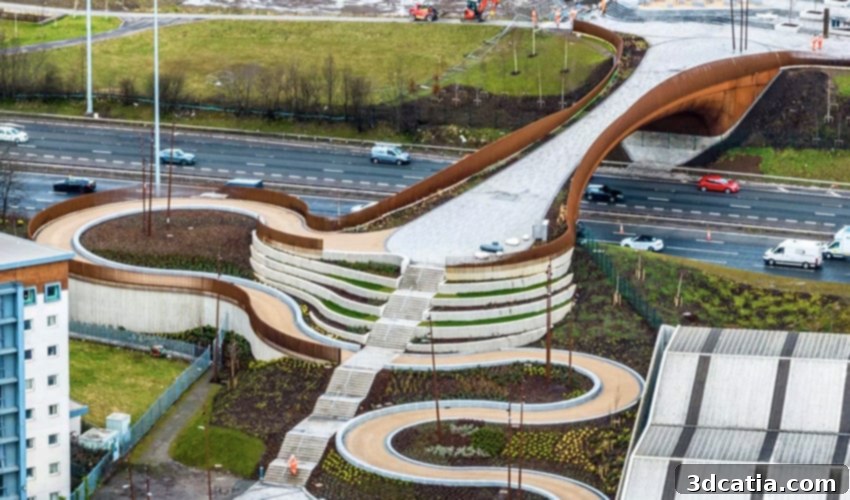
Revolutionizing Urban Infrastructure: Glasgow’s Sighthill Bridge Unveils UK’s Largest 3D Printed Structure
A monumental achievement in modern construction and a testament to the power of additive manufacturing has officially opened its doors to the public. In Glasgow, Scotland, the Sighthill Bridge now gracefully spans the M8 freeway, one of the nation’s busiest and most vital arteries. This remarkable structure represents a significant milestone, proudly incorporating one of the largest 3D printed components ever integrated into a UK public infrastructure project. While the bridge itself is a marvel of engineering, its unique distinction lies in its concrete staircase, which was expertly crafted using cutting-edge 3D printing technology by industry leaders BAM and Weber Beamix. This ambitious undertaking was conceived with a clear vision: to forge a seamless and accessible link between Glasgow’s vibrant city center and the redeveloped Sighthill neighborhood, fostering urban regeneration and community connectivity. Although the innovative staircase was installed back in 2021, the city has only recently celebrated the grand opening of the entire bridge, marking a new chapter in Glasgow’s urban landscape.
Pioneering Additive Manufacturing in Bridge Construction: A Global Perspective
The application of additive manufacturing in the realm of bridge construction is not an entirely novel concept, yet each new project pushes the boundaries of what is technically feasible and structurally sound. Indeed, the Sighthill Bridge project joins an illustrious list of initiatives where this transformative technology has been harnessed to erect public structures, with the Netherlands frequently emerging as a pioneering hub for such innovations. For instance, in the historic heart of Amsterdam, the visionary team at MX3D played a pivotal role in creating a fully functional, pedestrian-friendly bridge using robotic metal 3D printing. This iconic structure, spanning the Oudezijds Achterburgwal canal, stands as a symbol of digital craftsmanship and engineering ingenuity. Further south, in the Dutch city of Nijmegen, another groundbreaking project saw the inauguration of one of the longest 3D printed bridges specifically designed for cyclists. Notably, this particular endeavor also benefited from the collaborative expertise of BAM and Weber Beamix, underscoring their consistent commitment to advancing 3D concrete printing for large-scale infrastructure. These preceding projects collectively demonstrate a growing confidence in additive manufacturing’s ability to deliver durable, sustainable, and aesthetically pleasing solutions for modern infrastructure challenges, paving the way for the Sighthill Bridge’s own innovative approach.
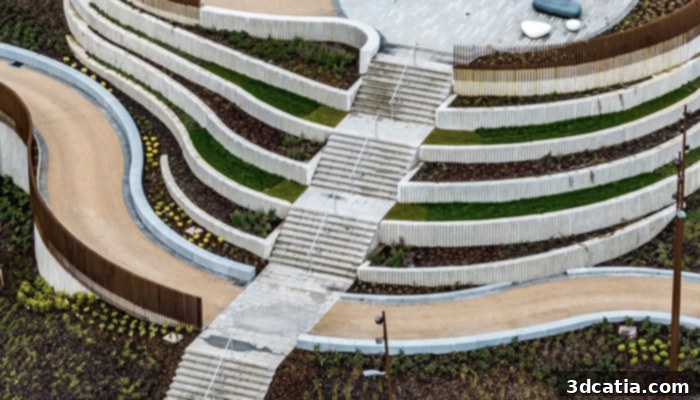
The precisely crafted 3D printed staircase by BAM and Weber Beamix for Sighthill Bridge (photo credits: BAM)
The Engineering Marvel: Manufacturing the 3D Printed Staircase
The successful realization of the Sighthill Bridge staircase hinges on the specialized expertise provided by BAM, a leading name in construction and civil engineering. Their additive manufacturing capabilities are centered around a sophisticated robotic arm, meticulously calibrated and equipped with a high-precision nozzle. This robotic system is designed to extrude a specially formulated concrete mortar mixture, depositing the material with extreme accuracy, layer by precise layer. Each successive layer boasts a thickness of approximately 5 mm, allowing for the gradual and controlled construction of complex geometries. BAM emphasizes that the utilization of 3D printing for fabricating the staircase steps offered an unparalleled advantage: the ability to achieve intricate and exact shapes that would be exceedingly challenging, if not impossible, to produce efficiently using conventional manufacturing techniques. Beyond design freedom, this innovative approach brings significant tangible benefits. The company proudly reports that 3D printing facilitated a remarkable reduction in material consumption, slashing it by an impressive 50 percent compared to traditional methods. Furthermore, the technology played a crucial role in minimizing construction waste, reducing it by up to 40 percent. This dual advantage of material and waste reduction not only contributes to a more sustainable construction process but also offers economic efficiencies. Ian Steele, BAM’s contract manager, encapsulated the essence of this project, stating, “The project has pushed the boundaries of what’s possible within construction, using cutting-edge digital techniques and collaboration from everyone involved. We are proud to leave a sustainable legacy that will benefit the north of Glasgow for years to come.” His statement underscores the collaborative spirit and forward-thinking methodology that propelled this project from concept to groundbreaking reality.
The Material Science Behind the Innovation: Weber Beamix’s Contribution
Complementing BAM’s printing expertise, Weber Beamix served as the critical supplier of the specialized concrete, which is fundamental to the success of this additive manufacturing process. Their unique concrete solution is meticulously engineered to harness the distinctive characteristics of rheological materials – substances that exhibit remarkable resistance to both flow and deformation once deposited. This particular property is paramount in 3D concrete printing, as it ensures that each freshly extruded layer retains its shape and structural integrity immediately upon placement, preventing collapse or unwanted distortion. Crucially, once the concrete is precisely placed by the robotic arm, it undergoes a rapid solidification process, swiftly bonding with the preceding layer to form a cohesive and robust structure. According to BAM, the timing of layer deposition is critical; each subsequent layer must be placed within a tight 10-minute window of the one before it to ensure optimal adhesion and structural continuity. Beyond material development, Weber Beamix also took charge of the actual 3D printing of the staircase components at their advanced manufacturing facility in the Netherlands. This off-site production approach allowed for a controlled environment, ensuring the highest quality standards and efficient production. Once these intricately designed and precisely printed components were completed, they embarked on a journey across the North Sea, carefully shipped to Scotland for final assembly and integration into the Sighthill Bridge.
Sustainable Construction and Unprecedented Design Freedom
The Sighthill Bridge project powerfully illustrates the profound advantages of incorporating additive manufacturing into mainstream construction. One of the most compelling benefits highlighted by BAM is the exceptional design freedom afforded by 3D printing. Traditional concrete construction often relies on formwork, which can be costly, time-consuming, and limiting in terms of complex geometries. 3D printing, conversely, liberates designers and engineers from these constraints, enabling the creation of intricate, organic, and functionally optimized shapes that would be incredibly difficult or economically unfeasible to achieve otherwise. This ability to print precise, customized forms opens up new architectural possibilities and allows for structural optimization, where material is only placed exactly where it is needed for strength and stability. This leads directly to the second major benefit: unparalleled material efficiency. By eliminating the need for extensive formwork and precisely depositing concrete only in required areas, the technology drastically reduces material consumption. The reported 50 percent material reduction for the Sighthill staircase is a staggering figure, translating not only to significant cost savings but also to a dramatically reduced environmental footprint. Less raw material extraction, less energy expended in production, and fewer transportation demands all contribute to a greener construction process. Furthermore, the concomitant reduction in waste by up to 40 percent addresses a persistent challenge in the construction industry, which is notoriously known for generating substantial amounts of debris. This commitment to sustainability through material and waste reduction positions 3D concrete printing as a key technology for developing more environmentally responsible and resource-efficient infrastructure solutions in the future.
From Factory to Freeway: The Journey of an Innovative Structure
The process of bringing the 3D printed staircase from concept to concrete reality involved a meticulous multi-stage journey that highlights the advantages of off-site manufacturing. The decision to print the staircase sections at Weber Beamix’s factory in the Netherlands was strategic. Manufacturing in a controlled industrial environment offers numerous benefits, including consistent quality control, protection from adverse weather conditions, and the ability to optimize production workflows without disrupting the on-site construction schedule. This factory-based approach ensures that each layer is deposited with precision and that the specialized concrete cures under ideal conditions, leading to a higher quality and more reliable final product. Once the individual staircase modules were fully printed and cured, the logistical challenge of transporting these large, innovative components across international borders to the Sighthill Bridge site in Glasgow began. Such transportation requires careful planning, specialized equipment, and adherence to strict safety protocols to ensure the integrity of the unique structures. The successful delivery and subsequent installation in 2021 underscored the feasibility of integrating advanced off-site additive manufacturing with large-scale urban infrastructure projects. This modular approach not only streamlined the on-site construction process by delivering ready-to-install components but also minimized on-site disruption, an essential consideration when working adjacent to a major motorway like the M8. It represents a forward-thinking model for infrastructure development, combining advanced manufacturing in a specialized facility with efficient on-site assembly.
The Aesthetics of Innovation: A Granite Veil for Advanced Technology
While the Sighthill Bridge staircase embodies cutting-edge 3D printing technology, those eager to observe the raw, layered beauty of 3D printed concrete with their own eyes may encounter a slight disappointment. Following its meticulous installation, the innovative structure was thoughtfully covered with granite. This decision, far from concealing the technological achievement, served a crucial practical purpose: to provide a durable, non-slip surface, significantly enhancing the safety and usability for the thousands of citizens who will traverse the bridge daily. In public infrastructure, safety and long-term durability often take precedence, and the granite covering ensures that the staircase meets all necessary standards for public access. This design choice represents an intriguing duality: advanced manufacturing creating the underlying form, while traditional, robust materials provide the aesthetic finish and functional top layer. It subtly bridges the gap between ultra-modern construction methods and familiar, trusted architectural aesthetics. This approach also allows the 3D printed structure to seamlessly integrate into the urban environment, offering a robust and visually appealing solution that complements the broader design of the Sighthill Bridge and its surroundings. It demonstrates a pragmatic understanding that while the technology is revolutionary, its application must ultimately serve the community’s needs for safety, durability, and visual harmony, ensuring that the innovation delivers tangible benefits without compromising on public expectation or functional requirements.
The Future of Construction: Embracing Additive Manufacturing for a Sustainable Tomorrow
The inauguration of the Sighthill Bridge, with its integrated 3D printed staircase, stands as a powerful beacon for the future of the construction industry. This project not only signifies a remarkable technical accomplishment in the UK but also underscores a global trend towards more sustainable, efficient, and creatively unbound methods of building. The collaboration between BAM and Weber Beamix showcases how specialized expertise in both robotics and material science can converge to create innovative solutions for complex infrastructure challenges. As we move forward, the lessons learned from projects like Sighthill Bridge, Amsterdam’s MX3D bridge, and Nijmegen’s cycling bridge will undoubtedly inform and inspire the next generation of architects, engineers, and urban planners. The demonstrable benefits—including significant reductions in material consumption and waste, alongside enhanced design freedom—make additive manufacturing an increasingly attractive proposition for large-scale construction. It offers a pathway towards reducing the carbon footprint of the building sector, optimizing resource utilization, and accelerating project timelines. While challenges such as initial investment costs, regulatory adaptation, and scaling up production remain, the continuous advancement in materials, robotics, and design software promises to overcome these hurdles. The Sighthill Bridge is more than just a crossing; it is a tangible piece of a sustainable legacy, demonstrating that innovation can indeed shape a more resilient and connected urban future. It invites us to reimagine what is possible when traditional construction meets the transformative power of digital fabrication, proving that groundbreaking technology can be seamlessly integrated into our everyday infrastructure for the benefit of all.
What are your thoughts on this latest 3D printed construction project and its implications for urban development? We invite you to share your insights and comments below, or connect with us on our LinkedIn, Facebook, and Twitter pages! Don’t forget to sign up for our free weekly Newsletter here to receive the latest 3D printing news straight to your inbox. You can also explore all our fascinating videos on our YouTube channel for more in-depth content.
*Cover photo credits: BAM