
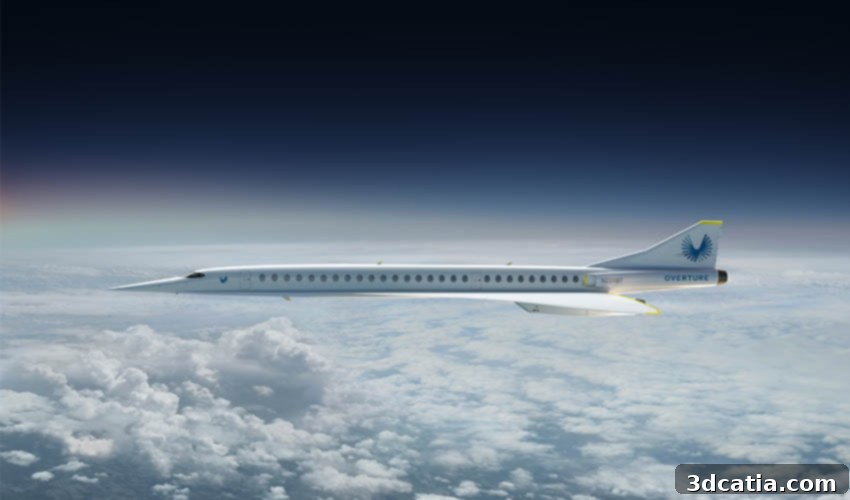
Boom Supersonic’s Overture: Revolutionizing Flight with Dassault Systèmes’ 3DEXPERIENCE and Advanced Additive Manufacturing
In a bold move to redefine the future of aviation, the innovative aerospace manufacturer Boom Supersonic is making significant strides in developing Overture, poised to become the world’s fastest commercial airliner. This groundbreaking Mach 2.2 aircraft promises to dramatically cut long-haul travel times, connecting global cities like never before. To accelerate the ambitious design and development phases of Overture, Boom Supersonic has strategically partnered with Dassault Systèmes, leveraging its powerful 3DEXPERIENCE platform. This collaboration underpins the digital transformation of their entire product lifecycle, from initial concept to final certification. Beyond their robust digital infrastructure, Boom Supersonic has also successfully secured substantial funding, raising an impressive $100 million in a Series B venture round, underscoring investor confidence in their vision. Further solidifying their technological edge, the company recently announced an extension of its crucial partnership with Stratasys, a leader in additive manufacturing. This renewed seven-year agreement focuses on manufacturing flight-critical parts for their XB-1 demonstrator aircraft, utilizing Stratasys’ advanced F900 3D printing solution. These strategic alliances highlight Boom Supersonic’s commitment to integrating cutting-edge digital and manufacturing technologies to bring supersonic commercial flight back to the skies.
The Digital Blueprint: Harnessing Dassault Systèmes’ 3DEXPERIENCE Platform for Supersonic Development
Boom Supersonic, a forward-thinking Colorado-based company, has embraced Dassault Systèmes’ ‘Reinvent the Sky’ industry solution experience to orchestrate its entire product development process. This comprehensive platform supports every stage, from the earliest conceptual sketches through meticulous manufacturing and rigorous certification. The profound advantages offered by advanced digital design and simulation tools are now undeniable, especially in complex industries like aerospace. By deploying the integrated 3DEXPERIENCE platform, Boom Supersonic anticipates a drastic reduction in the development timeline for their initial prototype, projecting to halve the time typically required. This efficiency gain is critical for a startup pushing the boundaries of aerospace engineering. Furthermore, the platform empowers the company to significantly enhance product quality by streamlining processes, reducing program complexity, eliminating inefficiencies, and optimizing the allocation of valuable resources – all common barriers that can impede market entry for new innovators.
Joshua Krall, co-founder and VP of Technology at Boom Supersonic, articulated the imperative need for such advanced tools. He explained, “Overture brilliantly synthesizes new advancements in aerodynamics, materials science, and propulsion technologies to fundamentally revolutionize long-haul commercial airline travel. To realize our audacious vision of a supersonic future, we absolutely require powerful and integrated design tools, and that is precisely what Dassault Systèmes’ 3DEXPERIENCE platform provides. As a dynamic startup, we benefit from not being encumbered by outdated legacy software systems. Our goal is to maintain minimal IT costs while maximizing operational agility. We found the 3DEXPERIENCE platform remarkably quick and easy to deploy, and we fully expect to scale up to hundreds of users seamlessly as our project matures and our team expands.” This statement underscores the platform’s flexibility and scalability, making it an ideal choice for innovative companies aiming for rapid growth.
The ‘Reinvent the Sky’ solution is specifically tailored to offer scalable access to a suite of digital design and simulation applications within a singular, secure, and standards-based environment. This makes it exceptionally well-suited for aerospace startups, agile new market entrants, and smaller original equipment manufacturers who need the capabilities of larger enterprises without the prohibitive overhead. David Ziegler, Vice President, Aerospace & Defense Industry at Dassault Systèmes, elaborated on this strategic alignment: “Aerospace companies globally are relentlessly working to deliver aircraft that are faster, lighter, and more fuel-efficient, all while refusing to compromise on passenger comfort and safety. Smaller innovators in this space require sophisticated tools for their product development programs that can provide them with the robust infrastructure typically enjoyed by more established companies, yet still allow them to remain nimble and incur minimal IT-related expenses. The 3DEXPERIENCE platform is designed to deliver precisely this level of comprehensive support. With it, Boom Supersonic can confidently create the next generation passenger experience, leveraging digital applications that have been integral to many of the industry’s most significant milestones throughout its history.” This sentiment highlights the platform’s role in democratizing access to cutting-edge technology, empowering companies like Boom Supersonic to innovate at an unprecedented pace.
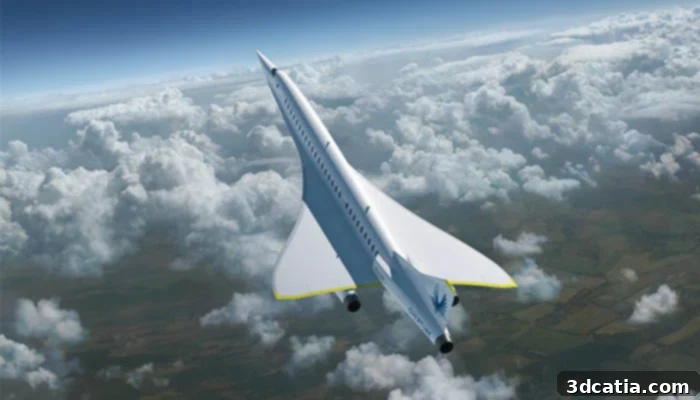
Overture airliner | Photo Credits: Boom Supersonic
Accelerating Innovation: Additive Manufacturing’s Role in Supersonic Flight
Complementing their advanced digital design capabilities, Boom Supersonic is deeply invested in the transformative potential of additive manufacturing, commonly known as 3D printing. The recently extended seven-year partnership with Stratasys is a testament to this commitment, focusing on the development and production of critical aircraft parts. This long-term agreement signifies a shared vision for creating a repeatable and robust process for manufacturing complex components. Additive manufacturing offers unparalleled advantages for the aerospace sector, particularly for innovative projects like the XB-1 and Overture.
One of the primary benefits of 3D printing in aircraft design is the ability to create highly complex geometries and optimized lattice structures that are impossible to achieve with traditional manufacturing methods. These intricate designs can dramatically reduce part weight without compromising structural integrity, leading to more fuel-efficient and agile aircraft. For supersonic flight, where every gram counts, this capability is invaluable. Furthermore, additive manufacturing allows for rapid prototyping and iteration, enabling engineers to quickly test and refine designs, significantly shortening development cycles. This agility is crucial for a company like Boom Supersonic, which is pioneering a new class of aircraft. The technology also facilitates the use of advanced materials with specific properties, such as high temperature resistance and strength-to-weight ratios, which are essential for supersonic environments.
The Stratasys F900 3D printing solution, a cornerstone of this partnership, is designed for demanding industrial applications, capable of producing large, strong, and high-performance parts. This technology enables Boom Supersonic to manufacture flight-ready components for their XB-1 demonstrator aircraft. By integrating 3D printed parts, Boom can benefit from a streamlined supply chain, reduced tooling costs, and the ability to produce on-demand parts, minimizing inventory and lead times. This collaboration goes beyond just prototyping; it’s about establishing a scalable manufacturing process for production parts, ensuring that the innovations proved on the XB-1 can be seamlessly transferred to the commercial Overture. The precision and reliability offered by Stratasys’ F900 system are paramount for ensuring the safety and performance required for supersonic speeds, laying a critical foundation for the future of Boom’s commercial fleet.
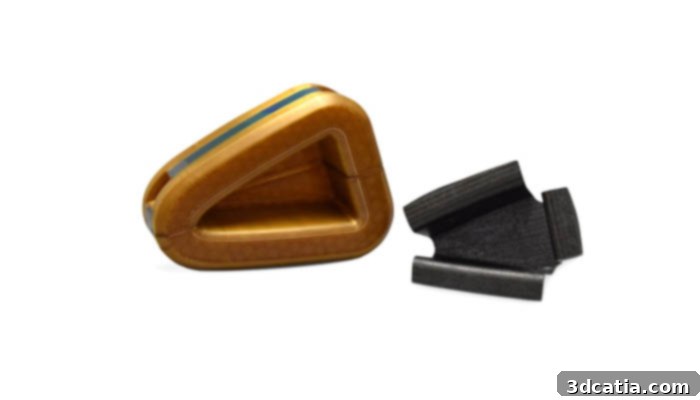
3D printed parts using Stratasys’ solution | Credits: BuisnessWire
The Path to Supersonic: The XB-1 Demonstrator and Overture’s Vision
Before Overture takes to the skies with passengers, Boom Supersonic is rigorously testing its innovations through the XB-1, a sleek, two-seat demonstrator aircraft. The XB-1 serves as a crucial testbed, designed to prove the key technologies essential for safe, efficient, and sustainable supersonic flight. This includes validating advanced aerodynamic designs, new composite materials capable of withstanding extreme conditions, and high-efficiency propulsion systems. The data gathered from XB-1’s flight tests will be invaluable, directly informing the final design and engineering of Overture, ensuring that the flagship commercial airliner meets and exceeds all performance and safety expectations. This phased approach minimizes risks and optimizes the development process for such a complex and pioneering aircraft.
Once operational and certified, Boom Supersonic’s flagship airliner, Overture, is set to make history as the fastest commercial airliner ever built. With a projected cruising speed of Mach 2.2, which is approximately 1,450 miles per hour, Overture promises to dramatically redefine international air travel. Imagine flying from New York to London in a mere 3.25 hours, or embarking on a journey from Tokyo to San Francisco in just 5.5 hours. These travel times represent a significant reduction compared to conventional subsonic flights, potentially halving current durations. This capability is not just a feat of engineering; it’s a paradigm shift in how global business is conducted and how people experience world travel. It will enable faster connections for business leaders, expand opportunities for tourism, and make distant destinations feel remarkably closer, fostering greater global connectivity.
Beyond the Horizon: Challenges and the Future of Supersonic Commercial Aviation
The return of supersonic commercial flight is an ambitious undertaking, fraught with challenges that Boom Supersonic is actively addressing. Beyond the technical hurdles of achieving Mach 2.2 flight, considerations such as environmental impact, economic viability, and regulatory compliance are paramount. Boom Supersonic has publicly committed to making Overture a net-zero carbon aircraft, emphasizing sustainability through advanced engine technology, sustainable aviation fuels, and efficient operations. The company is working diligently to overcome these obstacles, demonstrating a holistic approach to bringing supersonic travel back responsibly. The ultimate success of Overture will depend not only on its groundbreaking speed but also on its ability to integrate seamlessly into existing global air traffic systems, meet stringent noise regulations, and offer an economically attractive proposition for airlines and passengers alike.
Boom Supersonic’s journey with Overture, bolstered by strategic partnerships with Dassault Systèmes and Stratasys, marks a pivotal moment in aerospace innovation. By combining the power of advanced digital design and simulation with the transformative capabilities of additive manufacturing, Boom is not just building an aircraft; they are laying the foundation for a new era of air travel. The vision of a world where cities are closer, and experiences are more accessible, is rapidly becoming a reality. As the XB-1 paves the way and Overture progresses towards its maiden commercial flight, Boom Supersonic stands at the forefront of rekindling humanity’s fascination with speed and pushing the boundaries of what’s possible in the sky.
Find out more about Boom Supersonic’s partnership with Stratasys HERE.
What are your thoughts on Boom Supersonic’s ambitious plans and the future of supersonic commercial flight? Share your comments below or engage with us on our Facebook and Twitter pages! Don’t miss out on the latest advancements in 3D printing and aerospace innovation – sign up for our free weekly Newsletter to have all the breaking news delivered directly to your inbox!