
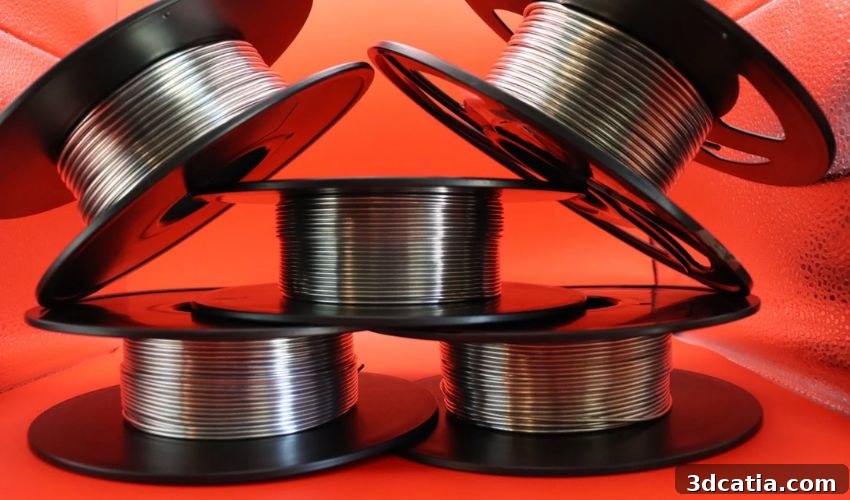
When Ian Ramsdell, founder of Kupros, first asked electronics experts whether solid copper could be 3D printed, he encountered widespread disbelief. One engineer told him flatly, “Copper can’t be 3D printed, it’ll never be 3D printed.” What that view overlooked was that Ramsdell was already building on validated laboratory research performed years earlier by a US military lab.
That gap between “impossible” and “already proven in the lab” is the origin story of Kupros and its flagship material, Cu29. Cu29 is a fully metallic, conductive filament formulated to run on standard fused deposition modeling (FDM) printers — the desktop machines commonly found in workshops and labs. The material is intended not only for simple conductive traces but for integrated electronics: embedded sensors, signal routing printed directly into parts, and conformal antennas and conductive paths that follow complex geometries instead of being confined to flat circuit boards. In sectors like aerospace and defense, Kupros highlights clear benefits: fewer wiring harnesses and connectors, integrated structural-health sensing in load-bearing parts, and much faster iteration as electrical and mechanical designs are developed together.
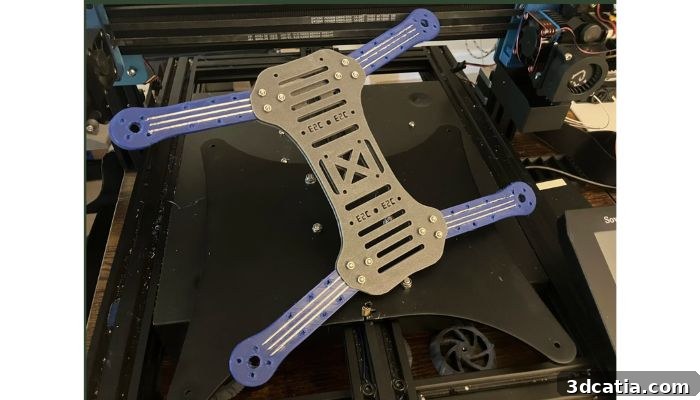
Cu29 can be used to develop embedded electronics.
NASA, Northrop and Boeing Pre-Ordered Cu29 Before It Existed
Demand for Cu29 formed early. After Ramsdell presented at the 2022 DMC conference in Tampa as an Army xTech finalist, he left with prepaid orders from major aerospace and defense organizations, including NASA, Northrop and Boeing. Additional pre-sales came from KBR, US Army DEVCOM and several universities. These institutions were willing to invest before final production because the material promised capabilities not otherwise available — an uncommon vote of confidence for a materials startup that had not yet reached revenue.
The Navy-Lab Origin
The technical foundation for Cu29 traces back to a US Navy laboratory. Ramsdell credits scientist Carson Holmes, who worked on additive electronics systems and published a top paper under the Office of Naval Research Design Innovation Award in 2017. Holmes’ approach addressed limitations of existing additive electronics platforms — expensive inkjet or aerosol systems that often depended on silver inks and suffered from porous traces, restricting them to low-voltage, low-current applications. Ramsdell licensed that de-risked technology in 2021 through a Department of Defense startup studio, choosing to commercialize a route already proven at the lab scale rather than inventing an untested process from scratch.
Ramsdell notes that some large electronics manufacturers had tried and failed to make similar materials for decades, which underscored the significance of adopting a lab-validated foundation rather than starting purely from experimental science.
Why Copper Is Hard to 3D Print
Copper poses several intrinsic challenges for additive manufacturing. It is highly reflective, conducts heat exceptionally well, and oxidizes readily with temperature changes. Those characteristics make copper difficult to process with many 3D printing technologies. Overcoming these issues opened opportunities beyond simply printing conductors: Kupros says the chemistry can be doped for functions such as radiation shielding or anti-tamper features that discourage reverse engineering by X-ray.
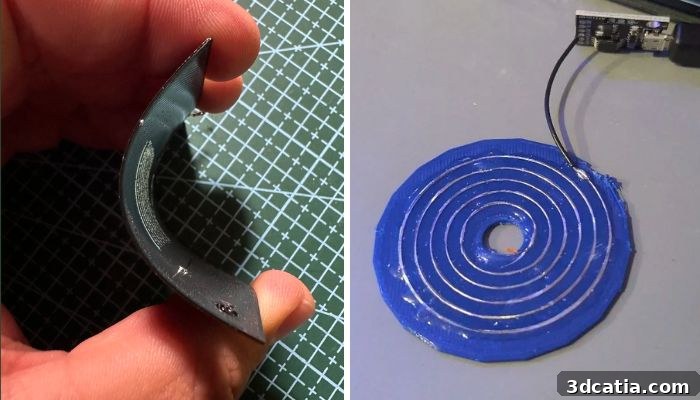
Conductive filament printing allows users to build embedded signal routing, integrated sensors, conformal conductive paths, embedded antennas, and more.
Built for Hardware You Already Own
A key commercial advantage for Cu29 is that it runs on commodity FDM printers rather than requiring specialized, six- and seven-figure machines. Kupros has demonstrated the filament on sub-$300 desktop printers and on consumer-grade systems such as the Bambu Lab A1 Mini, and is qualifying platforms like the Prusa XL. The material requires no printer modifications beyond a hardened steel hotend, and parts printed with Cu29 are functional directly off the bed with no sintering, plating, curing, or chemical cleanup. That contrasts sharply with silver-based inkjet methods that demand significant maintenance and post-processing.
Kupros emphasizes that Cu29 is not intended to replace bulk metal printing; the company has tested only a few layer heights in the vertical axis. Instead, the filament’s purpose is embedded electronics: conductive traces printed in and on polymer structures as part of a multi-material build. Typical workflows use dual-extruder or independent-extruder (IDEX) machines to lay down structural plastic and Cu29 together so electrical paths are incorporated where they are needed, enabling placement of components at the point of need instead of relying solely on traditional PCBs.
The Performance Claims
Kupros publishes preliminary performance results that highlight the material’s potential. In early high-voltage tests, Cu29 withstood 12,500 volts without failure and then continued to tolerate increasing current until testing equipment failed. In another test, a supercapacitor bank drove an estimated hundreds of amps through a short sample without destroying the material. Compared to silver inkjet chemistry, Ramsdell claims Cu29 offers dramatically higher conductivity. These company-reported figures await independent verification, but they position Cu29 as a single conductive material potentially suitable for both low- and high-power applications — a capability incumbent additive electronics chemistries struggle to provide. Kupros also received the TCT Materials Award at the RAPID event this year.
A Space-Grade Variant in Development
Kupros is developing a space-qualified variant called Cu29 Space to address tin whiskering, a failure mode where tiny tin filaments grow and can bridge adjacent traces, causing shorts. Tin whiskering is a major concern for spacecraft because hardware cannot be serviced once deployed. The Space formulation is designed to eliminate whiskering while enabling printed traces from roughly 0.2 mm to 1.2 mm on typical FDM hardware, potentially supporting power-grade conductors, modular and non-planar electronics, and embedded sensors and antennas for space systems.
What Cu29 Means for Additive Electronics
The company name nods to copper’s ancient significance: “Kupros” comes from the Greek word for copper, and Ramsdell points out that the Greeks were among the first civilizations to enter the Copper Age. That historical reference mirrors the product’s ambition to open a new chapter in additive electronics.
If the performance claims hold up under independent testing, a conductive copper filament that runs on commodity printers and offers a space-grade option represents a meaningful advance for additive manufacturing, enabling truly multi-material, functional parts straight off the print bed. Kupros is positioning Cu29 as a way to integrate electrical functionality into parts more directly and efficiently than current methods allow.
*Photo credits: Kupros