
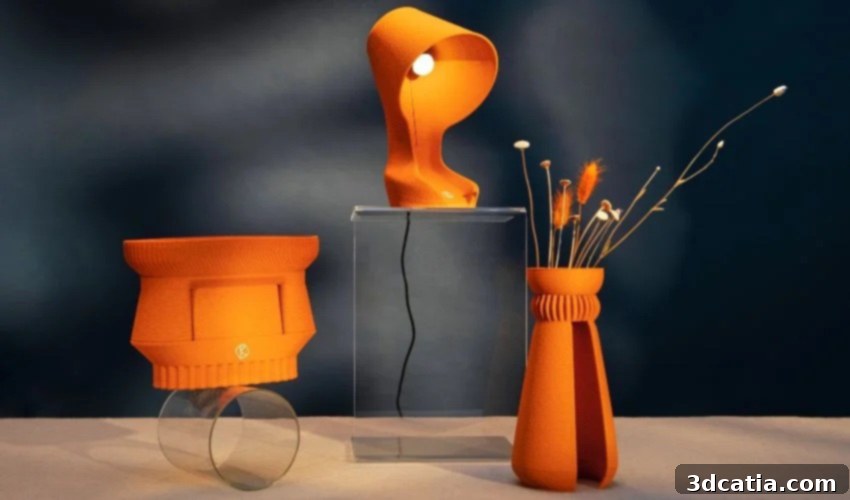
Krill Design: Pioneering Sustainable 3D Printing with Upcycled Food Waste Biomaterials
As the global conversation around environmental stewardship intensifies, the role of advanced manufacturing technologies like 3D printing in achieving sustainability goals has become a focal point. While often associated with rapid prototyping and industrial innovation, 3D printing is now proving to be a powerful tool for developing truly eco-friendly production methods. A remarkable testament to this potential comes from an unexpected quarter: Krill Design. This innovative startup, born from the vision of three Milan Polytechnic students, is demonstrating that cutting-edge additive manufacturing and planetary well-being can indeed go hand in hand.
Krill Design has carved out a unique niche by transforming everyday food waste – such as orange peels, lemon zest, and spent coffee grounds – into high-quality, functional, and aesthetically pleasing home decor items. Their product range, which includes elegant lamps, practical magazine racks, and various decorative objects, showcases a revolutionary approach to material sourcing and product design. This interview delves into their inspiring journey, uncovering the philosophy, processes, and future aspirations that drive their commitment to a greener future.
3DN: Could you introduce yourselves and provide more insight into Krill Design’s mission and origins?
The Krill Design team (photo credits: acube).
We are Krill Design, an innovative startup that officially came into being in Milan in 2018. Our core mission is to redefine product design and manufacturing by creating 3D printed objects using advanced biomaterials. What makes our approach truly distinctive is that these materials are meticulously developed from recovered food waste, offering a robust and environmentally superior alternative to conventional plastics.
The genesis of Krill Design was a synergistic meeting of three passionate individuals: Ivan Calimani, Martina Lamperti, and Yack di Maio. Each brought unique skills and a shared commitment to a trio of fundamental values: innovation, sustainability, and design excellence. Their collective thinking was born from a simple yet profound observation: while various industries have established efficient channels for intercepting and valorizing waste streams from materials like paper, glass, and plastic, the vast quantities of organic by-products generated by the food chain largely lack suitable, sustainable solutions.
Recognizing this significant environmental challenge, the three founders transformed what many saw as a problem into a powerful opportunity. They embarked on an ambitious journey of experimentation, dedicating themselves to the creation of innovative materials derived directly from this overlooked organic waste. When combined with the transformative capabilities of 3D printing, their pioneering efforts resulted in a production process that is not only highly successful in terms of product creation but also profoundly environmentally friendly, setting a new benchmark for sustainable manufacturing.
3DN: What were the key reasons behind your strategic decision to embrace 3D printing technology for your products?
Our decision to integrate 3D printing into the very fabric of Krill Design was a deliberate and strategic one, deeply rooted in its inherent advantages for innovation and sustainability. Two of our founders, Yack and Martina, already possessed extensive familiarity with additive manufacturing, having previously established and operated a dedicated 3D printing center. This foundational knowledge provided a strong impetus for adopting the technology.
Beyond prior experience, additive manufacturing aligns perfectly with our ethos of being digital-first and maximally sustainable. One of its most significant benefits is the ability to produce products strictly on demand. This “manufacturing on demand” model is a radical departure from traditional mass production, which often necessitates large inventories. By only producing what is needed, when it is needed, we effectively eliminate the substantial waste associated with unsold products and excess stock. This not only reduces material consumption but also minimizes storage costs and the environmental footprint of logistics.
Furthermore, 3D printing offers unparalleled flexibility, empowering us to create highly customizable products. This allows us to cater to individual preferences and unique design specifications, enhancing customer engagement and product value. The technology also fosters an environment of continuous internal experimentation. We can rapidly prototype new designs, test different material compositions, and iterate on product improvements with speed and efficiency. This agility is crucial for a startup like ours, enabling us to innovate constantly and bring novel, eco-friendly designs to market faster than conventional manufacturing methods would allow.
3DN: Can you elaborate on the fascinating production process behind your 100% natural and compostable Rekrill® materials?
Rekrill® is the cornerstone of Krill Design, representing our proprietary line of innovative biomaterials developed entirely in-house. The creation of Rekrill® is a meticulously designed process that transforms industrial food waste into valuable raw material for 3D printing. We selectively partner with food and beverage companies to source specific organic by-products that would otherwise be discarded, turning potential waste into a sustainable resource.
The core process for any type of food waste follows a consistent and carefully controlled methodology. First, the collected food waste undergoes a thorough drying phase to remove moisture, which is crucial for material stability and processing efficiency. Following drying, the material is finely chopped and then micronized – a process that reduces it to an extremely fine powder. This fine particle size is essential for achieving homogeneity and optimal flow characteristics during subsequent processing steps.
The micronized food waste is then compounded with a 100% vegetable-based binder. This plant-derived component is critical as it imparts the necessary technical properties to the material, such as strength, flexibility, and printability, while ensuring the final product remains entirely natural and compostable. The resulting granulate is then subjected to heat and extruded through specialized machinery to form continuous filaments. These filaments are then carefully spooled into coils, which are ready to be loaded onto our 3D printers.
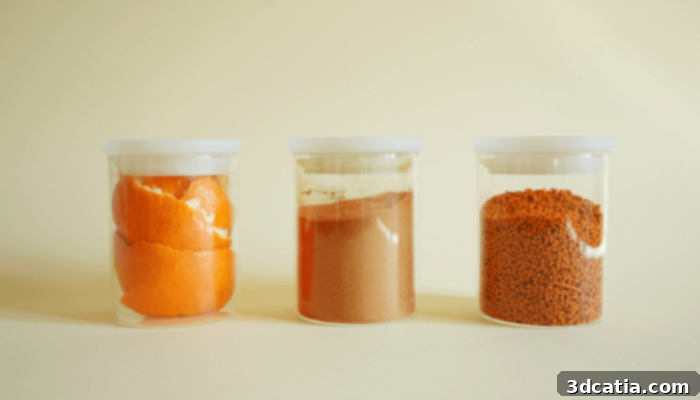
The Rekrill® Orange material
A common misconception about biodegradable materials is that they degrade rapidly. However, our Rekrill® materials are specifically engineered for durability. While they are 100% biodegradable and compostable at the end of their lifecycle, they are also designed to be long-lasting and robust in everyday use. They do not suddenly degrade or fall apart under normal conditions, offering the reliability expected of high-quality design products.
Currently, our Rekrill® materials are available in three distinct and beautifully scented varieties, each derived from a specific food waste: Rekrill® Orange, made from recycled orange peels; Rekrill® Lemon, crafted from lemon peels; and Rekrill® Coffee, produced from spent coffee grounds. These unique material compositions have inspired our three distinct collections of 3D printed home décor objects: Ribera, Amalfi, and Napoli, each reflecting the essence of its origin. A prime example of our success is Ohmie, our award-winning 3D printed lamp made from orange peels, which has become one of Krill Design’s most iconic and successful pieces. We are continuously pushing the boundaries of material innovation and are actively working on developing exciting new biomaterials set to launch in 2023, expanding our sustainable offerings even further.
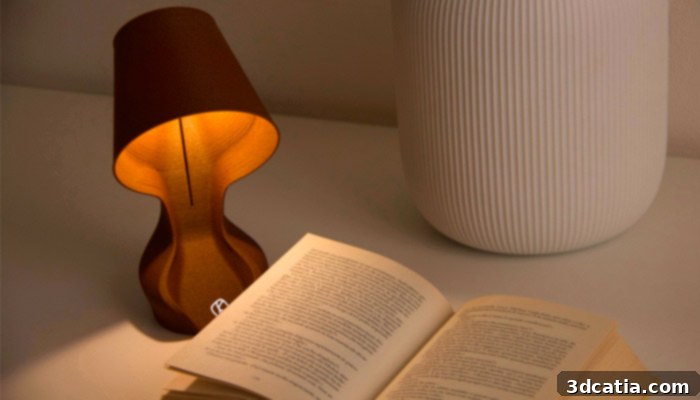
La lampada Ohmie.
3DN: Which 3D printing technology do you employ to bring your unique products to life?
At Krill Design, we primarily utilize FDM (Fused Deposition Modeling) technology for the creation of our products. This choice is deliberate, as FDM proves to be exceptionally well-suited for our specific application, allowing us to successfully process and reuse our unique biomaterials derived from food waste. The versatility and accessibility of FDM printers make them an ideal platform for transforming our Rekrill® filaments into tangible, functional design objects.
Our current setup includes a fleet of standard Prusa printers, renowned for their reliability and open-source nature, which allows for greater control and customization. In addition to these, we also operate a modified Creality CR10 Max. The modification of the Creality CR10 Max was a strategic decision to optimize its performance specifically for our Rekrill® materials, ensuring consistent print quality and efficiency with our unique filaments. This blend of standard and customized hardware allows us to maintain a flexible and scalable production environment.
The efficiency of our production process is notable. For instance, our celebrated Ohmie lamp can be 3D printed in approximately 3 hours, while a larger item like our magazine rack takes about 5 hours. However, achieving these optimized print times and consistent quality was not without its challenges. One of the most significant hurdles we faced, and successfully overcame, was finding the perfect configuration of printing parameters for each specific Rekrill® material and product. This involved extensive experimentation with factors such as extrusion temperature, print speed, layer height, and retraction settings to ensure optimal material flow, adhesion, and structural integrity of the final printed object. This iterative process of refinement has allowed us to maximize the potential of both our biomaterials and our FDM technology.
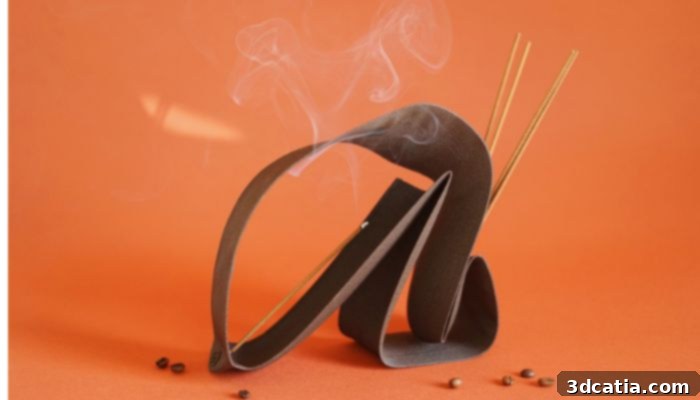
This incense holder was printed with Rekrill® Coffee material
3DN: How do you envision the future evolution and growth of Krill Design?
Our vision for Krill Design extends far beyond merely producing consumer goods; we see ourselves as a pivotal player in fostering a global circular economy. In addition to our direct-to-consumer product lines, we are actively engaged in collaborative circular economy projects with various companies. These partnerships are particularly exciting as they involve working directly with organizations that generate significant food waste, enabling us to design and develop bespoke products specifically tailored from their unique waste streams. This collaborative approach not only diverts waste from landfills but also helps these companies achieve their own sustainability targets by closing the loop on their material consumption.
As we’ve highlighted previously, the inherent advantages of 3D printing are fundamental to our future strategy. Its ability to facilitate digital manufacturing centers allows us to produce exactly what is needed, when it’s needed, thereby avoiding overproduction and minimizing environmental impact. This lean manufacturing principle is central to our scalable growth model. Looking ahead, our ambitious vision includes the establishment of “Krill Design hubs” strategically scattered around the world. These decentralized production units would enable us to get physically closer to our end customers, drastically reducing shipping distances and associated carbon emissions.
Crucially, these future hubs would also be designed to leverage local food waste materials. This localized approach would not only empower local economies by creating value from regional waste but also further enhance the sustainability of our operations by minimizing the transportation of raw materials. By tapping into diverse local waste streams – from regional fruit peels to specific agricultural by-products – we can create unique, geographically inspired product lines while strengthening the circular economy on a community level. This distributed, hyper-local manufacturing model represents the true future of sustainable production as envisioned by Krill Design.
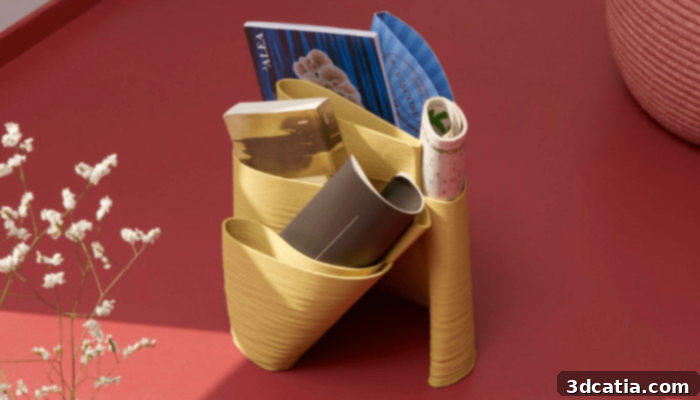
Krill Design’s 3D printed magazine rack made from recycled lemon peels
3DN: Do you have any final message or words of inspiration for our readers?
Our guiding philosophy and unwavering vision can be succinctly summarized in a powerful mantra: “Feed the change, shape the future!” This statement encapsulates our belief in transforming waste into opportunity and harnessing innovation to create a more sustainable tomorrow. We are incredibly passionate about demonstrating that beautiful design and environmental responsibility are not mutually exclusive but rather complementary forces that can drive meaningful change.
We invite all our readers to explore the world of sustainable design and material innovation that Krill Design is building. If you are intrigued by our work, our unique biomaterials, or our range of 3D printed home decor products, we encourage you to visit our official website HERE for more comprehensive information, product galleries, and insights into our mission. Join us in our journey to reshape the future of manufacturing, one upcycled piece at a time.
What are your thoughts on Krill Design’s innovative 3D printed objects and the groundbreaking materials they’ve developed from food waste? We value your insights and would love to hear from you. Please feel free to share your comments below or engage with us and the wider 3D printing community on our social media channels: Linkedin, Facebook, and Twitter! For the very latest updates, trends, and news from the dynamic world of 3D printing, don’t forget to sign up for our free weekly Newsletter here, delivered straight to your inbox. You can also explore all our engaging videos and content on our dedicated YouTube channel, where innovation comes to life.
*All Photo Credits: Krill Design