Guides
#Working3D: Six Questions for a Pharmaceutical 3D Printing Researcher
Additive manufacturing in the medical sector is continuously improving and progressing. Innovations and applications are flourishing, demonstrating the potential of 3D technologies to improve the daily lives of many patients. The pharmaceutical field is no exception, and the grad
- 3 min read
- Guides
- Six more stories
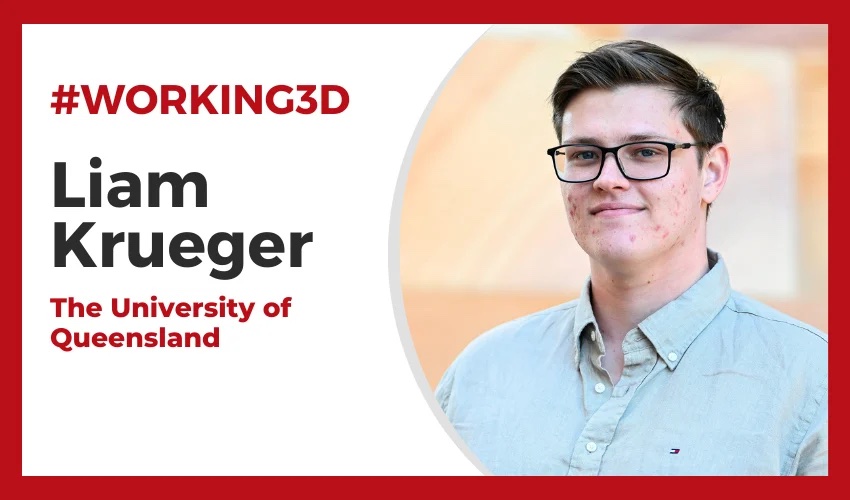
Additive manufacturing in the medical sector is continuously improving and progressing. Innovations and applications are flourishing, demonstrating the potential of 3D technologies to improve the daily lives of many patients. The pharmaceutical field is no exception, and the gradual launch of several different forms of 3D printed medication is testimony to the advances being made. The use of 3D printing makes it possible, among other things, to create medicines with personalized dosing of active ingredients, to combine several drugs in a single tablet according to the needs of each patient, and to modify their shape and consistency to make them more suitable, for example, for children or the elderly. To find out more about this world and what it means to work in 3D printing research for the pharmaceutical industry, we interviewed Liam Krueger, a PhD student specializing in pharmaceutical 3D printing at the University of Queensland.
3DN: Could you introduce yourself?
Hi, my name is Liam Krueger, I’m a pharmacist and final year PhD student studying 3D printing of pharmaceuticals at the University of Queensland, Australia. I finished my pharmacy degree in 2020 and went straight into my PhD. Although I’m nearing the end of this chapter, I’m still very passionate and motivated to continue my research.

Liam Krueger, center, with colleagues from the University of Queensland.
3DN: How did you discover additive manufacturing?
When I was a pharmacy student, my research supervisor, Professor Amirali Popat, who is now my thesis supervisor, was working on an extrusion and fused deposition modeling project, which appealed to me. Since then, we have considerably expanded our 3D printing section, with two hot-melt extruders and a dozen 3D printers.
More from the desk
Six other notes from the rest of the bench.
 NewsJob Offers and 3D Printing: What Are the Major Trends and Developments?Every year, 3Dnatives takes a look back at the 3D printing job market, to find out what the major trends are for the coming years. To do this, we rely on the job offers published on our Job Board, in…
 NewsMani.me and their 3D printed Nails; the future of manicures?The technologies of additive manufacturing’s impacts is constantly brought to different sectors from food to vehicles, through fashion and reaching consumer products. However, believe it or not, 3D printing technologies have gone into manicures… Or at least that is th
 NewsSALTGATOR Introduces World’s First Desktop SoftGel Injection Molding MachineSALTGATOR Tech Inc., a new company based in Dickinson, Texas, has unveiled a desktop SoftGel injection molding machine aimed at DIY makers. Injection molding has traditionally been confined to large industrial settings, where machines are bulky and costly. Now, SALTGATOR’s&hellip
 ApplicationsTISSIUM receives FDA approval for its polymerizable vascular sealantTISSIUM was founded in 2013 to address one of the most persistent medical challenges since the inception of medical procedures: to reconstruct damaged tissue. The medtech company developed a proprietary technology, called biomorphic programmable polymers, to transform the way tis
 GuidesWhich European Car Manufacturers Are Using 3D Printing?More and more car manufacturers are adopting 3D printing to improve their production processes and offer more personalized vehicles. Whether for electric cars, mass-market models, or luxury cars, 3D technologies are part of the value chain, and have become one…
 ApplicationsBMW Leverages 3D Printing for Improved Robotic Gripper DesignAdditive manufacturing has become a fully-fledged production process for the BMW Group. For over 30 years now, the automaker has relied on 3D printing for the manufacture of automotive parts, tools, work aids, and training. The “Additive Manufacturing Campus” in…