Applications
BMW Leverages 3D Printing for Improved Robotic Gripper Design
Additive manufacturing has become a fully-fledged production process for the BMW Group. For over 30 years now, the automaker has relied on 3D printing for the manufacture of automotive parts, tools, work aids, and training. The “Additive Manufacturing Campus” in…
- 3 min read
- Applications
- Six more stories
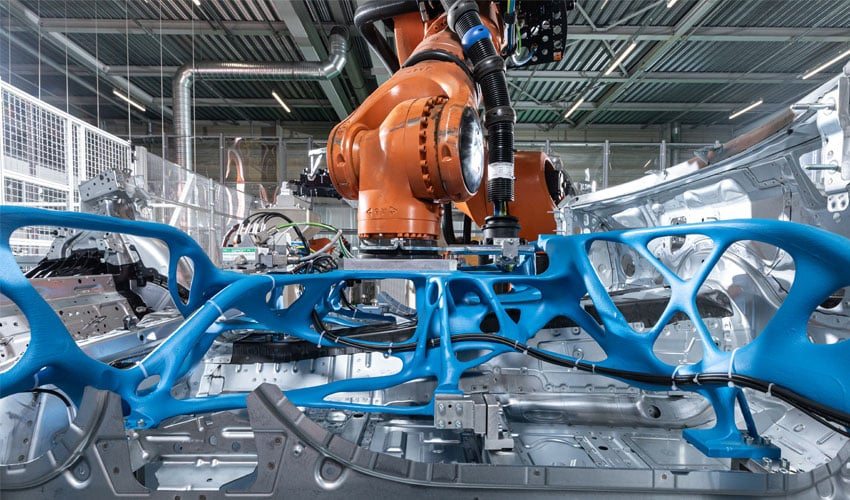
Additive manufacturing has become a fully-fledged production process for the BMW Group. For over 30 years now, the automaker has relied on 3D printing for the manufacture of automotive parts, tools, work aids, and training. The “Additive Manufacturing Campus” in Oberschleißheim plays a central role in this development. Last year, a total of over 300,000 parts were printed here, using a variety of processes. More recently, at the same center, the automaker unveiled 3D-printed XXL grippers. They have been installed on a press for the production of all the German brand’s carbon-fiber-reinforced polymer (CFRP) roofs.
This robotic gripper, weighing approximately 120 kilograms and requiring 22 hours for printing, showcases the efficiency of additive manufacturing. By leveraging this process, the final product achieves a 20% reduction in weight, significantly enhancing operational efficiency. The manufacturing process combines two techniques: SLS for crafting vacuum and needle grippers crucial for lifting CFRP, and Large Scale Printing (LSP) for producing the expansive roof shell and load-bearing structure. Notably, LSP utilizes recycled plastic injection pellets, rendering it exceptionally conducive to economically and sustainably manufacturing large components. As a result, the process yields a notable 60% decrease in CO2 emissions during the production of the grippers.
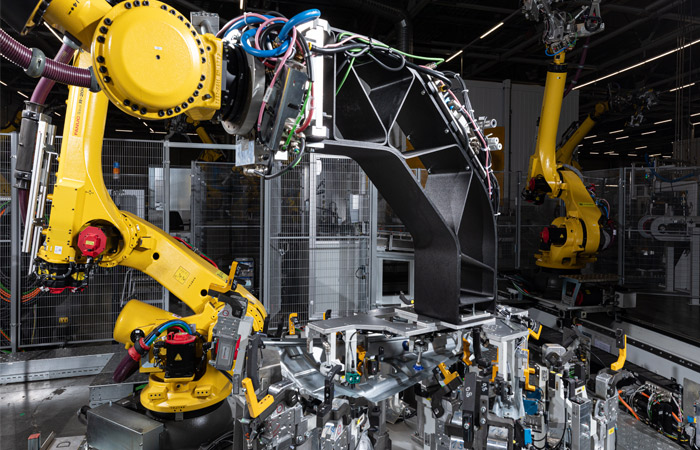
Example of a 3D-printed gripper at the Regensburg plant
Jens Ertel, Head of BMW Additive Manufacturing, explained, “The increasing use of additive manufacturing in the BMW Group production system has many benefits. For example, we are able to quickly, economically, and flexibly produce our own production aids and handling robots, which we can individually adapt to specific requirements at any time, as well as being able to optimise their weight. Less weight allows higher speeds on the production line, shorter cycle times and reduced costs. Plus, smaller robots can be used in the medium term, which also cuts CO2 emissions and costs.”
More from the desk
Six other notes from the rest of the bench.
 NewsTOP 5 VIDEOS: 3D printed Moon models, micro robots and much more!This week we found the top 5 videos about 3D printing and the way additive manufacturing is shaping our society. The technology has infiltrated many sectors, from medical to automotive! Check out our selection of the week to keep up with the innovations! This week we…
 Applications3D Printed Prosthetic Beak Saves Bird’s LifeAdditive manufacturing has already proven to be a valuable asset to the medical department on countless occasions. In some cases, its use can even help to save lives, like in the recent case of Crescent, a Great Indian Hornbill from…
 NewsStudy Suggests Benefits of 3D Bioprinting In Plant Cell ResearchA recent study from North Carolina State University experimented using 3D bioprinting to produce plant cells in order to assess the use of the method in biological research. They produced Arabidopsis- (thale cress; often used in genetic research) and soybean…
 NewsAmazon Invests in 3D Printing Construction Company 14Trees3D printing has already made huge waves in the construction industry—there are 3D printed houses and buildings all over the world, an abundance of research on 3D printing materials for construction, and a growing number of 3D printing construction companies…
 NewsTop 5 Videos of the Week: Bone 3D printing and more!This week we found the top 5 videos about 3D printing and the way additive manufacturing is shaping our society. The technology has infiltrated many sectors, from medical to automotive! Check out our selection of the week to keep up with the innovations! This week we…
 MaterialsBMW Advances Recycling with 3D Printing at Additive Manufacturing CampusThe BMW Group has taken another major step toward a circular economy. At its Additive Manufacturing Campus in Oberschleißheim, southern Germany, the company has begun to recycle waste powder and end-of-life components into new 3D printing materials. The process supports…