News
Why Is Automated Powder Removal So Important in 3D Printing?
Additive manufacturing has enjoyed increasing popularity and acceptance within various industries in recent years. The investment of companies in 3D printing has increased rapidly and the number of 3D printed parts has also continued to grow. Additionally, various CAD softwares&h
- 3 min read
- News
- Six more stories
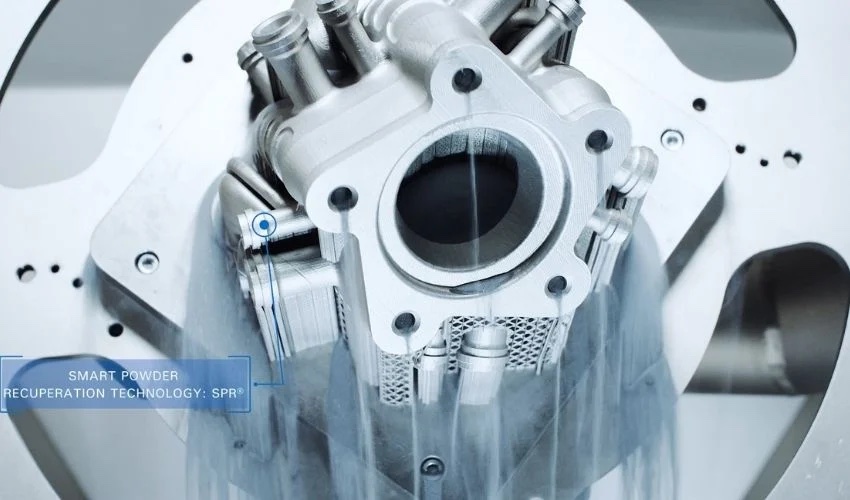
Additive manufacturing has enjoyed increasing popularity and acceptance within various industries in recent years. The investment of companies in 3D printing has increased rapidly and the number of 3D printed parts has also continued to grow. Additionally, various CAD softwares have been developed alongside the technology and the range of possible 3D printing materials is still expanding. Already we have seen plastic, metal, ceramics or even chocolate, ash and sugar – the list is extensive and getting longer. As numerous as the additive manufacturing processes are, so are the steps for post-processing: these include, for example, the removal of support structures, surface finishing, polishing or even the removing of excess material. Notably, as additive manufacturing continues to industrialize, powder removal is gaining importance.
When using powder-based metal 3D printing, in order to be able to start to finalize the object and move to other post-processing steps, a significant amount of powder must be removed. This powder is located in channels and cavities of the part. Nowadays, the powder still adhering to the component after printing is often removed manually. However, it must be removed with great care and precision, otherwise there is a risk of damaging the component in the cleaning process or of causing problems in the next steps. This is because the part must be free of any powder before additional processing can continue, such as heat treatment. However, manual depowdering of additively manufactured components entails some disadvantages and risks.
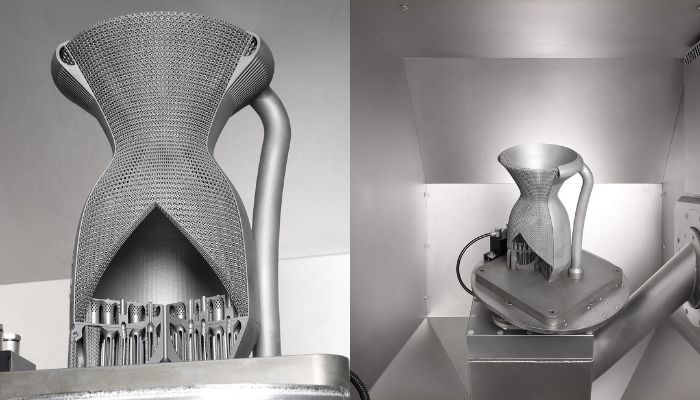
Manual powder removal quickly reaches its limits, especially with filigree structures (photo credits: Solukon Maschinenbau GmbH)
AM Experts See Challenges with Manual Powder Removal
The company Solukon Maschinenbau, which specializes in systems for powder removal from components made using metal or polymer laser powder bed fusion processes, surveyed experts from the AM industry about the limitations of manual powder removal. The results showed that health risks are perceived as the biggest concern with manual powder removal. This is because manual powder removal inevitably brings users into direct contact with the fine dust powder, which is a health hazard. The risk of explosions was also mentioned by the respondents.
More from the desk
Six other notes from the rest of the bench.
 NewsUltimaker partners with America Makes to increase female representation in STEMUltimaker has announced a donation of more than twenty 3D printers on International Women’s Day in partnership with a leading American organization for additive manufacturing and 3D printing technology research, discovery, creation and innovation, America Makes. As the market lea
 MaterialsAll You Need to Know About 3D Printing with Cobalt-ChromeCobalt-chromium (or cobalt-chrome) is a metal alloy that has gained prominence in a variety of industrial applications, particularly in additive manufacturing. With its unique combination of strength and durability, cobalt-chrome is ideal for creating parts that require high prec
 NewsTop 5 Videos: Palaeontologists Use 3D Printing to Complete Skeleton of Prehistoric BearIt is once again Sunday, which means it is time for the week’s top 5 3D printing videos! This week’s content features another Inside 3D Tour at 3D Printing company XJet’s headquarters, how additive manufacturing’s contributions in the field of…
 NewsNano Dimension stocks soar thanks to 3D printing technologyNano Dimension is an Israeli manufacturer that specialises in intelligent machines for the 3D printing of high fidelity active electronic and electromechanical subassemblies, and has recently obtained a patent for their circuit board additively manufactured with inkjet printing.
  GuidesTrio Labs and its Microscopic Metal 3D Printing TechnologyTrio Labs is an American company that has developed a metal additive manufacturing technology capable of designing parts on a microscopic scale. Called Resin Infused Powder Lithography, it can achieve a resolution of 5 microns, making it possible to design…
 GuidesStartup of the Month: 3D MicroPrintA well-known German company in the 3D printing industry is EOS. EOS have been in the 3D printing industry for more than 25 years, and pioneered laser sintering technologies. EOS recently cooperated with another company to create a new innovative…