Materials
Which Filament Should I Choose for My 3D Printer?
Fused deposition modeling (FDM) is one of the most widely used 3D printing processes on the market due to its ease of use, accessibility and performance. It is known especially for its compatible with a variety of thermoplastics, i.e. materials…
- 3 min read
- Materials
- Six more stories
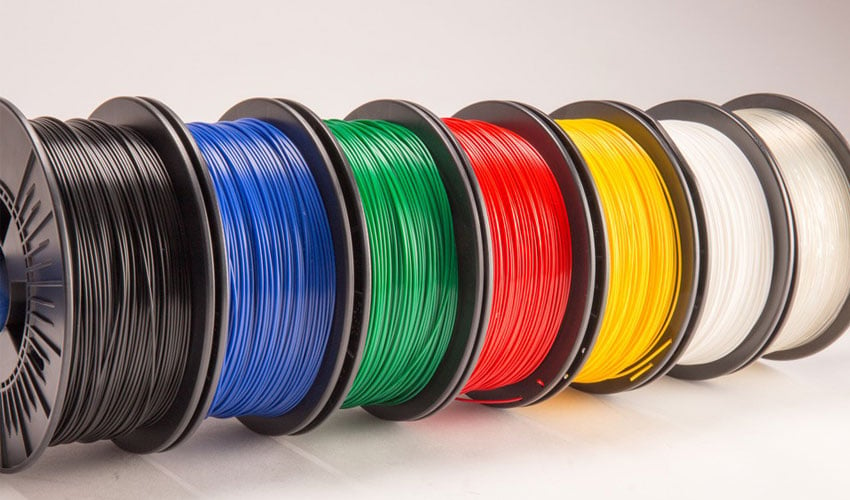
Fused deposition modeling (FDM) is one of the most widely used 3D printing processes on the market due to its ease of use, accessibility and performance. It is known especially for its compatible with a variety of thermoplastics, i.e. materials that are able to soften under the effect of heat but return to their initial shape when they cool down. In order to be extruded by the 3D printer, these thermoplastics are transformed into a filament that can then be driven and melted by the extruder. Today, most plastics in the industry can undergo this transformation, thus expanding the field of possibilities. But how do you choose your filament for your 3D printer? What characteristics need to be taken into account?
Before moving on to the different filaments that exist in the additive manufacturing market, it is important to understand how plastics are classified, a crucial first step that will help you to better understands the materials available and their characteristics. Today, there are so-called amorphous or semi-crystalline plastics: these adjectives define the intermolecular structure of the polymer, based on how they react when they solidify following a fusion. Specifically, the chains of amorphous plastics will become entangled and remain disordered during the solidification phase. Conversely, the chains of semi-crystalline plastics will organize and arrange themselves in relation to each other. From this will result different properties; amorphous materials for example are generally more transparent and have a lower dimensional stability. Finally, another important point that orders the family of plastics is the melting temperature: standard plastics will have a lower temperature than the so-called technical materials. High-performance polymers, on the other hand, require more advanced thermal management, with melting temperatures close to 572°F (300°C).
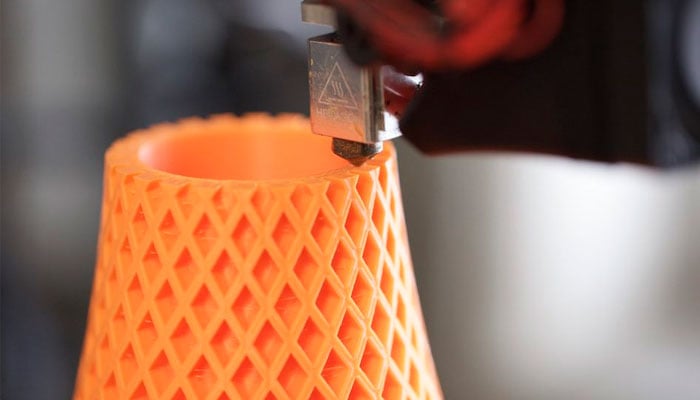
FDM is one of the most widely used processes in 3D printing. It is compatible with plastic filaments.
Standard 3D printer filaments
PLA
PLA, or polylactic acid, is a semi-crystalline material derived from renewable resources – usually corn starch. Unlike most plastics from the petroleum industry, PLA is considered greener because it is biodegradable under the right conditions. It is a very easy to use this 3D printer filament, which is why it is very popular in the 3D printing market. Compatible with food contact, its extrusion temperature is usually 180°C. It has good geometric stability and is generally not subject to warping. It is mainly used for prototyping, tooling, decorative parts or in the medical sector. PLA is available in a variety of colors and is often used as a matrix for composite materials.
More from the desk
Six other notes from the rest of the bench.
 NewsPrintFoam Announces the Development of New 3D Foam PrinterPrintFoam, a start-up company founded by Alumni of MIT in Cambridge, Massachusetts, recently announced the development of the first printer hardware specializing in the industrial-scale printing of resin foams. Of all the additive manufacturing materials on the market, 3D printin
 NewsZap&Buj, making fashion through additive manufacturingThe development and manufacture of fashion through additive manufacturing is not new in the technology sector. Many firms have already benefited from 3D printing for fashion design and production. Innovation and originality in the creation of unique products opens up…
 NewsThe First Ever 3D Printed Stellar Nurseries to be Used to Study Star CreationIn recent months, 3D printing and space have often been associated. And for good reason, many additive manufacturing has proven itself to have numerous applications for interstellar voyages. For example, 3D printing is increasingly being used as part of spacecraft…
 GuidesWhat Are the Available Post-processing Solutions for 3D Printing?The additive manufacturing process rarely stops once your 3D printer has completed the part. Often, it takes varying amounts of time to complete post-processing steps, depending on the printing technology used. In fact, a recent study showed that the biggest…
 NewsVoices AMplified at RAPID + TCT 2023: Learning From the SpeakersAs you know, Voices AMplified is a new series in collaboration with SME the main organizer of RAPID + TCT 2023, the largest additive manufacturing trade show in North America. In these videos, we are putting a spotlight on different…
 NewsUK Government Considers Criminalizing the Possession or Distribution of Gun 3D Printing FilesThe UK government is currently consulting on proposals which would offer law enforcement agencies more power to tackle serious crime, including 3D printed weaponry. They are considering the criminalization of the ‘making, modification, supply and possession’ of ‘articles for use&