News
The First Ever 3D Printed Stellar Nurseries to be Used to Study Star Creation
In recent months, 3D printing and space have often been associated. And for good reason, many additive manufacturing has proven itself to have numerous applications for interstellar voyages. For example, 3D printing is increasingly being used as part of spacecraft…
- 3 min read
- News
- Six more stories

In recent months, 3D printing and space have often been associated. And for good reason, many additive manufacturing has proven itself to have numerous applications for interstellar voyages. For example, 3D printing is increasingly being used as part of spacecraft and satellites and it is even being considered as the technology to be used to create habitats on other planets. But this time, we are talking about additive manufacturing and space for another reason. Notably, astrophysicist Nia Imara and her team have used 3D technologies to study the process of star creation also known as a molecular cloud or a star nursery. Thanks to these 3D printed stellar nurseries, scientists hope to be able to understand exactly how stars form and what conditions need to present when this happens.
In order to accomplish this impressive feat, Nia Imara and her collaborators used data from a stellar nursery simulation. They were able to model and then 3D print these models. John Forbes, an astrophysicist who assisted Nia Imara during this project, noted both the beauty of these printed nurseries as well as their use for scientific research. He stated, “Just aesthetically they are really amazing to look at, and then you begin to notice the complex structures that are incredibly difficult to see with the usual techniques for visualizing these simulations. Within the spheres, you can clearly see a two-dimensional sheet, and inside it are little filaments, and that’s mind boggling from the perspective of someone who is trying to understand what’s going on in these simulations.”
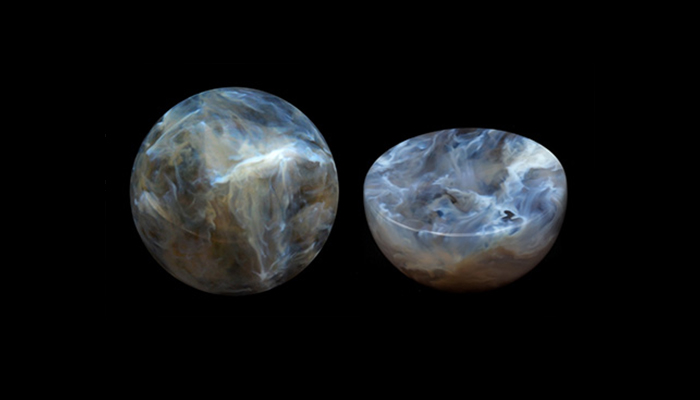
The researchers also printed half-spheres to reveal midplane data. (Photo credits: Saurabh Mhatre)
3D printed stellar nurseries
With these stellar nursery models, scientists have been able to observe previously unseen phenomena. For example, the 3D printed models reveal continuous structures that were impossible to determine with 2D projections. Nia Imara expanded, “If you have something winding around through space, you might not realize that two regions are connected by the same structure, so having an interactive object you can rotate in your hand allows us to detect these continuities more easily.” And while the researchers did not specify exactly what printing process was used to create these models, it appears that they used material jetting a technology known for designing extremely accurate multi-material, multi-color parts.
More from the desk
Six other notes from the rest of the bench.
 MaterialsFortify combining magnetics and DLP technology for 3D printingFortify is a young company that seeks to revolutionise the long delivery cycle and the often poor material quality of traditional manufacturing processes.The company was founded on research on composite 3D printing by Randall Erb and Joshua Martin at Northeastern…
 NewsTop 5 Videos: Optimizing your 3D printing designThis week we found the top 5 videos about 3D printing and the way additive manufacturing is changing production. The technology has infiltrated many sectors, from medical to automotive – check our selection of the week to keep up with the innovations! If you enjoy these, you&hell
 News#3DStartup: Addiguru and its real-time monitoring software for 3D printingIn the additive manufacturing market, the user is not immune to potential manufacturing defects, not only wasting time and money, but also sacrificing quality. In order to limit these defects as much as possible as well as automate the production…
 NewsFluent Metal Is Our 2024 Startup of the Year2024 saw the rise of many groundbreaking startups leveraging additive manufacturing—but which one stands out above the rest? We featured a remarkable company each month, showcasing innovations ranging from personalized medical solutions to transformative manufacturing techniques.
 NewsAre 3D Printer Shipments Back to Pre-COVID Levels?When the pandemic shut down the world last year, a number of industries were severely impacted. However, 3D printing proved to be more robust than many others. That being said, a few studies have shown that though it did not…
 ApplicationsPershing GTX116 Luxury Yacht Includes 3D Printed Air GrillesWho, lying comfortably on the beach and watching the boats on the horizon, has never dreamed of plying the seas aboard in their own luxury yacht? Know that you are not the only one. In fact, the luxury yacht market…